

It’s the beauty within us that makes it possible for us to recognize the beauty around us. The question is not what you look at that matters, it’s what you see.
Henry David Thoreau
Blog
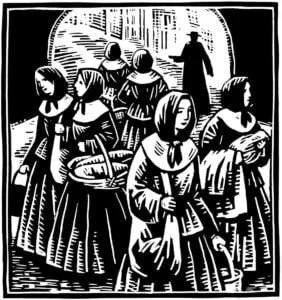
Founders of the Sisters of St. Joseph by artist Julie Lonneman
Each year the Federation of the Sisters of St. Joseph of Canada provide a gathering for us, entitled S.A.I.L., which is an acronym for “Sojourners for Active Inclusive Love.”
During the gathering this year we focused on the first six courageous and faith-filled women, who in the year 1650 made a commitment to God and neighbour with the blessing of the Church. While living among the people, they spread the good news of the gospel, in order to build bonds of relationship and respect among all.
The seventeenth century saw the thirty-years war, the wars of religion and the great designs of Louis XIII and Cardinal Richelieu with glittering palaces. In the wake of these events many suffering families were left in poverty because of injustice and violence.
The six faith-filled women in Le Puy, France varied in age. As widows and single women, they had already been reaching out to the needy with acts of compassion. Their names were Francoise Eyraud, Anna Vey, Marguerite Burdier, Anna Chaleyer, Clauda Chastel and Anna Brun. They had a desire for more. On October 15, 1650 in Le Puy-en-Velay, a new form of apostolic religious life under the protection of St. Joseph, was given to these Christian women by Father Jean-Pierre Médaille, S.J. and Bishop de Maupas. When it came time to sign the documents that would give a legal foundation to the community, only one of them could sign her name--Clauda Chastel.
These amazing women were able to support themselves and their ministries by making lace in their kitchen sitting around the light of a candle at the end of their daily visits. They did not live the cloistered existence but divided the city and spent their days between prayer and the service of others. As the community spread, the members adopted the clothes worn by widows in their locality which varied from town to country. Their apostolic tasks were extremely varied and adapted to the needs of the people.
This new form of apostolic religious life was/is called the Sisters of St. Joseph. We claim Fr. Jean Pierre Medaille, S.J., as our founder and spiritual guide. His little design (in opposition to the great design of governing authorities) was to spread the gospel and build bonds of friendship with active, inclusive love. He stated that the Sisters were to draw love from its source, Jesus in the Eucharist. The Eucharist was to be the model for this form of apostolic life; the women were to imitate its hiddenness, its humility and were to be entirely for God and the dear neighbour, as Jesus was.
Spending time at S.A.I.L. observing our roots and the dedication and eagerness of women wanting to spread the gospel by living lives completely emptied of self, to be entirely for God and the dear neighbour, was inspiring and hopeful. Our world needs this kind of faith and dedication.
-Sister Elaine Cole, C.S.J.

A reflection on Orange Shirt Day 2026
On September 29, I went in for my weekly shift at St. Joe’s Café, a welcoming space that offers two meals daily operated by the Sisters of St. Joseph. At the Café we were remembering Orange Shirt Day on both the 29th and the 30th. Volunteers wore orange shirts. Our staff created a web with orange ribbons for people to write the name of someone they wished to remember. Just before opening, I was speaking to a volunteer at the front door. He was a former student of mine in high school some 40 years ago. In those days a few of the teachers and students, with the help of contacts in Moosonee, began to run a summer camp for the “Indian” children in the bush about 20 kilometers outside the town. Some relationships have lasted over these many years. He asked one question before we opened our doors. “Did you know anything about residential schools when we were there some 40 years ago?” we both shook our heads in some kind of disbelief that we knew nothing. Not a thing.
Some 13 years ago, First Nations people with the inspiration of Phyliss Webstad began commemorating Orange Shirt Day to remember the history of residential schools, to commit to changing the relationship between aboriginal and non-aboriginal peoples and recognize the harm created by the attempt to erase a culture.

On September 30 I was going for a noon time walk in a parklet that serves as a playground for a local school. It was around noon. Suddenly, across the parklet about 50 students between the ages of 6-8 began to race toward the swings and slides. Every one of them wore an orange shirt. The principal must have directed the teachers who reminded the students. The parents rummaged through drawers and found orange shirts. Some of them were specifically created for the day. Some were Halloween shirts or other team shirts. The point is they were all orange and people were intentional. I wondered what these children were learning about the history of other children. The counterpoint of carefree children reminded of other children who were not carefree was obvious. The hope that those running and jumping children and their teachers and parents inspired brought hope of an enlightened history moving toward real change.
And I was reminded that when something changes…something changes.
-Sister Margo Ritchie, csj
Image: chris robert @chris_robert/Unsplash