
Advocacy

International Day for the Elimination of Violence against Women

Violence Against Women and Girls     

November 25 each year proclaims The International Day for Eliminating Violence Against Women. For me, it is a sad day as I read about the plethora of startling statistics from around the world documenting the horror of murders, attacks, and suffering of women in diverse countries, including our own. The 2024 United Nations report on this subject estimate that globally 736 million women have experienced physical and/or sexual violence. The Canadian Femicide Observatory for Justice and Accountability reported in 2022 that 184 women and girls in Canada were violently killed, primarily by men. One woman or girl is killed every 48 Hours. An average of 102 women and girls were victims of gender-related homicide per year in Canada. In 2009 the Canadian Department of Justice stated that 7.04 billion dollars was spent dealing with the aftermath of spousal violence alone. In countries such as Afghanistan, the freedom of women to study, work, travel, or be protected from violence is non-existent. 

However, public protests, stories, and reports have been effective in reducing sexual violence in Canada. Women’s persistence in reporting sexual abuse in universities and places of work has achieved results.  Complaints about police abusing women are now taken seriously.  Progress has been slow in changing, practices in the Armed Forces to provide justice for women, but there is progress. The “Me Too” movement has encouraged women to speak about abuse and demand justice. Women are more likely to complain of abuse and seek justice without being ignored.

I have observed how women have stopped abuse by changing themselves. Some women have told me how one day they decided that they would no longer tolerate spousal abuse. Their firm declaration of this brought an end to the abuse. A woman who ends an abusive relationship without changing herself is likely to repeat the pattern with a subsequent partner. On one occasion, I asked a client who was in an abusive relationship, how she had taught her first husband that it was all right for him to beat her up.  After a startled reaction, she exclaimed: “I guess I let him get away with it the first time”.  I asked how she stopped the abuse and she replied: “I left him.”  She then began to pay attention to how her failure to listen to what she felt or wanted left her open to the unreasonable demands and abusive treatment by others, including her current partner. Her decision to change brought results. She discontinued allowing herself to be the subject of abuse or the unreasonable demands of friends and relatives.

Women have been indoctrinated to be caregivers and prioritize the needs of others.  We cannot solve the widespread problem of violence against women but we can help women, particularly young women, to respect their own freedom and dignity so that they are less likely to be subject to abusive partners, friends, and relatives.

Today we unite to End Violence against Women. #NoExcuse

-Sister Patricia McKeon, CSJ

World Food Day - October 16th  

World Food Day is a time to celebrate food in all its diversity and goodness. It is also a day to remember that many people, in our cities and in our world, are food-deprived, and even suffer hunger and malnutrition. How can this be happening in this beautiful world which produces enough food for all? Can our systems of food delivery be lacking? Can the will to feed all Earth’s peoples be amiss? How do we approach this issue when it is so complex and fraught with challenges?  

Over 820 million people worldwide suffer from hunger and 2 billion people face food insecurity, yet 1/3 of food is wasted. This is a moral, environmental, and economic disaster. Many people contribute to their local food bank or soup kitchen. Community gardens also help to address this problem at the local level; but as individuals and as a society, is it past time to examine our practices around sustainability, food systems and delivery, and consumption?  

World Food Day is a call to action; since 1979, the Food and Agriculture Organization of the UN has highlighted the issue. Governments, businesses, and individuals must work together to feed the hungry and create a world where equality and dignity are respected and promoted. What is my response as I tuck into another wonderful nutritious and balanced meal? We do not need guilt; we need action. 

Questions to ponder:  

  1. What is my protein footprint? 

  2. Am I eating “local,” observing the 100-mile diet, as much as possible?  

-Sister Helen Russell, CSJ

September 30 - National Day for Truth and Reconciliation

94 Calls to Action.  How Are We Doing?

On Monday, September 30, we will celebrate the National Day for Truth and Reconciliation. This day provides an opportunity to consider what progress we are making in remedying the harm caused by the policies and practices of settlers, and in creating a climate of respect and friendship among all of us.    

In December 2015, on the eighth anniversary of the final report of the Truth and Reconciliation Commission, a Canadian Government statement asserted that over 85% of the 94 Calls to Action involving the Government were completed or well underway. However, according to Indigenous Watchdog, only 11 of the Calls to Action were completed and 39 were “in progress.”  At this time, seventeen years after the Truth and Reconciliation Commission’s report, there are still many of the 94 Calls to Action that have not been completed.

I suggest that we look beyond the 94 Calls to Action in assessing progress on rectifying the imbalance concerning the wellbeing of Indigenous people in Canada. We still have indicators that all is not well in our quest to reconcile relationships between our Indigenous and non-Indigenous populations. However, in weighing progress on completion of the 94 Calls to Action, the prevalence of problems such as higher rates of incarceration, and reports of abusive treatment in hospitals of Indigenous persons contrast with indications that Indigenous members of our country are making significant progress as respected citizens, and that relationships between settlers and Indigenous persons are improving.

There are now many well-educated Indigenous persons who are writing books, teaching in schools and universities, negotiating land claims, providing health care services, exercising political power, and operating successful businesses.  I am aware that churches no longer disparage the culture and spirituality of aboriginal people; traditional aboriginal practices are incorporated into the teachings and liturgical practices of Christian churches. Efforts to educate non-aboriginal Canadians about the history and culture of our native population have effectively improved respect and altered attitudes.  Schools and colleges have been making consistent efforts to welcome Indigenous students and provide any services needed to support academic and social success.

We still have many hurdles to overcome in our quest to treat all aboriginal citizens with respect and to resolve issues such as economic disparity, settlement of claims for compensation of past wrongs, or ill-treatment of Indigenous patients in hospitals. But such issues are publicized now, regarded as unacceptable, and stimulate action to stop harm and promote justice.  There is a welcome change in attitudes towards our Indigenous neighbours and a growing population of competent aboriginal persons who  will no longer tolerate being treated as second-class citizens.

Let us celebrate National Day for Truth and Reconciliation wearing our orange shirts, attending local festivities, and extending friendship to our Indigenous neighbours.

- Sister Patricia McKeon

image: Denise Bossarte @dbossarte / Unsplash

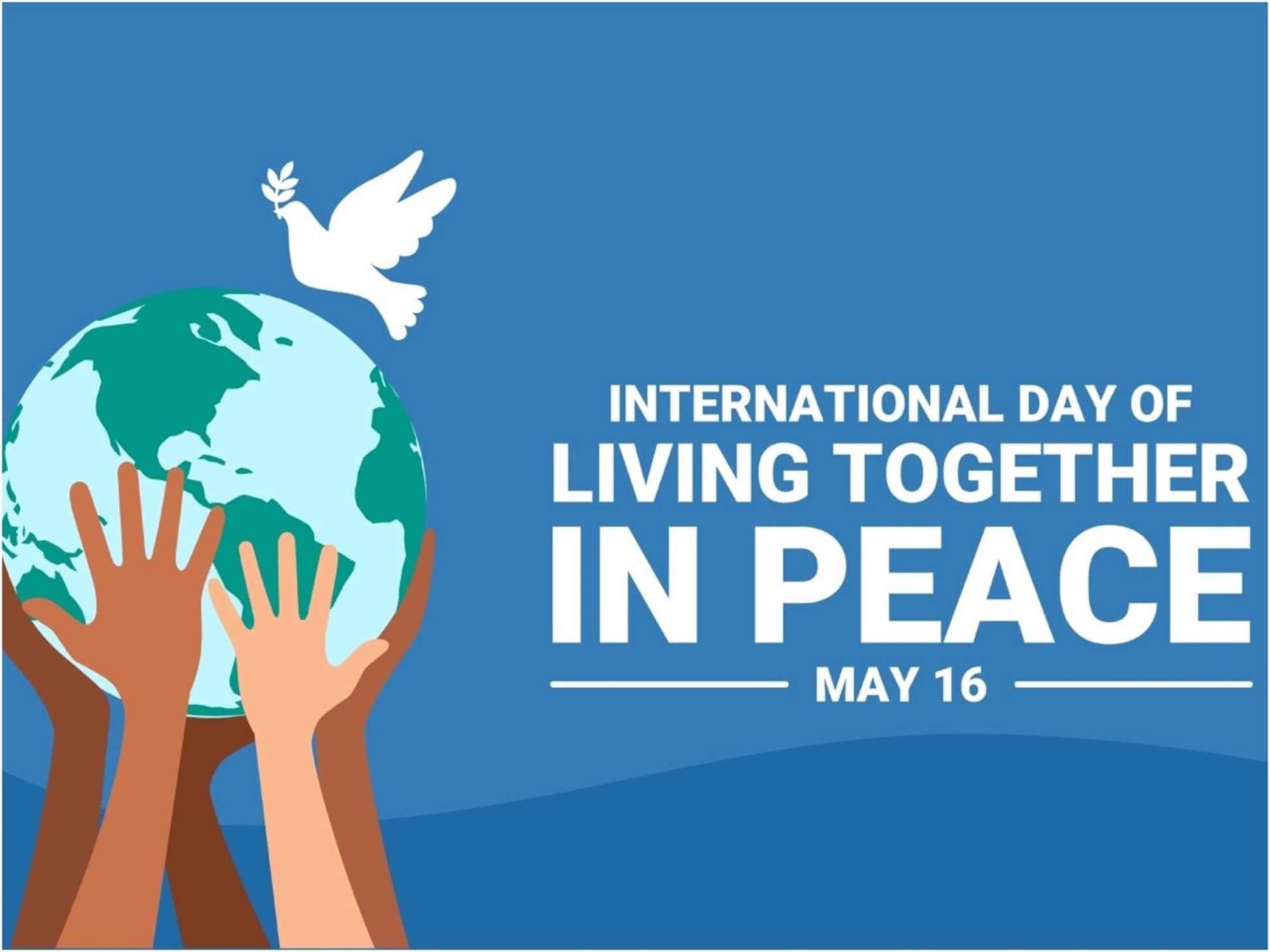
May 16 - International Day of Living Together in Peace

The International Day of Living Together in Peace (May 16th) captured my interest.  Thinking about our world at this time – where scenes of violence are regularly shown on our TV screen or are the headlines in our newspapers. Reports bring many emotions forward but are not on the side of peace. News of ongoing atrocities in Sudan; gang violence in Haiti; starvation and destruction of villages in Gaza; devastation of the people, land and structures in Ukraine. Unbearable news that breaks one’s heart and leaves one feeling helpless.

Most recently is the unrest seen at many University campuses both in the U.S. and in parts of our own country.  Young students standing on behalf of those who have literally lost their voice. Students ‘wanting a peaceful world’ risk being jailed on behalf of their Palestinian brothers and sisters.

How are each one of us being called at this moment to respond?  Knowing that we are not called ‘to the front lines’ in any of the above situations, what is ours to do?

I recently came across the following quote adapted by Mirabai Starr which has become a daily invitation as I go about the work of the day.

Joshua Sukoff/Unsplash

“Our task is to mend the broken world.  We do this through every act of loving kindness we offer others in a spirit of generosity, and hospitality.  It is an offering of each of us as we are…with no strings attached.

As I said earlier ‘we will not be asked to go to the front lines to serve the dear neighbor’ yet, who is the neighbour nearby to whom I can offer kind words or gestures of generous hospitality? On this International Day of Living in Peace, how can I live peace that will make a difference? Our actions, large or small, and our thoughts make a difference, and they can help mend this broken world. 

-Sister Ann MacDonald, CSJ

World Press Freedom Day

World Press Freedom Day

The thirty-first annual World Press Freedom Day will be held on May 3.  It is a time to reflect on the quality and adequacy of information about events and situations that impact our lives in Canada.  Consider the role of journalists and news organizations in obtaining information, obstacles that impede the publication of information that impacts the well-being and freedom of people, the health of our environment, and the administration of justice. World Press Freedom Day is also a time to consider the responsibility of each of us in advocating and protecting freedom of the press.

In south-western Ontario communities our news reporters, radio and television stations generally, in my opinion, function quite well.  For example, in London, Mayor Josh Morgan is available weekly on the radio to provide information about local government and respond to citizens who phone in with questions.  Newspapers report information about the administration of justice, safety, environmental, and social issues,  Local radio explores current problems such as public transportation or traffic safety.  Citizens have opportunities to raise concerns through letters to the editor or phone calls to a radio station.

Provincially, information about the public good is less available.  Questions arise about private healthcare facilities unjustly charging patients for services, the sale of public land reserved for green spaces, particular developers being favoured, or the construction of highways that many consider unnecessary.  At the federal level, news organizations and journalists protected by legislation continue to demand answers about matters pertinent to the public good.  Yet the government often fails to respond in a timely or adequate manner.  Long-promised revisions of the Access to Information Act languish.  We are fortunate to have journalists who will investigate questionable situations, and report possible abuses. Public pressure and the persistence of journalists uncover actions that the government attempts to keep secret, such as the interference of foreign governments in elections, and the sale of scientific information and products to China.

Attempts to prevent or block disclosure of information occur for various reasons. Information about safety concerns may result in fines, lawsuits, loss of reputation, votes, business, or jobs.  Competent women are sometimes targeted because they are successful in roles traditionally filled by men such as politicians, police,  airplane pilots, or CEOs. In Ontario, there have been several incidents of local female members of city or town councils being targeted by verbal or physical harm. This discourages women from participating in politics.  Corruption in political leaders may lead to scandal, theft of public funds, or defeat in elections. 

Each of us can help to preserve freedom of information.  One way to do this may be by writing a letter to your local city council or member of parliament about a public concern.  Respectful complaints or inquiries about concerns encourage the provision of civil answers.  Prompt and truthful responses would facilitate trust.  Acknowledging errors, failures, and wrongdoing along with what corrective action is being taken is far more acceptable than denial and procrastination.

Democracy cannot survive without freedom of the Press and protecting this freedom is the responsibility of each one of us. On this World Press Freedom Day, may all of us consider ways in which we can support freedom of the press.

-Sister Patricia McKeon

Images: Patrick Fore, Thomas Charters/Unsplash