
Articles

What’s the Connection between the Three Little Pigs and the Angus Tornado?

Although you are no doubt quite familiar with the bedtime tale of the Three Little Pigs. Are you aware of the Three Little Pigs project? As one might suspect there is a commonality between the two. We know that the title characters in the first case each built their house of different building materials. The Three Little Pigs Project is more formally known as the Insurance Research Lab for Better Homes. Western University in its overview depicts its lab as a multi-million dollar research facility built to examine all aspects of house construction by performing experiments including extreme wind effects.

What’s the Connection between the Three Little Pigs project and the Angus Tornado? Western University’s lead researcher, Gregory Kopp, pointed out that their research, reported in the Toronto Star, has found “that small, low cost measures can prevent family homes from common tornado and hurricane damage.” Knopp says, “that [though] its counter-intuitive for builders [to think of holding the roof down] because they think of holding the roof up with walls…but in a windstorm you have to hold the roof down. In particular, he says, the installation of what’s known as “hurricane straps”- small pieces of metal that bind the roof truss to the top of the wall-can help enormously. He estimates the cost per house to be about one hundred bucks. Kopp says replacing two-inch nails holding down plywood roof sheeting with 2.5-inch nails, for example can double binding strengths. And the difference in cost is probably pennies per house.”

Joe Vaccaro, CEO of the Ontario Homes builder Association says, “It isn’t their cost, but their absence from the building code that dissuades builders from installing straps [or often making other changes].”

Hopefully, the research being done at the Insurance Research Lab for Better Homes will provide the necessary evidence to support changes in the building code to ensure the construction of homes more resistant to wind damage.

Nancy Wales, CSJ

Peter & Paul

Peanut butter & plums, plants & palms, pink & purple—NO Peter and Paul. We recently celebrated within the Catholic community the feast days of Peter and Paul.  Two totally different men! One Simon called Peter, one Saul called Paul but both followers of Jesus Christ, each coming to know Him in a different way, time and place. One was a fisherman and one a tent maker. I wonder what it was like when Peter met Paul for the first time, face to face. Their single bond was the desire to spread the good news of Jesus Christ. They may not have agreed about each other’s methods but they did agree on the Message.

Thinking about these two disciples, we have many lessons to learn. Peter reached out to his Jewish brothers and sisters. Paul moved beyond the Jewish community and brought the good news to his Gentile brothers and sisters.  They knew the message of Jesus was for all people. Our present Pope Francis, understands this well and is finding ways to reach out to so many diverse people across the world.  Beginning with the example of Peter and Paul, we also are called to meet “all our neighbours” with an open mind and an open heart.

Recently, I watched the fireworks over the Detroit River, and my thoughts took me to another Peter and Paul moment.  We are two countries, with many diverse points of view, yet we share an underlying belief of “Freedom for all”.  And so there is much to learn from a few moments of reflection on these two early mentors and leaders of faith. Perhaps their example might help us in our day to day encounters with the people and events that challenge us.

Barbara Vaughn, CSJ

Feast of the Precious Blood

On June 5th in London, Ontario, about 200 blood donors were honoured. It was a real privilege to witness women and men, young and not so young step forward to receive their certificate to commemorate various milestones. I was the guest of the amazing Sr. Loretta Hagen, csj, who was honoured for having donated plasma 600 times. How awesome is that! Also honoured was a gentleman who has reached the incredible milestone of 1000 units donated over a period of 58 years.  Such inspiring donors. Let us follow their example and get out there, as well, and donate ‘Blood, the Stuff of Life’ which is also the title of Lawrence Hill’s latest book all about the life giving blood that courses through our veins. ured for having donated plasma 600 times. How awesome is that! Also honoured was a gentleman who has reach the incredible milestone of 1000 units donated over a period of 52 years. Such inspiring folks. Let's get out there, as well, and donate blood 'The Stuff of Life' which is the title of Lawrence Hill's book all about the life giving blood that courses through our veins.

Close on the heels of this memorable occasion followed International Blood Donor Day on June 14th which prompted me to ponder some more about how I am invited not only to donate blood, but also about my call as a Missionary Sister of the Precious Blood to share the Precious Blood with all whose paths crosses mine each day. I remember thinking about my community, all those sisters ministering in so many places, saying to myself ‘together let us save lives by generously sharing our blood and the Precious Blood.’

And then came Trinity Sunday - June 15 the red-letter day if ever there was one, the day indelibly inscribed on the heart of all who knew and loved our dear Sister Mary Paule Tacke who that day was kidnapped and found dead the following day.  I had been thinking about how we are invited to ‘share our blood’ and the Precious Blood.  THIS is NOT what I had in mind.  However, what I had in mind is irrelevant.  On Trinity Sunday In Mthatha, South Africa, where our sister had lived our Precious Blood charism to the fullest, had poured out her life for God’s most vulnerable little ones, she shed her blood. As Sr. Christa Mary, cps, so eloquently reminds us: save lives by generously sharing our blood and the Precious Blood.

The focus of this year's World Blood Donor Day campaign is "Safe blood for saving mothers". Every day, about 800 women die from pregnancy or childbirth-related complications. Severe bleeding during delivery and after childbirth is a major cause of mortality, morbidity and long-term disability. The goal of the campaign is to increase awareness about why timely access to safe blood and blood products is essential for all countries as part of a comprehensive approach to prevent maternal deaths.

This story needs to form part of our congregational history. This woman needs to be part of the pride of our heritage. Out of Cottonwood USA came a CPS with an American spirit of justice and fairness for all people that was tested in the fire of her life history – and it was found to be gold!  This daughter of America and woman of Africa really lived her service to those in need. 

Not all of us are called to ‘shed our blood,’ however we all share the same life-blood of Jesus Christ, the Precious Blood that has been and is being transfused—poured out in loving service all over the world. In order for us to have life, it is essential that we gather around the altar of God to hear Jesus say to us…”Take, eat, this is my body.  Take, drink, this is my blood.”  In a sense, we receive a transfusion from God. On the lintels and doorposts of our hearts let us sprinkle the Precious Blood of Jesus so that everyone knows that our lives belong to God.  

May the Precious Blood of our Lord Jesus Christ ever bless and protect us.

Guest Blogger: Sr. Magdalena Vogt, cps


Evolutionary Consciousness & Last Call for Symposium 2014

What comes to your mind when you hear the words ‘evolution’ and ‘consciousness’? According to the Merriam -Webster dictionary, evolution means “a process of slow change and development” while consciousness is “a person's mind and thoughts or knowledge that is shared by a group of people”.

Evolutionary consciousness simply means becoming aware of and embracing the reality that the cosmos, our world, and we human beings are engulfed in constant change.  And, it is suggested, that we are called to do our own part to move things forward, just as Jesus did.

Different times use different terms to express the same reality.  However, there is a thread that runs from the beginnings of the Sisters’ founding in 1650 at LePuy in France to our present living in 2014. The founding community was guided by Jean Pierre Medaille, http://www.csj-to.ca/jean-pierre-medaille-sj , a Jesuit of great spiritual depth. He counseled the early members to strive constantly for “the More” – being more and becoming more in their personal and relational lives with one another and among the people with whom they worked. This was and is an on-going developmental day-by-day process. This was and is evolutionary consciousness in action!

The Sisters of St. Joseph hold oneness with others and all of created reality to be the heart of evolutionary striving as the future calls us forward to “the More”.  Becoming more inclusive and enlarging our heart calls for self-emptying and letting go of fear, limitation and narrow interests just as God or Spirit did and continues to do in entering into the created world.

Medaille's concept of "the More", from 1650, seems to have similarities with the vision of Teilhard de Chardin, http://www.teilharddechardin.org/index.php/biography, another Jesuit. Teilhard , as scientist and priest-visionary in the 20th century, had the realization that “we are moving” and that “Love” is the heart and direction of cosmic, cultural and personal evolution calling us forward.  We are “on the way” led by a Great Love.

As S. Margo Ritchie has said, “The movement of evolutionary consciousness calls for deepened personal responsibility for moving beyond the places of impasse in our shared life on the planet.”  Please check out Margo’s blog at /blog/2014/5/28/nothing-elitist-about-it.html

To learn more please join us at the Summer Symposium 2014, ‘Becoming Agents of Evolutionary Change’.  For details go to https://www.etouches.com/ehome/79110. Carter Phipps’ public keynote address at 7 pm Friday night will be held at the Kenny Auditorium, Kings’ College, London.

Mary Vandersteen, CSJ and Ann Steadman, Associate


Celebrating the Elderly in a Throw-away Society

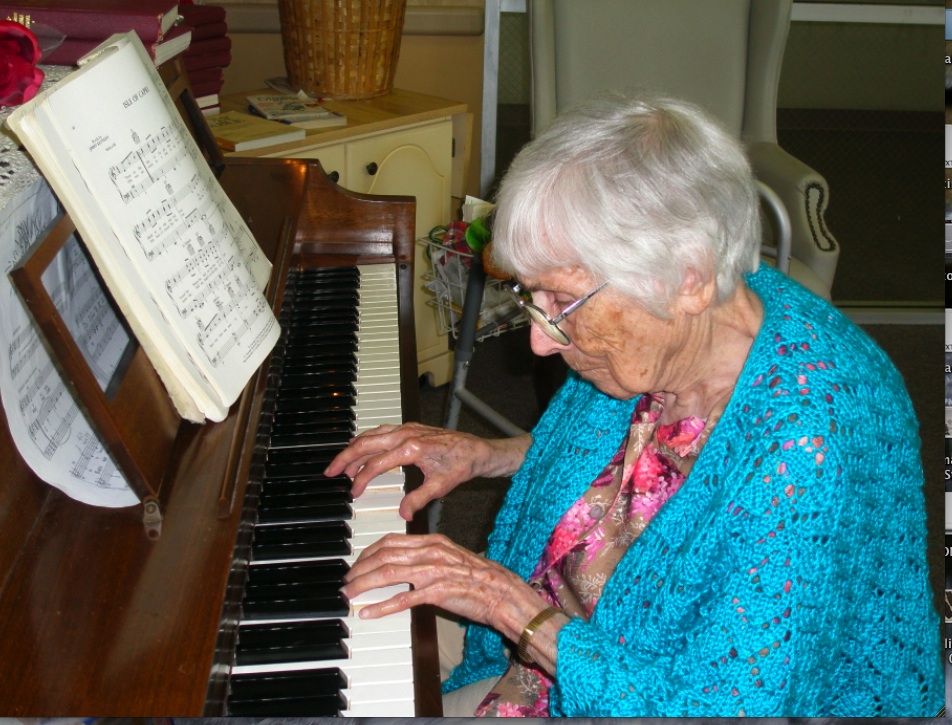
Have you ever wondered what it might feel like to celebrate your 100th birthday?  Have you even taken the time to think about it?  Who would possibly be present and how would they look upon you?  The probability of such a celebration becomes increasingly likely, as it has been reported that more than 2000 in Canada will reach such a milestone this year.  Within our congregation, there are three Sisters born in 1914, and three celebrations, different in tone and style to match the context and the wishes of the woman feted.

In a society where youth is idolized, millions of dollars are annually invested in the production of goods and services that promote the illusion of youth. In this context the markings of old age are often disdained.  With an emphasis on performance in our world, those who cannot produce are considered an unwanted burden. In our frenetic pace of life, there is no time for those who can’t keep up. With the breakup of the traditional family system, and the growing urbanization of our world, neglect and loneliness among our elders becomes an increasing phenomenon. And so we hear horror stories of elder abuse in many forms; we are aware of the need for increasingly more spaces and better-staffed facilities for vulnerable seniors. As a society we are slow to address this critical situation.                          

Almost a year ago I was missioned by my congregation to be local leader for 27 Sisters at our motherhouse, 12 of whom were more than 85 years old.  Although I knew that this assignment was fitting for me, I was most aware of my limitations because of total inexperience in health or senior care. I was also one who had often felt drawn to visit our sick and elderly on occasion, but was always too busy.  And so I approached this task with some trepidation. A wonderful system for meeting the needs of our Sisters was well in place, and my first challenge was to discover my role within the context of the mandate I had accepted.   I had recently ministered at a retreat centre where I had learned to really listen to those who came, and set out to do the same in this new assignment. I listened to the stories of those who spoke volumes about their life and mission; I listened to the silence of those who said very little; I listened to the struggle of those who could not find the words as mental acuity decreased, and I listened to the concerns and compassion of those who were much in tune with suffering in our world. And I have learned that I am not immune to the values of the society in which I live.  There were moments when I thought that I could find more productive things to do.  There were moments when I felt very uncomfortable because my future of frailty, loss and diminishment was right in front of me and I wanted to run from the reminder.

But I have learned much more.  During this year I have encountered an incredible zest for life that astounds me. I have met with the deep pain of helplessness that breaks my heart and I have found a practical wisdom, culled by experience, that calls me to ponder. In walking with our elderly, I am slowly experiencing a transformation that is freeing me of a perspective I unknowingly held.  Because I have come to know women who face with courage, compassion and serenity the diminishment of old age, I can more easily look ahead without anxiety.  I have come to appreciate the wisdom of experience, the powerful effect of prayer as life diminishes, and the commitment to mission that finds new expressions as circumstances change.  In my own journey, I have come to value these women as a source of inspiration, guidance and support and find much to celebrate.

In a myopic society that does not see the needs of the elderly, we are called as Christians to respond in love. I am most impressed by those around me, family, friends and co-workers, who have dedicated their lives to the service of the vulnerable elderly, who go out of their way to make life easier for those who have lost their independence.  I admire those who enter the political arena to draw attention to an increasing lack of care for our elderly. At the heart of the matter is a need for a change of attitude that calls us to honour and appreciate those who may have lost the precious gifts of youth, but hold a treasure that our world has no time to rediscover. To find that treasure and to celebrate its value makes the journey toward our own 100th birthday a more wholesome and enriching experience.  What do you think?

Joan Driscoll, csj