
Guest Bloggers

WORLD PRESS FREEDOM DAY ~ MAY 3 2019 Theme ~ Media for Democracy:

Journalism and Elections in Times of Disinformation

What compels journalists to risk their lives to expose oppression and corruption?  Perhaps we who are called to prophetic mission are closer than we might imagine to journalists committed to truth, democracy, human rights and the environment.

For many global citizens, the journey to democracy is fraught with peril.  For those in democratic countries, troubling trends such as intrusive surveillance highlight the need for ongoing vigilance. 

Though sometimes considered meddlesome and even “dispensable”, journalists and news organizations can play a vital role as guardians, informed commentators and advocates.  Their protection and independence are essential for many other freedoms at the heart of democracies.  

This year in Canada, World Press Freedom Day precedes a fall federal election already marked by competing narratives about truth, trust and vision.  Credible voices also warn about potential international interference in our upcoming election.  In the United States, questions still surround the last federal election, while comments about “fake news” abound. 

The United Nations notes that World Press Freedom Day offers opportunities to:

  • Celebrate the fundamental principles of press freedom;
  • Assess the state of press freedom throughout the world;
  • Defend the media from attacks on their independence, and
  • Pay tribute to journalists who have lost their lives in the line of duty (www.un.org).

The observance also highlights Article 19 of the Universal Declaration of Human Rights upholding the right to freedom of opinion and expression, including the right to impart information and ideas through any media regardless of frontiers.

In both 2018 and 2019, Reporters Without Borders ranked Canada 18th out of 180 countries on its World Press Freedom Index.  Overall, the Paris-based organization pointed to a deterioration of media freedom around the world as the number of countries where journalists can work safely declines (rsf.org).  Earlier, the government of Canada announced it will co-host a conference on media freedom with Britain July 10-11 this year in London.

World Press Freedom Day was inspired by the 1991 UNESCO* seminar held in Windhoek, Namibia.  The Windhoek Declaration focused on promoting a free, independent and pluralistic African press.

This year’s international celebrations are being held May 1-3 in the Ethiopian capital, Addis Ababa.  Globally, about 100 other events are planned to mark the observance, including a celebration May 2 in Ottawa sponsored by the Canadian Committee for World Press Freedom (www.ccwpf-cclpm.ca).

In his 2019 message for the church’s World Communications Day, Pope Francis emphasized the importance of real -- not only virtual -- human communities.  He highlighted the urgent need for the Internet and social media to be at the service of truth and respectful relationships which foster communion (w2.vatican.va/content/francesco/en/messages/communications/documents/papa-francesco_20190124_messaggio-comunicazioni-sociali.html).

Questions for Reflection

  • How does what we read, see and hear through various forms of media shape our perspectives and choices?  How does what we’re not seeing, or hearing do the same?
  • Highly concentrated ownership of mainline media in Canada can restrict our sources of information.  What alternative sources of news, information and commentary do/might we choose to explore?
  • How might we and our religious/faith communities support and encourage younger media personnel and journalism students?

~ Roma De Robertis, SCIC 

Roma De Robertis is a Sister of Charity of the Immaculate Conception based in Saint John, NB.  She has worked in Catholic journalism and justice and peace ministries.  During her current sabbatical, she has been staying with Sisters of St. Joseph first in North Bay and now in London, ON. 

(*UNESCO is the UN’s Educational, Scientific and Cultural Organization based in Paris, France.)     

The Role of Journalists

The Importance of Journalists and Publishers

My primary purpose for this blog is to affirm the critical value of journalists.  My second purpose is to call attention to the terrible injustice of trafficking labour in Canada. Reading the individual stories of victims in the April 6 and April 8 editions of the Globe and Mail is heart rending. The abuse of unscrupulous traffickers contained in these editions contain horrendous accounts of the kind of abuse we might expect in places where traffickers force immigrants into leaky boats crossing the Caribbean or lead them across the deserts of southern United States.  In this article I wish to applaud the courage and skill of journalists who investigate and write stories of government neglect or abuse, and of the publishers who dare to publish them. We hear of the imprisonment and murders of journalists in Mexico and other countries. We have seen how journalists of investigated and written accounts about such topics as “unfounded” rape charges, money laundering, insurance fraud, solitary confinement, abusive sales of telecommunication packages or bank services have forced governments, corporations, and institutions to change their practices. 

In a time of instant and unreliable spreading of news on social media, we need more than ever to support our journalists and publishers. Political parties promise transparency of government during election campaigns but once in office they tend to make it very difficult, expensive, and time consuming for journalist to access information needed to keep the public informed. Reading reliable newspapers and magazines, writing letters to editors or members of parliament, and supporting responsible broadcast and television stations are some of the ways in which we can protect freedom of speech and promote democracy in Canada.

Trafficking Foreign Workers

In this paragraph, I am simply quoting some phrases and sentences from the April 6 and April 8 editions of the Globe and Mail.  These two editions contain well investigated accounts of how unscrupulous immigration consultants and international recruiters make millions of dollars by enticing thousands of foreigners seeking sustainable employment in Canada to non-existent jobs, uncertified training in career colleges, virtual enslavement, and horrifying living conditions. The Globe’s four-month investigation identified 45 recruiters and consultants “accused of exploiting at least 2,300 people . . . from countries such as India, the Philippines, Mexico, and Guatemala for their money, their labour or both.” . . . “The Trudeau government is well aware, from being told repeatedly in consultations, that some recruits are ending up in dismal situations. Working under intolerable conditions for meager pay. Crammed into wretched temporary housing. Holding a useless career-college diploma and no work permit.”  . . . . “The number of licensed immigration Consultants has doubled to more than 5,000 in the past five years . . . . . “Enforcement is lacking . . . . . “the number of leads that immigration authorities recorded about employment fraud by agents doubled in the past five years – from 153 to 301 – while, inexplicably, the number of investigations went down to 27 from 38.”

Freedom of the press matters. How can each of us support this in our Country?   How will our Government respond to the Globe and Mail’s  reports of abusive treatment of immigrants?

- Sister Pat McKeon

WORLD PRESS FREEDOM DAY is this FRIDAY, MAY 3, 2019

The Missing Maharajah: A Book Review

If you are looking for your next novel to read, I am recommending you read Frances Brody’s mystery novels. Kate Shackleton is the keen detective who leaves not a stone unturned to find out ‘who done it’. Murder on a Summer’s Day is situated in England, but Kate’s investigations take her beyond those borders. In this novel interesting detail of India’s history, customs and culture add to our knowledge of the 1920’s.

I think fans of Jacqueline Winspear’s books will also enjoy Frances Brody’s mystery novels.


- Sister Valerie Van Cauwenberghe

Rooted in Optimism

Beatrice Bruteau author of Radical Optimism and many other books, wrote many articles including one entitled Radical Optimism Rooting Ourselves in Reality.  In this she spells out thoughts and concerns, applicable for our times, re the imagination.  To this article I add my own thoughts and reflections.

Bruteau suggests we need to be aware of the power of our imagination. Is my personal and our collective imagination feeding distortions, fear, falsehoods and being fertilized by such things as the news and social media that conjure up the worst of the news?  Often today, the term “fake news” throws red lights and fear around what we use to take as truth or fact.  In our minds, inner walls now rise.  We seek safety. Such reports may lead to bullying or buying guns as suspicions grow.  In these ways, the images we absorb from the media, can reinforce an unbridled imagination by building negative thoughts.

Louise Hay cautions, “If you accept a limiting belief, then it will become a truth for you”.  Frequently, those who can imagine the impossible against all odds, can achieve their goals.  Here the imagination projects hopeful, inspiring direction.  The learning then I would suggest, is that on our life journey, we need family or friends who are help up stretch our boundaries and to live the best of who we are and can be together. We never do this alone. Ever!

In history, Jesus stands out as a person not limited by his fears. He called others to trust. While perhaps imagining the worst for himself, he was not consumed by such thoughts, but believed beyond his own imagination, in a God who loved and cared for the world. Not once did he repeat “do not be afraid.” But rather over and over again.

Bruteau in her writings during her lifetime, like Jesus, rained down courage, faith, inspiring rays of light upon the earth. Her influence engenders refreshing hope to readers even today. Inspired by prayer, she exuded the gift of imagination in a broad, positive and reflective way.  Bruteau is a guide for today who envisoned the story of creation and relationship with God, in a new way because of a deeply refreshing perspective .  

Quoting from Pauls’ Epistle to the Philippians, Bruteau writes, “Whatever is true, whatever is honorable, whatever is just, whatever is pure, whatever is lovely whatever is gracious, if there is any excellence, if there is anything worthy of praise, think about these things” (Philippians 4:8). Those words root us, ground us and focus us. They serve as a “guide” for our imagination. We find direction for our lives.  We find hope.  Now when hearing many voices, we, with an awakened consciousness, are firmly rooted.

- Patricia St. Louis csj

Reference: www.worldcat.org/title/radical-optimism-rooting-ourselves... Radical optimism : rooting ourselves in reality. [Beatrice Bruteau] -- Beatrice Bruteau is a Christian philosopher whose vision of life is an inspiration to some of the most influential thinkers of our time. In Radical Optimism, she shines new light on the deepest truth ...  


Passion Sunday

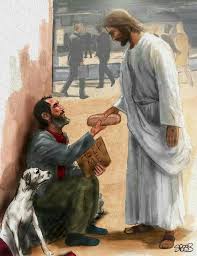
I am taking my reflection from the Passion narrative of Luke’s gospel just at the end of it which states “All Jesus acquaintances, including the women who followed Him from Galilee, stood at a distance, watching these things.”

Hopefully as you read this reflection the weather will be more inviting and welcoming but today I want to reflect on the terrible cold weather of just a few months ago. I was driving down Main Street in Hamilton on the absolute coldest day I have ever experienced.  My car was delightfully warm.  I was so spoiled as to even have the seat warmers on.  However there I passed a younger man holding onto a pole without the proper clothing, no boots, no hat, no gloves.  This intersection is possibly one of the busiest in Hamilton.  While I was distressed to see this individual and annoyed that it had interrupted my comfort, I was sure somebody else would help him.  I continued on my way for a substantial distance when I came to my senses and realized I had to make sure he was ok.  I turned around and there he was in the same place with nobody there with him.  I felt I was doing my civic duty asking if I could call an ambulance for him but could get no response.  I went on a little way further and did call 911 but the dispatcher said that an ambulance could not be sent only if he had given permission for it and that the police would not come to check on somebody like him because they were too busy. I tried to tell her that this man must have some psychiatric issues but it became an argument as to how I could assess this?  Once again I drove around the block and there he was but this time somebody was trying to put some gloves on him.  He agreed to get into the car and I tried again to phone for an ambulance.  Thank God this other man did get through and an ambulance was coming…

From the back seat of my car I could hear the man repeating over and over again how troubled he was.  Finally the ambulance arrived and the woman attendant could not have been more attentive and compassionate to him. 

I, too, was troubled as I drove away, wondering what we as a city have come to?  Do you have to be rich, or influential in order to be treated fairly?  The very next day I wrote a letter to the police chief, outlining how I was treated and ultimately what poor attention this man received.  One of the police chief’s assistant’s contacted me and assured me that they would look into the matter.  Her response was that her father has Alzheimer’s and it could have been him out in the cold.  The good news is that a week later the woman contacted me again to say that all of the people involved were spoken to and that action had been taken.  She was most appreciative of the feedback and felt that in her words “this was the best resolution of a case that she has handled in her twenty-two years of service".

Today I am questioning myself - how often do I simply watch from a distance, not choosing to get involved? Is my relationship with Jesus from a distance or is it so intimately alive that I will put myself out there for the poor? Then at Mass shortly after this episode our Deacon quoted from Mother Theresa who said, "How can I truly recognize the poor among us if I am too poor to pray?"   My prayer is that I (we) continue to see with our eyes wide open!    

- Sister Ann Marshall