
Guest Bloggers

Paradox

unsplash-image-0Rd5zJS3v4s.jpg

For poet Mary Oliver it was the blue iris that gave her pause.  For me, it is the yellow iris. In her poem Praying Oliver writes: “It doesn’t have to be the blue iris, it could be weeds in a vacant lot or a few small stones; just pay attention, then patch a few words together …” As I stood admiring the tall yellow iris, I patched a few words together.  “I see you have returned in full splendour,” I whispered. Last year, I had stood in that same spot admiring the iris.  On my daily walks these past months I watched the iris bloom and die. During the winter months, this same spot was barren and frozen. There was no sign of the lovely iris.  In April, when warm rays of spring sun thawed the ground, suddenly there were tips of green poking through the soil reaching for light and warmth. I watched these shoots grow tall, eagerly awaiting the first buds, harbingers of the return of the bright yellow crown of the iris. On my walks these days, I make it a point to pause and admire the iris now once again in full bloom.  As it does each year, it took the entire cycle of dying and rising for this lovely yellow iris to bloom. 

While I stood admiring the iris, I recalled what the Danish philosopher, Søren Kierkegaard, observed long ago: “Life can only be understood backwards, but it must be lived forwards.”  Like for the iris, how we got to where are today, depends entirely on the past, that which we have lived. However, we know life cannot go on if we constantly dwell on the past and on things not in our power.  Kierkegaard urges us to keep living for the future, and herein lies the paradox - not only does the past keep looking over our shoulders it lurks right here in our midst.  Yes, we all live forwards but can only understand backwards. A case in point is the recent discovery of the remains of 215 children found buried at a former Indian Residential School in Kamloops, British Columbia. The news of the devastating history of this tragedy left Canada reeling.  The past is never past; it reaches into the present.  While we struggle to comprehend the Kamloops tragedy backwards it surely may be the catalyst prompting us to move forward, to shape a more just and equitable future for this country.

unsplash-image-ahHn48-zKWo.jpg

For the first time, this year Canada claimed the top spot in the annual ranking of best countries for quality of life. This beautiful country purportedly with the best quality of life, has a dark history. What a stark paradox. Vacillating between opposites is what life so often is about.  There is the good, the bad, and the ugly not only in Canada but all over the world.  We, you and I, and all people contribute either to the good, the bad, or the ugly in our world.  We each have a choice. 

LondonMuslimCommunity.jpg

On June 6 here in London, Ontario, a 20-year-old chose to brutally mow down a Muslim family with his pickup truck while they were out for a walk.  As I write this, the public funeral of the four members of this family is being aired on TV.  Hundreds of Londoners of all faiths came to support the family of the deceased and of the entire Muslim community.  The presence of so many is a witness and reminder that darkness and light so often are juxtaposed. Out of the dark, seemingly barren earth, the beautiful yellow iris grew and bloomed.  It is evident, many of the people here in London are choosing to bring light into this tragically dark moment to birth something new in this land ranked as the best country. 

The Spirit of God also hovers over us even during these dark times. 

Even in this best country, we will always live with paradoxes. There is no need to look afar. Paradoxes are part of who we are.  Thankfully, extremes like Dr. Jekyll and Mr. Hyde are rare. For all of us, though, facing the paradoxes within ourselves can be a real challenge.  We all know the struggles and pitfalls when we are faced with choosing between doing the good, the bad, or the ugly.  At times we all stumble. We tend to pick ourselves up, dust ourselves off, and hope to do better.  Change is never easy.  Changing ourselves is a real challenge.  Psychologist Carl Rogers, who had great insight into human nature, famously said, “The curious paradox is that when I accept myself just as I am, then I can change.” Easier said than done. 

isn’t it odd. We can only see our outsides, but nearly everything happens on the inside
— from the book, The Boy, the Mole, the Fox and the Horse by Charlie Mackesy

We can learn from the yellow iris.  Out of darkness beauty can be birthed.  In the first chapter of Genesis, we read that when the earth was “formless and empty, darkness was over the surface of the deep, and the Spirit of God was hovering over the waters.”  The Spirit of God also hovers over us even during these dark times.  Life will never be perfect, yet we can change ourselves and help to make our world a better place for all.  Earlier this week I came upon these wise words by Parker Palmer, “As often happens on the spiritual journey, we have arrived at the heart of a paradox: each time a door closes, the rest of the world opens up.”  The tragedy of the pandemic, of the 215 children buried in Kamloops, and of the senseless killing of the Muslim family could be a door closing on a terrible darkness. On this side of the closed door, with new hindsight, may Canada and the rest of the world, in Kierkegaard’s words, “live forward” to a better and brighter future for all.  A glimmer of light and hope is made visible amid the darkness.  

-Sister Magdalena Vogt, cps 

National Indigenous Peoples Day - June 21, 2021

What Celebrating/Recognizing National Indigenous

Day in Canada means to me

Boozhoo, Koolamalsi, Greetings,

My name is Wabusk skweow kahetopit (Polar Bear Woman Who is Looking Ahead). I am Anishinabe Lenaapeew (Ojibway/Lenape woman) from the Moravian of the Thames, known today as Eelunaapeewi Lahkeewiit (Delaware Nation).

What it means to me to Recognize and Celebrate National Indigenous Day and National Indigenous History month comes from the experience as a second-generation survivor of the Canadian Indian Residential School system. For me, to be Indigenous are these three action words; resiliency, reclamation, and intergenerational wisdom, my mother. The original waters I come from: My mother was dismembered from her nation, her culture, her identity, and her language due to the impact of patriarchal colonial structures like the Indian Act, the residential school system. My mother had a really difficult time fitting in when she left the residential school. She felt disconnected from her community, her family, and her culture. This had a ripple effect on the next generation. As a little girl growing up I was dismembered, as well. I was raised in a eurocentric colonial system of racism, bullying that led me to believe that “I am not good enough”, which stripped away my sense of self-worth and my identity. It was in the late 90's I began my process of recovery and reclaiming my Indigenous heritage.

resiliency, reclamation, and intergenerational wisdom

Miigweech (Thank you) to the Sisters of St Joseph Hospitality Detoxification Centre. In the 1990s, it was there at that particular detox centre in London, Ontario that I started my journey to re-member, re-claim, and re-search who I truly am. I may have stumbled here and there on this Red Path. I did start to believe there was a path that has always been charted for me. It is through ceremony, teachings, and sitting with elders. There was one particular life lesson, I value: and that is to forgive and let go.

It is time to acknowledge that it is Indigenous Peoples Day every day

I learned it is the act of resiliency within my own intergenerational wisdom that I was able to reclaim who I am. I am an Anishinabe/Lenaapeew kwe(Lenaapeew/Objiway woman) and Ndaa’miigeyaabi maapii (we are still here).

It is time to acknowledge that it is Indigenous Peoples Day every day and it's about all Indigenous People of Turtle Island (North America) to be able to acknowledge ourselves as resilient Indigenous People. It is a celebration of life as we continue to reclaim who we are.

Therefore, every day when we wake up let us give thanks to the Creator for this breath of life, and give thanks to all of creation, the universe, and our ancestors for blessing us this day to live, love, and re-learn.

Let us give thanks to the Creator for this breath of life
residentalschoolsurvivor.jpg

This wise elder whose name translated in english: Pathfinder baa, he who has passed on, taught me this and it is what I live by: “Life is a Ceremony, Ceremony is all about Life”. This is what it is to me to be Indigenous and to recognize National Indigenous Day and National Indigenous history month.

Miigweech, Anushiik

All My Relations

Wabusk skweow kahetopit (Polar Bear Woman Who is Looking Ahead)

M.Tracey Whiteye

Learn More about National Indigenous Peoples Day here

When father doesn’t know best

I’m a father. My children are 12 and 9.

I don’t know what it’s like to have my kids taken from me.

I don't know what it’s like to have them removed from our home and sent to a place where they were forbidden to speak their language or practice their culture. A place where they normalized nightmarish emotional and physical abuse, bullying, deprivation, and death.

I don’t know what it’s like to be abandoned and betrayed by the government.

And I don’t know or understand the true history of our country.

What I now know is that for more than a century, 150,000 First Nations, Métis, and Inuit kids were subjected to residential schools where the prime directive was assimilation.

I now know that we have a responsibility to seek out, understand and acknowledge the truth. And that everyone in Canada can contribute to reconciliation.

And I know that on this Father’s Day (and every day), it’s not good enough to teach our kids what our fathers taught us.

It’s far more important we teach them the things they didn’t.

Please read.

Please listen.

Please give.

-Jeff Sage is a resident of London, Ontario.

Graduating during Covid

unsplash-image-iPjAS-aTBdE.jpg

Graduating during COVID-19 is a weird experience. There was very little celebration on the last day of class, I remember that I had biology and when the lesson ended I thanked her for all that she has done during the past 2 years that I have had her as a teacher and then I closed my computer. There wasn't any yelling in the halls or high-fives, I simply closed my computer and had lunch. My emotions that day were fairly neutral and the rest of the day was insignificant as I carried out the same routine that I have been doing for months at this point. I think that all the other students agree with me in saying that we are all looking forward to university where we can make up for the lost social interactions and events that were cancelled because of Covid.

Everybody I talk to isn't focussed on what we missed out on in the last year of high school, but rather what is to come in university. It's almost like missing the last year of high school has amplified all the excitement of going off to university. That being said, I think it's safe to say that everybody in my grade is saddened and a little frustrated that we couldn't have our final prom, or go to school sports events, it definitely feels as though the social part of high school is missing, and there is nothing we can do to have a similar experience to those in the past. 

classof mask.jpg

To be frank, there aren't any substitutes that could fulfill an in-person graduation or grad party. There have been some parties hosted by students in my grade, however, they are unsafe and have caused a significant amount of Covid cases. If it weren't for the risk I would have gone but I can't put my family in that situation. I am lucky in that I have made friends with the people in my neighbourhood and we can hang out and socialize, however, some of my classmates don't have the luxury of spending time with friends and have gone into depressive states.

In summary, there isn't really any substitute for our graduation being cancelled by Covid and some members of my class are truly struggling to cope with this reality. That's why I think it's important to routinely check-in and talk to people that you haven't seen in person for some time, if they aren't doing so well mentally you should try and help them cope with what they are going through. 

-Sean Lizzola | Sean is 18 and recently graduated from Upper Canada College in Toronto. Sean is the grand-nephew of Sister Ann Marshall, CSJ.

Amnesty International: 60 Years of Humanity in Action

amnesty.jpg

60 years ago, on May 28, 1961, the worldwide movement for human rights that is now Amnesty International was born.

A few weeks earlier, British lawyer Peter Benenson was on a commuter train heading into London when he read a news story about two Portuguese students who were sent to prison for several years just for having raised a toast to freedom in a restaurant. Outraged at this injustice, when he disembarked from the train Benenson went into the Church of St. Martin-in-the-Fields near Trafalgar Square and prayed for guidance. The inspiration for what was to become the world’s largest grassroots human rights movement was born.

On May 28, 1961, The London Observer published an article on their front page written by Peter Benenson titled “The Forgotten Prisoners” which launched the “Appeal for Amnesty 1961” – a campaign calling for the release of all people imprisoned in various parts of the world because of the peaceful expression of their beliefs.

In the article, Benenson made the case for the students’ release and urged readers to write letters of protest to the Portuguese government. The article also drew attention to the variety of human rights violations taking place around the world and coined the term “prisoners of conscience” to describe “any person who is physically restrained (by imprisonment or otherwise) from expressing … any opinion which he honestly holds and does not advocate or condone personal violence.”

Reprinted in newspapers around the world, Benenson’s campaign for amnesty received hundreds of offers of support. In July 1961, delegates from Belgium, the United Kingdom, France, the United States, Germany, Ireland, and Switzerland met to begin “a permanent international movement in defense of freedom of opinion and religion.” The following year, this movement would officially become the human rights organization Amnesty International.

Amnesty International took its mandate from the United Nations Universal Declaration of Human Rights, which was adopted in 1948, which holds that all people have fundamental rights that transcend national, cultural, religious, and ideological boundaries.

Amnesty canada.png

The Canadian Section of Amnesty International was officially incorporated in 1973, but there were Amnesty activists in this country almost from the moment the movement was born globally.

60 years later, on this May 28, more than 10 million people in over 150 countries around the world are part of the Amnesty International movement. Amnesty members believe that all people in our world – regardless of who they are, where they were born, the language they speak, their spiritual beliefs, their age, or gender – are deserving of the same human rights. They also believe that there is something each one of us can do to take action to improve the lives of people experiencing human rights violations.

The Sisters of St. Joseph in London have been stalwart supporters of, and partners in, Amnesty International’s work for justice and dignity for all people for decades.  

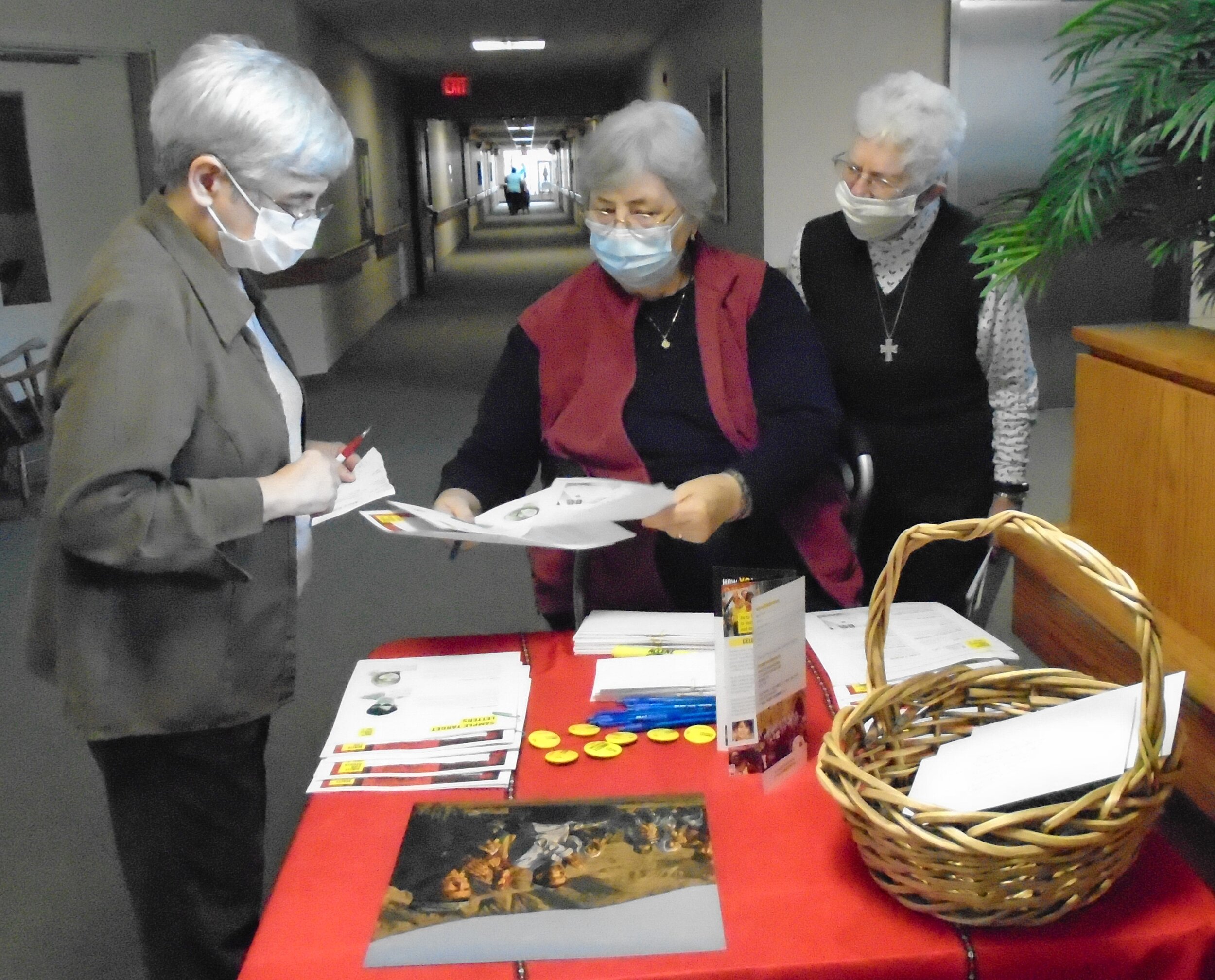
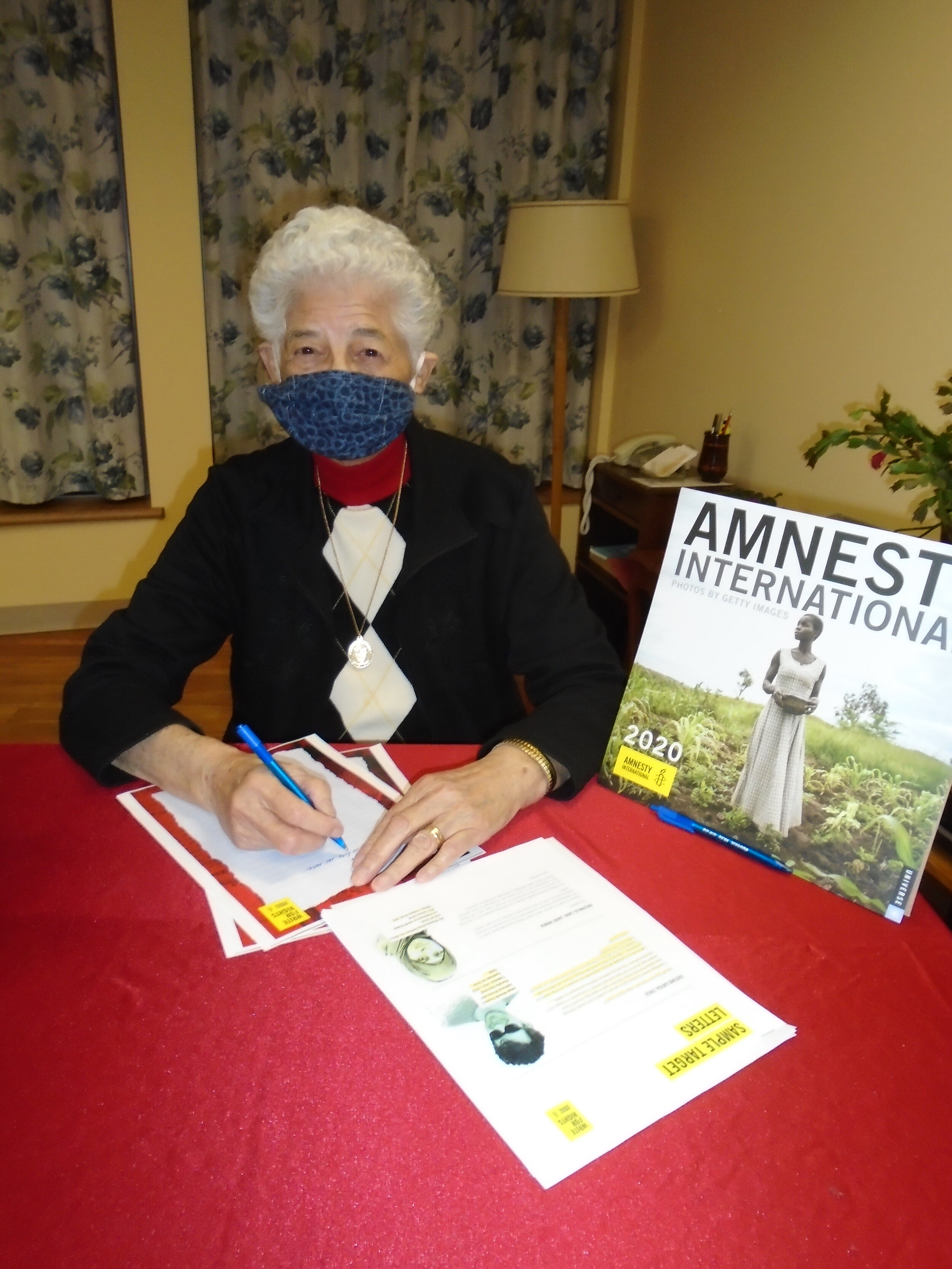
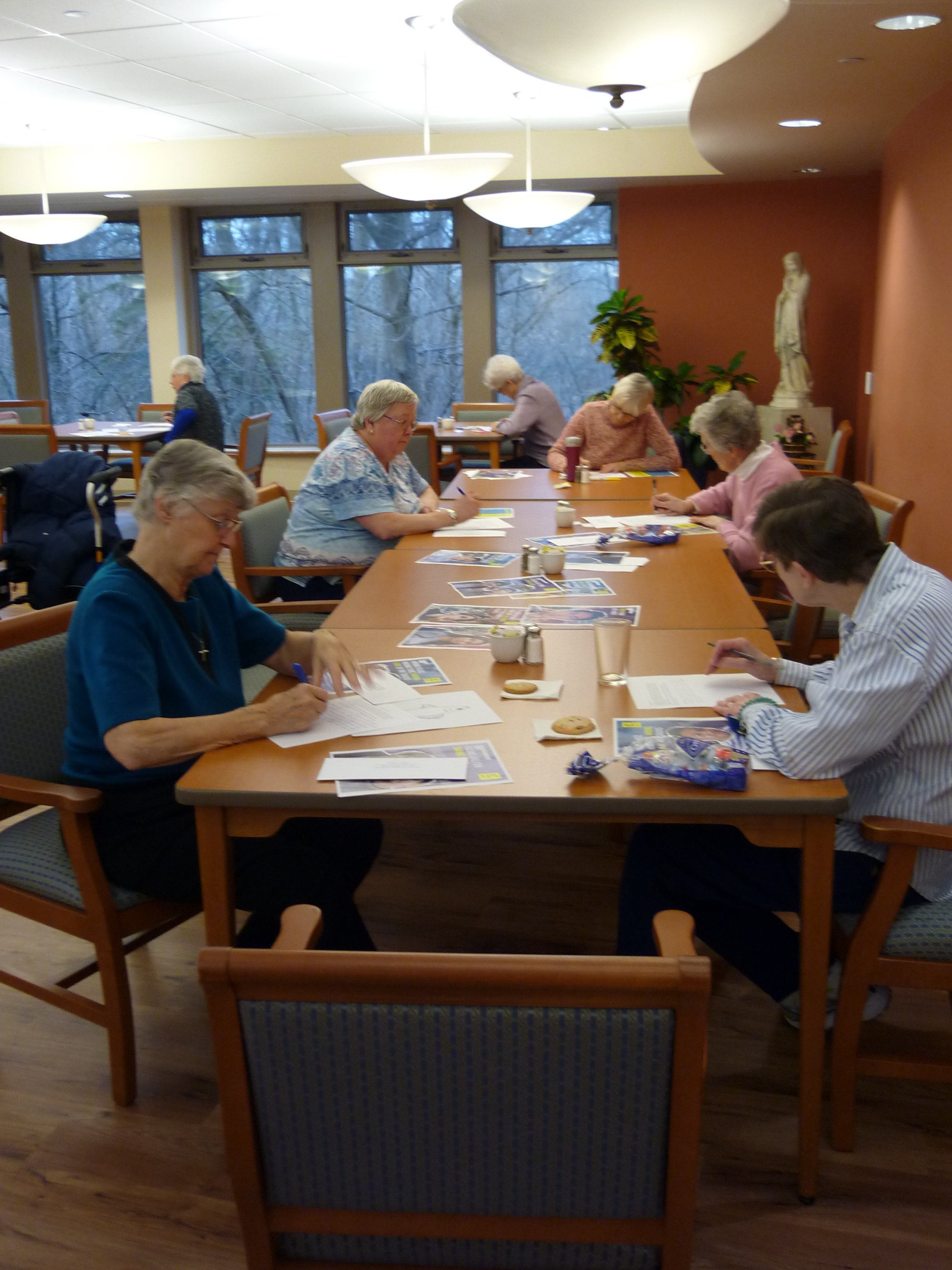
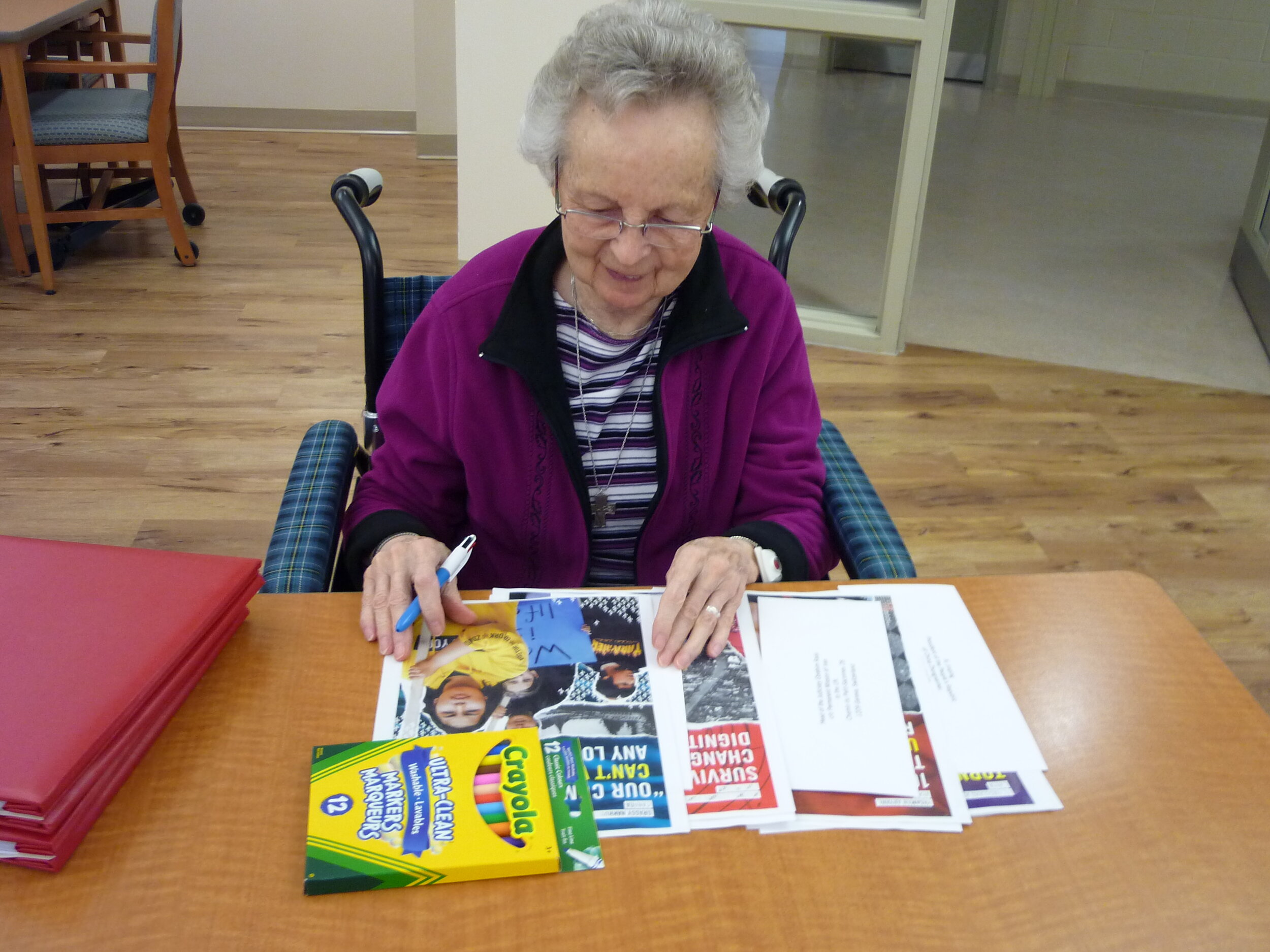
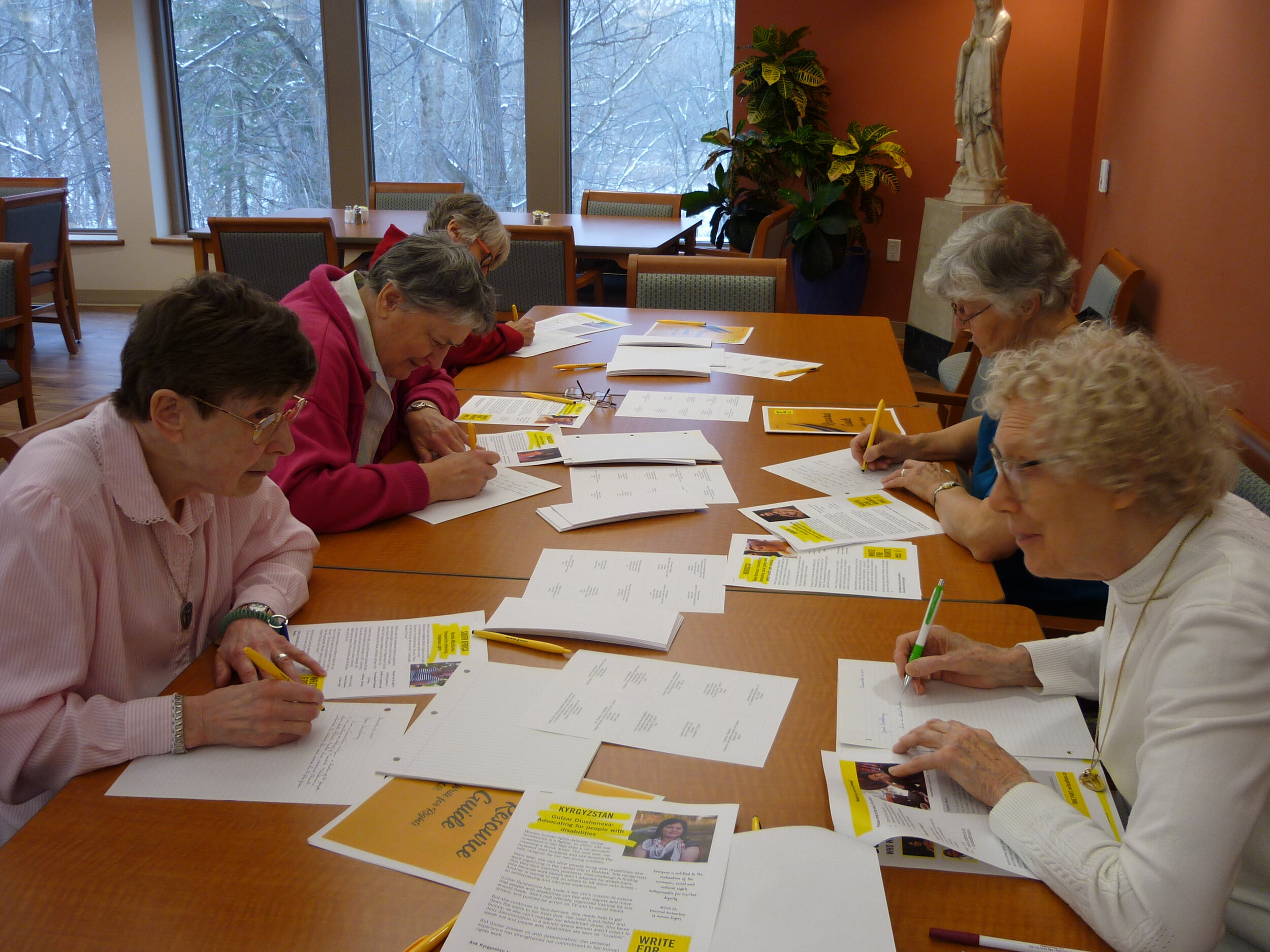
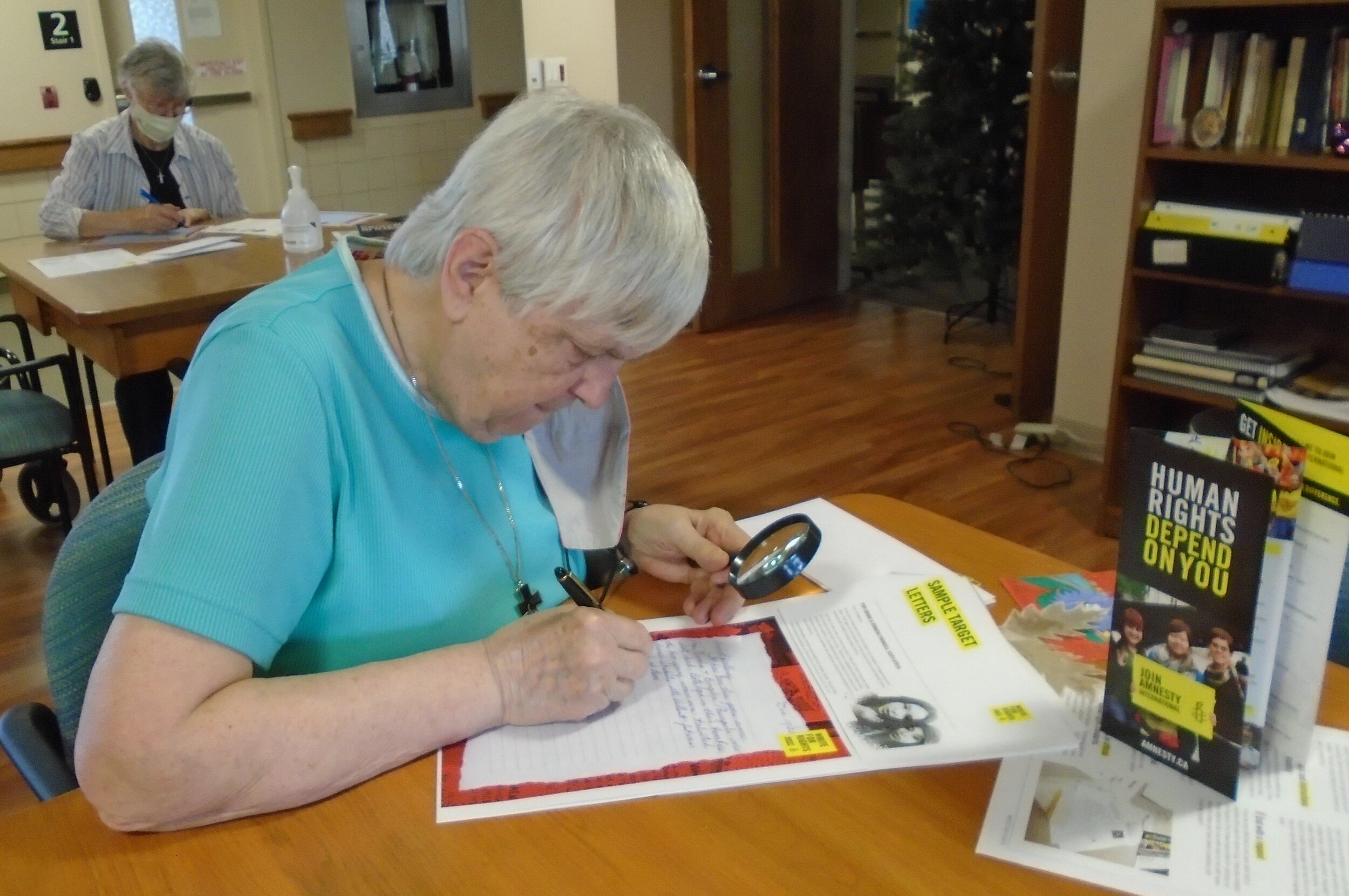
Sisters work on writing Amnesty Letters

Sisters work on writing Amnesty Letters

Over the past several years, the financial and spiritual support from the Sisters of St. Joseph has been instrumental in advancing Amnesty International’s work in solidarity with Indigenous Peoples and communities in Canada.  In 2004, the Sisters of St. Joseph provided the funding needed for our first research project on the national crisis of Missing and Murdered Indigenous Women and Girls. Our first report, Stolen Sisters, published in 2004, and the follow-up No More Stolen Sisters in 2009, were instrumental in our work in solidarity with Indigenous communities in demanding a national inquiry and national action plan for this human rights crisis.

The compassionate and caring support from the Sisters of St. Joseph for individuals like Maher Arar and his family, after his return to Canada from Syria where he had been tortured and imprisoned for more than a year, were remarkable. Your constant interest in the case of Omar Khadr was also notable.

More recently, generous contributions from the Community of the Sisters of St. Joseph have funded urgent work on refugees, crisis work in Yemen and Syria, advocating for the Uyghurs held in prison camps in China, and much more. The Sisters of St. Joseph have helped protect the rights of protestors in Hong Kong, helped outlaw child marriage in Burkina Faso, helped educate the next generation of activists in South East Asia, and helped free unjustly detained human rights defenders like Loujain Al-Hathloul in Saudi Arabia, imprisoned solely for her advocacy for women’s rights in that country.

Amnesty International is only able to do our human rights work with the activism and support of extraordinary donors like the Community of the Sisters of St. Joseph in the Diocese of London.

We send our heartfelt thanks for your partnership in our shared goal of a world with more justice and dignity for all people. We look forward to working with you over the next 60 years!

With heartfelt appreciation from all of us at Amnesty International.