
In the Spirit of Gratitude and Hope

As the celebration of Thanksgiving approaches, I write to you in a spirit of gratitude and hope. At this time of year, it can sometimes seem like a time of loss, as we see trees and gardens completing their summer cycle. In the midst of COVID, this sense might be heightened.

In the past two weeks, I have harvested my vegetables and flower seeds. I have been filled with gratitude for the food I have been able to share. As I have picked cranberries, both high bush, and low bush, I have been grateful for the quiet, reflective time in the silence of the trees. Thanksgiving filled my heart as I remembered the beauty of each flower that graced my yard this summer.
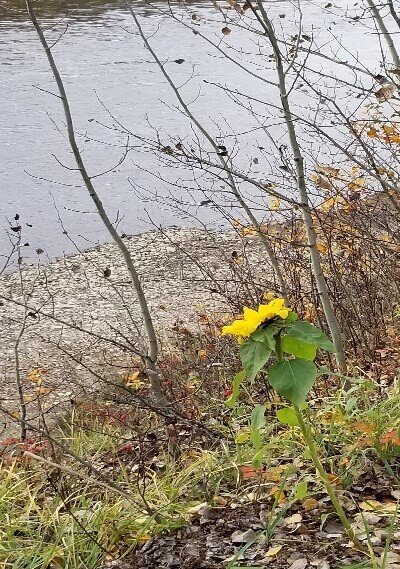
SUNFLOWER by the river.jpg

In collecting seeds from some of the flowers, I experienced a sense of hope as I looked at the tiny seeds, and knew the potential each seed held in bringing new life and beauty next summer. I smiled the other day as I sat reflecting from my recliner. Looking out the front window, I was surprised to see a small sunflower blooming on the edge of the riverbank. With a closer look, there were two more sunflower plants growing. No doubt, a bird or squirrel had dropped the seeds. Such potential of new life!

Walking through the backyard a few weeks ago, I noticed a delicate, soft, cream coloured pansy in full bloom, growing away from all the other flower beds. It caused me to ponder, what an unlikely place to grow; how did it land here; how did it survive my footsteps?

We have each been blessed with the fruits of the Spirit; love, joy, peace, patience, kindness, goodness, faithfulness, gentleness, and self-control.These are our seeds to sow; our gifts to share. Which particular gift is yours to share? During these days of COVID our works and presence in our communities may be altered, and yet we are still called individually and as a group of dedicated women, to be witnesses to our values or pillars of faith, service and justice. Where might our seeds fall? How might my gift give life to another? I may never know.

Blessings, Sister Margaret Ann Beaudette, csj

In the gift of this new day,


In the gift of the present moment,


In the gift of time and eternity entwined


Let me be thankful


Let me be attentive


Let me be open to what has never happened before…

Taken from Sounds of the Eternal: A Celtic Psalter, Morning and Night Prayer, J.Philip Newell


"Tensions and Tragedy": World Day Against The Death Penalty

On March 15, 2018, the State of Georgia executed Carlton Michael Gary, for the crimes of rape and murder. The case against Gary was based on the flimsy and conflicting evidence of an “eye witness” and a claim that he had confessed although no documentation of the alleged confession existed. Ultimately, it was shown that a dental mold ordered by lawyers, the size of a footprint found at the scene of the crime, and DNA evidence excluded Gary. In Gary’s unsuccessful petition for clemency, Gary’s lawyers stated that “we are not talking about questionable recanting witnesses who came forward long after the trial, but hard physical evidence of innocence.” Nonetheless, the execution of Gary went ahead.

October 10 marks the 18th “World Day Against the Death Penalty” (capital punishment). The day, supported by numerous world governments, the European Union, the United Nations, Amnesty International, and many NGOs, calls on all people to oppose the death penalty, globally and in all cases.

The following reasons are given by those who call for the abolition of the death penalty:

  • The inherent possibility of mistakes being made by the justice system whereby innocent persons may be condemned to death. The example of the case described briefly above illustrates this point. Globally, there is compelling evidence that wrongful executions occur and not infrequently. There is also evidence that confessions are often derived from torture.

  • The practice is inhumane and rather than bringing justice for brutal crimes it perpetuates a cycle of violence.

  • The act is irreversible, leaving no possibility for repentance or forgiveness.

  • The death penalty is ineffective in deterring violent crime.

  • Importantly, the death penalty is disproportionately applied to the poor, visible minorities, and marginalized groups.

  • Often, little attention is paid to the existence of mental illness and cognitive challenges in the perpetrators.

Sister Helen Prejean

Sister Helen Prejean

Sister of St. Joseph, Helen Prejean, makes the point that “if we believe that murder is wrong and not admissible in our society, then it has to be wrong for everyone, not just individuals but governments as well. Sister Helen continues, “people are more than the worst thing they have done.” These words guide her ministry with people on “death row” as depicted in the powerful book and movie, based on a true story, “Dead Man Walking”.

Sister Helen’s words, however, may give rise to moral tension in us especially when we look upon heinous crimes, particularly murder, often committed against children, adolescents with so much promise in their lives, and seniors.

DEAD MAN WALKING BOOK.jpg

In “Dead Man Walking”, we see Sister Helen facing such moral tension.  Lloyd Le Blanc, the father of a teenage boy murdered alongside his young girlfriend, challenges Sister Helen. Lloyd reprimands her for not speaking out for the victims and their families. His excruciating pain moves Sister Helen profoundly. She reflects upon and questions her position and above all, she reaches out to Lloyd and his family with deep compassion. She does, not, however, alter her pastoral care for the alleged perpetrator, Patrick Sonnier whose own poverty and sad life speak volumes. For Sister Helen, “mercy is stronger and more God-like than vengeance.”

Interestingly, it is Lloyd LeBlanc who witnesses so convincingly to this. In the book, we read that when he was taken to view the body of his son, he knelt by him and prayed the Lord’s prayer. As he reached the line, “Forgive us our trespasses as we forgive those who trespass against us”, he added, “whoever did this, I forgive them.” Said in one moment, Lloyd continues to struggle to live out that forgiveness day by day. In his actions, he bears witness to it. He provides financial support for Sister Helen’s ongoing work, he regularly prays not only for his son but also for the Sonnier family, even comforting Sonnier’s mother on her deathbed. What Lloyd shows us is that while punishment is necessary, revenge and the death penalty are not the answer.

world day death penalty.jpg

Together with others, many religious traditions echo this. The Roman Catholic Church has, in recent years, moved to the abolition of the death penalty. In line with his ever-evolving “consistent ethic of life” position, Pope John Paul II was clear on the issue. He stated, “A sign of hope is the increasing recognition that the dignity of human life must never be taken away even in the case of someone who has done great evil. Modern society has the means of protecting itself without definitively denying criminals the chance of reform. I appeal for a consensus to end the death penalty, which is both cruel and unnecessary.”

In his Encyclical (letter) entitled, Fratelli Tutti signed just a few days ago (October 3), Pope Francis follows in his predecessor’s footsteps now categorically stating that the death penalty is a “false answer” that “ultimately does no more than introduce new elements of destruction in the fabric of national and global society”. Francis thus, “calls upon all Christians and people of goodwill to work for the abolition of the death penalty.”

Today, The World Day for the Abolition of the Death Penalty, October 10, provides us all no matter our background, religious or not, to work together for this end.

Sister Mary Rowell, CSJ

From the Ashes: Overcoming Adversity

Have you ever had the privilege of attending a captivating, autobiographical lecture by a recently published author and then have a copy of the book immediately placed in your hands?  That’s what happened to me a couple of weeks ago when I attended the King’s University College’s virtual Veritas Lecture Series to hear Jesse Thistle - whose 2019 memoir, From the Ashes is a #1 National Bestseller and is a 2020 selection on CBC’s “Canada Reads”.  The low-key, honest presentation of this Cree-Metis young man traced his stormy life from childhood abandonment through tempestuous years at school to life as a homeless addict on Canada’s streets from Vancouver through the prairies to Toronto and area.

jesse thistle.jpg

Jesse’s arduous, heartbreaking story recounts his many years of abject poverty, homelessness, and wretched living on unforgiving streets.  Constant hunger, danger, and feeding his addiction fueled his destructive choices that frequently led to jail and finally to the rehab centre Harvest House where he began the long journey back to health and inner strength.

Several chance meetings with a beautiful flame-red-haired Lucie led to love, a home, and academic success as a graduate of Toronto’s York University where he is an assistant professor of Metis studies.  In fact, Jesse is considered an expert on homelessness and Metis history. He won the top two doctoral scholarships in the country: the Pierre Elliott Trudeau Foundation Scholarship and the Vanier Scholarship. He also received the Governor General’s Silver Medal for graduating with one of the highest grade-point averages in the country!  Jesse is the first student in York University’s sixty-year history to receive this honour.

As I shared Jesse Thistle’s journey through his forthright lecture and written account of many horrendous and key moments in his troubled life, I came to understand more about homelessness, addiction, and life on the streets.  I hope you have time to read From the Ashes or view his website and rejoice that the human spirit can conquer seemingly insurmountable trials and rise like the phoenix to great heights of success, care, and compassion, just as Jesse has done.

-Sister Jean Moylan, csj

Creativity in the time of Covid

As COVID -19 cases increase in London, restrictions for those of us living in our residence have curtailed normal activities such as visiting, going to stores, and having close proximity to each other.  We have reverted to “phase two” conditions which seem even more challenging this second time around.  Yet we seem to have accepted our reality and are rising to the challenge of keeping our residence free of the virus. The September 28 issue of The Globe and Mail contains an article by Wency Leung which describes research showing that “Playfulness may help adults improve their mood and lessen depressive symptoms, among other perks . . .” 

BOOKS.jpeg

One of our members described the pleasure she felt in seeing several sisters at different tables playing various games. Signs of creativity are emerging.  Card games and board games for two players are found on the internet and taught to others. Borrowing, buying, trading, and discussing books has increased significantly. Conversations about dealing with restrictions are more humorous, less dismal.  Seating at tables is limited to two persons so the dedicated card players have been using the internet to find new card games which they teach to others. There are people playing various forms of solitaire for two players, in addition to kings on the corner, spite and malice, thirteen, euchre, pepper, thirteen, golf and cribbage.  Board games are more frequent and varied. Walks in the neighbourhood, or in our hallways seem ongoing. Creativity abounds and is particularly present in our prayers together.  We are more aware of political, social, and environmental issues in our neighbourhood and in the world. Our community prayers reflect our increasing creativity and the concerns for the good of all creation – our common home.

cards.jpg

Play is creative, and creativity has an imaginative quality that expands our minds, bestows energy, and lifts our minds from despondency to hope.   With hope and faith, we actively work to make our world a better place.

- Sister Pat McKeon, CSJ

Anniversary of Jean-Piérre Medaille

MEDAILLE.jpg

On the day that you were born … October 6, 1610…

Jean-Pierre was welcomed into the world by his parents, Phélippe and Jean Médaille on October 6, 1610 in Carcassonne, a medieval walled city in southwest France. The Médaille family belonged within the local bourgeoisie, so they would have enjoyed many cultural and religious events. He was the eldest son and had two brothers, Jean and Jean-Paul. When he was fifteen years old, upon completion of his studies at the local Jesuit College, Jean-Pierre left the prosperity of his family to enter the Jesuit Novitiate in Toulouse on September 15, 1626. From the beginning, Father Médaille’s superiors recognized him as a person of remarkable intellect and apostolic zeal. They also judged him “healthy but fragile”. Despite these cautions, his superiors wrote that he was “born for the missions” and preaching. So many wonderful hopes and dreams for this young gifted Jesuit … and then came the outbreak of the bubonic plague…

What was your experience of living through a pandemic? Well, it was hard. I was an eighteen-year-old seminarian at the time and I lived through four years of outbreaks of bubonic plague (1628-1631). This plague, as you know, was one of the deadliest bacterial infections in human history and it caused an estimated 50 million deaths in Europe during the Middle Ages when it was known as the Black Death. Our Jesuit life was not a comfortable refuge from the storms of life. When the plague broke out in Toulouse in 1628, many of us novices wanted to go out and serve the sick and suffering. However, our youth and zeal for service were curtailed when our novice master took us off into solitude at Lardenne. He wanted to remove us from exposure to the deadly plague so we stayed in this “place of refuge” for a couple years.

How did you and your brothers in community cope with the lockdown and isolation? To be truthful, it was not always easy and some of the brothers struggled more than others with the restrictions placed upon us. At times there were tensions amongst us but as followers of Ignatius, we tried to “find God in all things”. Over time, and with the wise counsel of our novice master, I believe we learned a delicate discernment lesson needed for the entirety of our spiritual lives. He cautioned us to be aware that the world will always present itself to us with an urgency and demand for some form of service to the dear neighbour, but care and discernment must be present to preserve the interior life of charity, the soul of any apostolate. He counseled us that impulsive, over-eager and rushed decisions made in the face of pressing needs, are not always God-inspired choices. In his wisdom, he saw vaster fields of missionary service for us courageous young men. At Lardenne, we were encouraged to spend more time in prayer and study. Years later, I wrote this maxim to remind me of the wisdom learned in those early days of my vocation.

“Never go ahead of grace through imprudent eagerness but await its moment in peace, and when it comes to you, follow it with great gentleness and courage” (M. P. 6:9).

“sufferings accepted well are like the wood which serves to kindle the fire of love… and to sustain a great love for God throughout life it is necessary to endure great sufferings” (M. P. 5:2).

What was stirring in your heart as you learned of the ravages of this disease? My heart swelled with compassion for the poor and the suffering. Our Order took many precautions throughout this plague period, but from time to time, messages arrived that told us of more deaths. “Such precautions notwithstanding, the plague struck all age groups of the Society of Jesus and decimated the ranks of the Toulouse province. Between 1628 and 1631, ninety-seven Jesuits died, reducing the population of the province by one third.”1 I grieved the loss of so many fine professors and brothers who had given their lives to the Lord so generously and succumbed to the ravages of this dreadful disease. In my contemplative prayer, I offered our sufferings in union with Jesus’ suffering on the cross and actually experienced a greater love grow in my heart. I pondered how it could be true that “sufferings accepted well are like the wood which serves to kindle the fire of love… and to sustain a great love for God throughout life it is necessary to endure great sufferings” (M. P. 5:2). This prolonged solitude became my teacher of mysteries my heart longed to embrace.

Did any special gift come to you during your time of staying in place? For sure, God was gracious and kind to me knowing I needed friendship and support as I carried this awakening dream within my heart. I consider my time at Lardenne, in our place of refuge, my best school of prayer for the missions. If I was to be God’s instrument, I longed for soulful conversations with like-minded brothers. It was here I met Father Jean-François Régis, then a philosophy student. As fellow Jesuits we exchanged ideas and inspired one another with our growing vision of a possible spiritual revitalization emerging in our own homeland. As we spoke, it seemed that we shared an ideal of being contemplatives-in-action. How beautifully God led us, his chosen instruments, to be brought together for some mutual encouragement and clarification of our vocation calls. After my two year Novitiate period, I made profession of simple vows at Toulouse on September 16, 1628. It was only as the years evolved, that I came to realize that I was born for these times! I was God’s instrument as I preached all those Missions throughout the parishes of southern France at the time of its great spiritual/mystical awakening. Gratefully, my “fragile health” sustained me for over forty-three years of Jesuit ministry until I had to retire to our residence in Billom in the fall of 1669.

Use this precious time of solitude and “staying in place” as a God-given grace.

Do you have a word for us in these pandemic times? Yes. Use this precious time of solitude and “staying in place” as a God-given grace. In your “places of refuge”, you too are able to gather over phone, email or Zoom for soulful conversations and friendship support. Be generous and forthright as you exchange ideas and foster dreams of the ‘something new’ God is bringing into your world of the 21st Century. As you keep sharing hearts, you will deepen your understanding of what consecrated women religious might be called to embrace now and into the evolving future. To help maintain your peace of heart, pray this maxim:

No matter what disagreeable things happen to you, never see them as obstacles but as profitable and necessary to your daily life. If you consider them as effects of the tender and loving providence of God, your Father, you will love them tenderly and accept them willingly (M. P. 7:3).

As your founder and spiritual father, I want to encourage all of you in the family of Joseph to embrace your times of contemplative prayer and spirituality study with renewed fervour and attention. As always, I am fond of reminding the small communities of Little Design to abide in your “homes like the tabernacle” and “leave them only to devote yourselves to activities which advance the glory of God” (E.L. par. 38).

Thank you, Father Medaille. Today, on the 410th anniversary of Jean-Pierre Médaille’s birth, may we deepen our belief and trust that our daily contemplations will bring forth conversations and choices that foster a genuine spiritual revitalization affecting global transformation. What a faith-marvel if this ‘dark night’ is truly God’s gift, hidden within a 21st Century global pandemic crisis. Jean-Pierre Médaille, pray for us. Walk the way with us.

-Sister Rosemary O’Toole, csj


1 Anne Hennessy, CSJ, In Search of a Founder, The Life and Spiritual Setting of Jean-Pierre Medaille, S.J., Founder of the Sisters of St. Joseph, PhD thesis (Berkeley: Graduate Theological Union, 1988) 78.