

Our lives have meaning and purpose…. We either help build this world up in love or tear it apart. Either way, we bear the responsibility for the world’s future, and thus we bear responsibility for God’s life as well.
Ilia Delio.
Blog

Every year on the 4th Sunday of October, we are invited by the Church community to celebrate Mission Sunday, a day that we focus on the Call to Mission that each of us has received through our Baptism.
Growing up I thought that folks called to do mission work in other countries were rather special in the eyes of the world. It wasn’t until I had my own lived experience with Scarboro Missions working in the Diocese of Mzuzu in Malawi that I looked at my experience in another country with different eyes.

Sister Ann in Malawi with former students
I was not special in responding to this call at all…I was blessed and graced to live among the people of Mzuzu offering my gifts to serve wherever I was needed. It was I who was transformed and renewed in spirit leaving behind my preconceived notion that I came to change the people I had been called to serve - after all, I was the missionary!

Sister Ann, left, with Sister Veronica and MIC postulants
Living in Malawi, I became sensitized to new themes of Christianity and certainly experienced a reverse culture shock and alienation from my own culture when I returned to Canada after 8 years away. Like other returned missionaries I faced into choosing between a couple of possibilities. I could settle back into old ways of consumerism and of exercising domination over others or I could channel that feeling of alienation to identify with people in our country who look different, who speak a different language, who experience racism every day. A quote from an author, Cyril Powles has been an inspiration for me since my return from Africa. It reads: “One goes overseas so as to come back – to come back as an activist, a marginal person and a perpetual sojourner.” While I would not claim that I am fully living this invitation as I would like to, I continue to be reminded each day that it is impossible for me to unbecome what I learned and lived from my living with and among the people of Mzuzu Diocese for 7 years.
The invitation to be a missionary is a personal call to get involved here in our own country in some of the many issues facing us as a Nation. We read daily in our papers and online about addressing with others the impact of climate change; about refugees fleeing their country of origin coming to live in a safer country; about offering support to our Indigenous brothers and sisters; about accompaniment with the hungry and homeless who perhaps live in our neighborhoods.
“Listening to God, to the universe, and to the world’s pulse, we trust whole making energies are released in ourselves as we use our skills, experience and knowledge to become a missionary in our own country and in the communities where we live.”
-Sister Ann MacDonald, csj
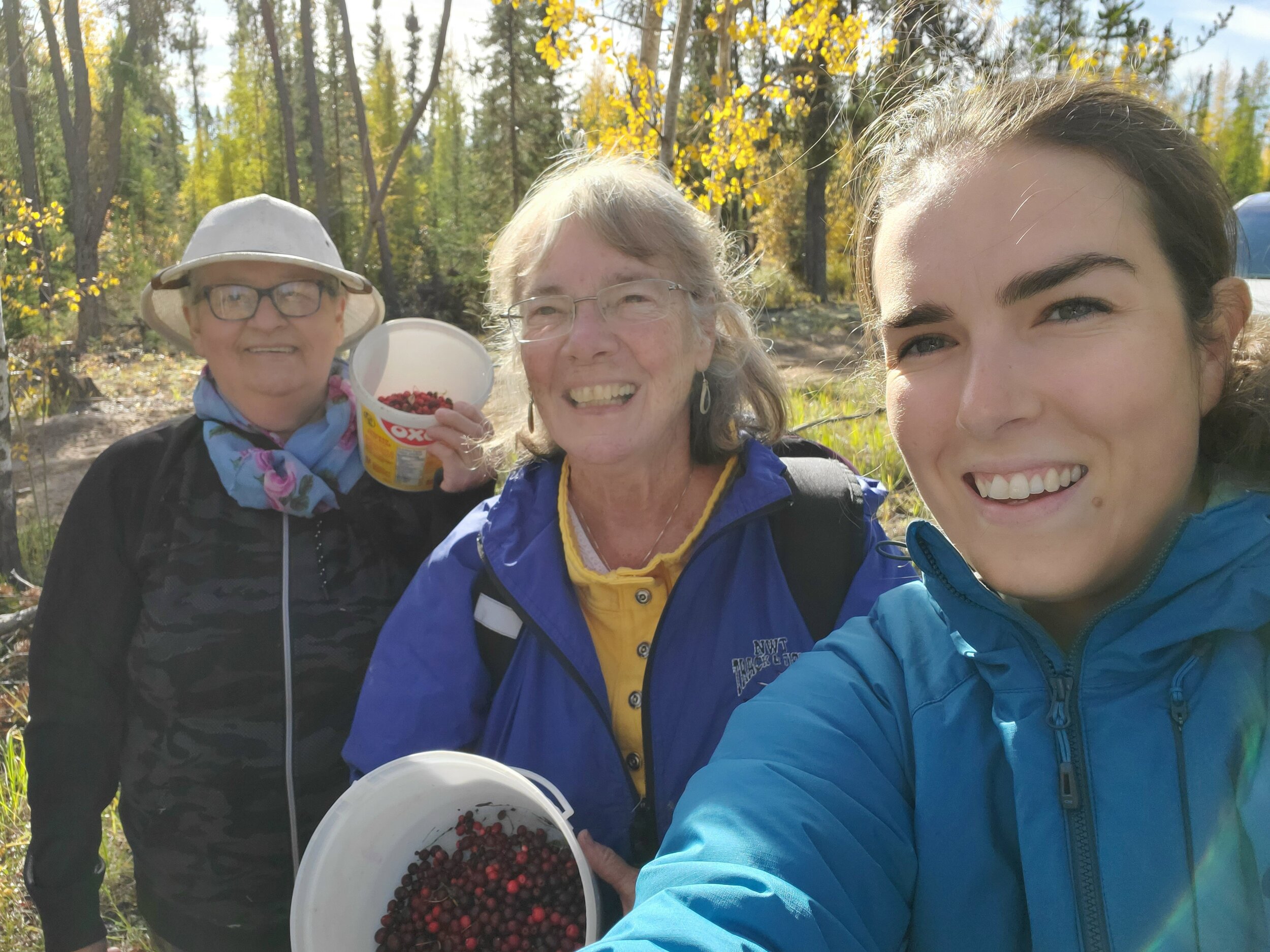
Cranberry Season, Sister Maggie in the middle with Beatrice and Julia
Every season, spring, summer, autumn, and winter holds a particular beauty for me. The later weeks of summer are some of my favourite because it is cranberry picking season!
When I visit “down south” and talk about picking cranberries, many people think that I am wearing hip waders and standing in ponds of water…perhaps, if I lived in B.C. However, did you know that there are highbush and lowbush cranberries? In Hay River, Northwest Territories where I live, I am surrounded with cranberries, both highbush and lowbush.
Pictured above: Left to right: highbush cranberries, lowbush cranberries, Sister Maggie with Beatrice & Julia, Sister Maggie’s special sauce!
Beginning in August I can be found along the trails or in the wooded area on my property picking highbush cranberries. The leaves resemble a narrow maple leaf, and the berries grow in clusters on a stem. Red in colour, the berries are small, juicy, and quite tart and have a small, flat stone. The bushes around the vicinity grow waist high. As the summer season progresses and cooler days come, the foliage turns a beautiful pinkish red and you can smell the scent of the berries in the air. Cranberries are an excellent source of Vitamin C. I make a wonderful barbeque type sauce with the berries. Although labour intensive, the process, and the aroma of the seven spices makes the task worthwhile.
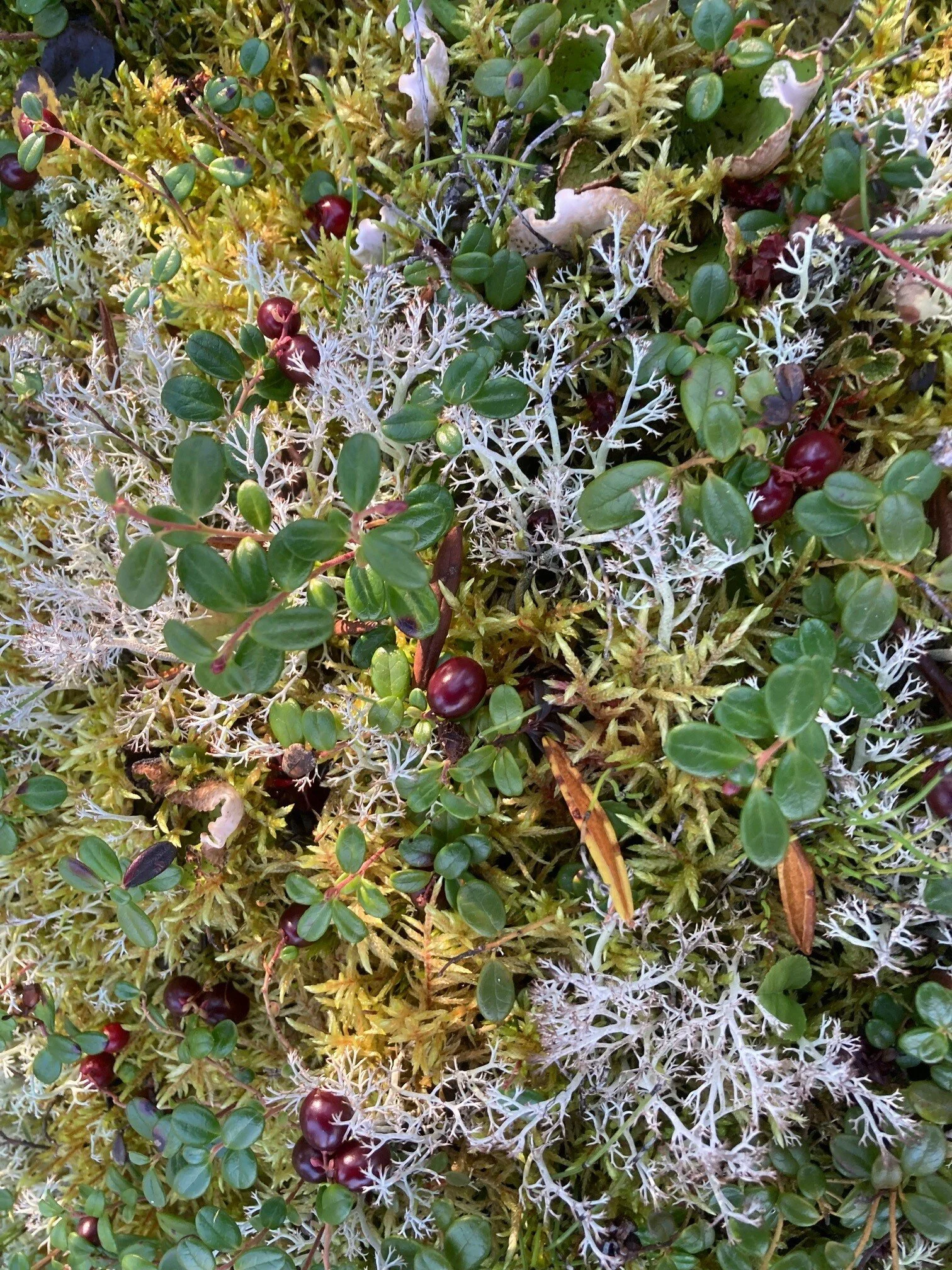
Low bush cranberries grow on the ground, so I am on my hands and knees picking these beautiful berries. I can spend hours picking, always aware of bears. To that end, I wear bells and seldom pick alone. Low bush cranberries are picked usually in September until the snow arrives. They are very tasty after the first frost. The leaves are leathery and shiny, and the berries are found at the end of the stem. Unlike high bush, these berries are sweet in taste and do not have a stone. The plants grow on muskeg, moss, around the trunks of trees and in tall grass. Some seasons the forest floor is carpeted with berries. The berries range in colour from red to a deep purple depending on the place they are growing. Sometimes they are found on white lichen or muskeg and their shiny gloss has the appearance of beautiful Christmas decorations within the whiteness of the lichen. In other places, I dig into the wet moss with my fingers to find the berries which grow to a good size and remind me of chocolate covered almonds in shape! These berries I simply clean and freeze in three cup portions. They are used in muffins, loaves, jam, and sauce.

lowbush cranberries
The season of cranberry picking is a time for moments of quiet reflection, time spent with friends, an opportunity to be aware and grateful for the gifts of the land. I try not to pick all the berries in an area, leaving some for the bears and birds and, also time to reproduce.
Cranberries are a beautiful gift from the Creator!
-Sister Maggie Beaudette, csj

The days leading up to Thanksgiving formed an appropriate time for the staff of St. Joseph’s Hospice of London to pay tribute to their generous volunteers in a method that has become popular during the pandemic months. On a sunny Wednesday morning, staff invited volunteers to a drive-by in front of the hospice area.
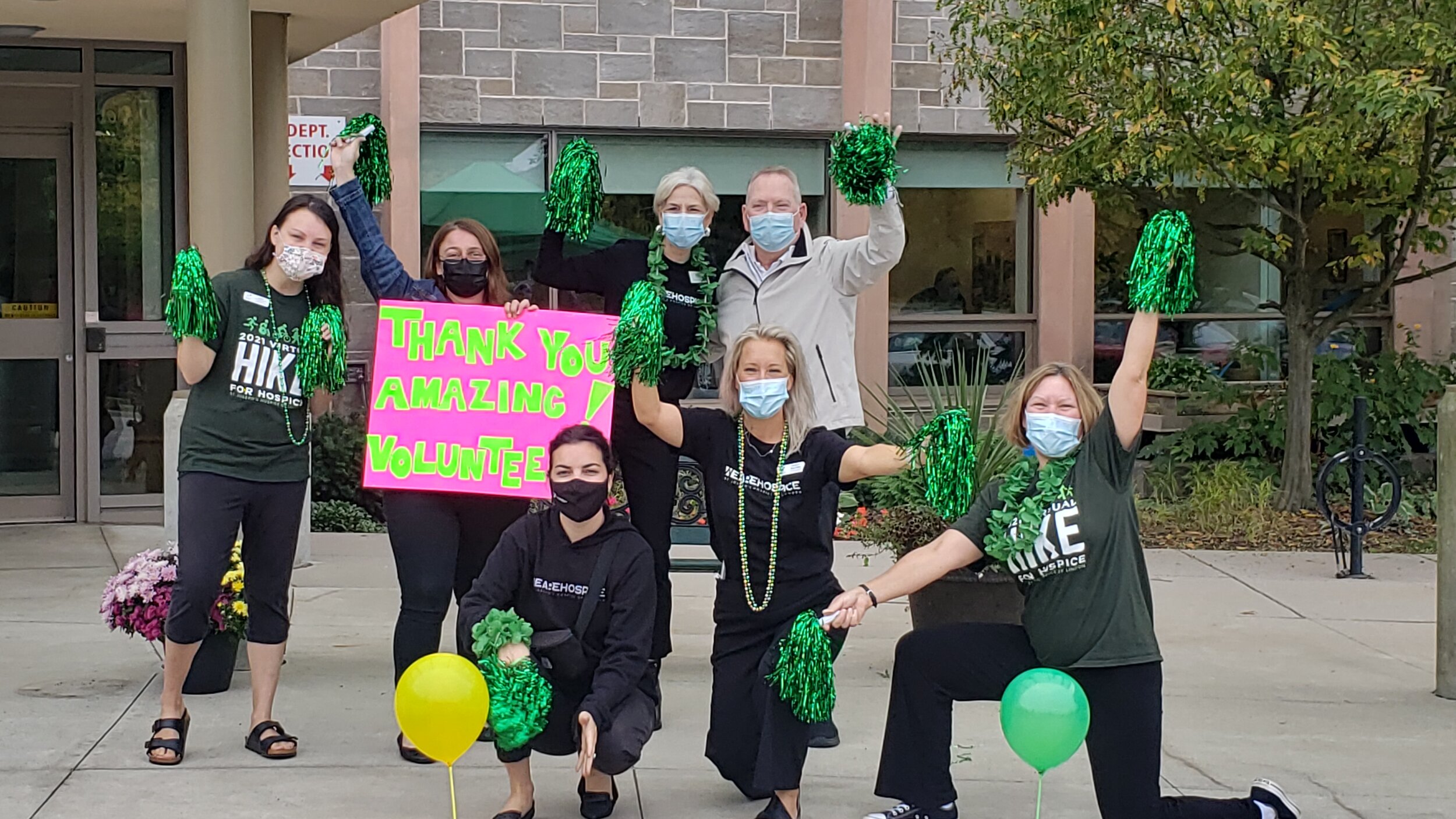
As the volunteers approached the circular driveway, they were greeted by vivacious young staff members dressed as cheerleaders in bright green, waving green pom poms and displaying placards of praise and support. They surrounded the cars and delivered words of praise and appreciation to the volunteers. From their brightly colored stands, they offered special coffee and refreshments. The expressions of gratitude were graciously received by those who came to be acknowledged for their generous assistance.

The hospice organization and staff recognize that volunteers are crucial to the ongoing operation of underfunded hospices. They work at the reception desk and help in the kitchen area. They give direct support in the hospice wing and in the wider community. They also take part in fundraising initiatives. Even the enclosed garden and grounds are thriving under the capable hands of volunteers. In fact, some volunteers are giving back to hospice in appreciation for the care given to a family member who spent his/her final days in hospice.

Volunteer appreciation day was a beautiful occasion for staff to reach out and recognize people who see how they can make a difference. They put their plans into action. Volunteers make a city a strong, vibrant, caring place to live.
Thank you for bringing your generous spirit to St. Joseph’s Hospice of London!
-Sister Jean Moylan, csj
St. Joseph’s Hospice of London is our neighbour here in London, Ontario. To find out more about the incredible work they do, you can visit their website here.


