The Transfiguration and Two Graces: Listening, and Seeing!

LENT II

“In the prayer at the beginning of the Mass we asked the Lord for two graces: “To listen to Your beloved Son”, so that our faith might be nourished by the Word of God, and another grace — “to purify the eyes of our spirit, so that we might one day enjoy the vision of glory”. To listen, the grace to listen, and the grace to purify our eyes.

This is directly related to the Gospel we heard…”

(excerpt of Pope Francis’ homily on the Transfiguration, March 16, 2014)

For me, the story of Jesus’ Transfiguration, tells the truth about what happens when we go with Jesus, away for quiet prayer, especially when there is an issue of suffering, as Jesus took Peter, James and John with him right after he had told them the hard news of his coming Passion.  What seems, then  gives way to what is, as surely as the person of Jesus became transformed and shining, divinely beautiful, while God told the apostles, This is my beloved Son, Listen to Him.

As Pope Francis says it, the graces of prayer change our hearing and our sight, so that what we bring to prayer, takes on a new light, coming from the Lord himself and his  silent message of love and support, his inspiration, and kind call for outreach.

Sister Wendy Cotter, CSJ, Ph.D

A Conversation with a Personal Support Worker (PSW)  

The Covid-19 pandemic revealed a large number of deaths and deficiencies in the care provided to patients in long-term care facilities in Canada. There was much suffering for patients as well as their families. Currently, national standards which provide guidance to enable long-term care homes to provide high-quality care are being reviewed and many health care organizations have been asked to comment on the draft document. I invited a PSW to talk about her experience working in long-term care facilities. I will call the PSW “Margaret” instead of using her real name. Margaret’s comments describe the thoughts and feelings of a long-term care worker who loves her occupation and the patients she cared for while working in a public-funded facility. The conversation went like this: 

Sister Pat:  Margaret, did you work in any long-term care facilities before coming here? 

Margaret: Yes, one in Toronto and one in London.  

Sister Pat: What did you like about working in those places? 

Margaret: I had not taken care of my parents when they grew old and so it was an opportunity to give to my patients the kind of care I wish I could have given my parents.  I learned patience. And I learned about the cycle of life: being a child, becoming an adult who could give to others, and then growing old. I learned to give my patients the kind of care I hope to receive when I become old. 

Sister Pat: Margaret, was there anything you did not like when you worked at those places?  

Margaret: Yes, I did not have the time I needed.  If a patient had dementia and could not communicate, I needed time to get to know them, to observe, and to listen. I needed to see if I could point to something they wanted and to read their body language. But often I would have to move on to a new task and could not spend the time I needed to know and communicate with that patient.  I also would have up to twelve patients, and it would be impossible to give them all the care that they needed.   

Sister Pat: Margaret, how did you feel when that happened: 

Margaret:  I felt sad.  

Sister Pat: Margaret, did you feel angry when you had too many patients? 

Margaret:  I felt very sad. I would go home and just feel sad that we (staff) could not give these patients the care that they needed.  

Sister Pat: So, the long-term care facility was a sad place to work. The atmosphere was not happy. Did that affect everybody? 

Margaret: Yes.  

. . . . . . 

I have great admiration for the PSW’s who provide care to patients in their homes and in long-term care facilities. They are persons who often work for minimum wages and love their patients and want to make their lives better. I hope that the review of standards for long-term care homes will help our society to value the service they provide with such dedication.  

-Sister Pat McKeon, csj


Let Their Voices Carry: International Women’s Day 2022

Let Their Voices Carry: International Women’s Day 2022

I have been an active feminist organizer and writer in three countries for nearly 60 years. This cause of justice still energizes me. I see it as spiritual-political work to which I am called for my lifetime.

I am thankful that Sophia Godde showed herself to me so early, and that I have had guidance from the best theologians and activists from around the world for many years to sustain me, deepen my convictions and provide me with an international community, even when nearby women, most church authorities and even an occasional family member were not with me.

My left-wing orientation, a fierce opposition to elitism and exclusion, and a commitment to internationalism have formed my beliefs, along with the example of my involved-citizen father, who actually subscribed to Hansard, the daily record of the House of Commons in print edition.

I find nourishment in the New Testament, in prayer and meditation, and in the witness of good people in Canada, Jamaica and Tanzania.

I am a philosophy and English grad from a Catholic Canadian college in Toronto, from the fifties. How, other than through grace, would I have landed there from a remote Northern Ontario town, and been drawn to living in residence with the Sisters of St. Joseph in Toronto? How, other than through grace, would I have recognized a desire to pursue the major questions which my major, philosophy, posed: who am I? where is here? and who are all those other people?

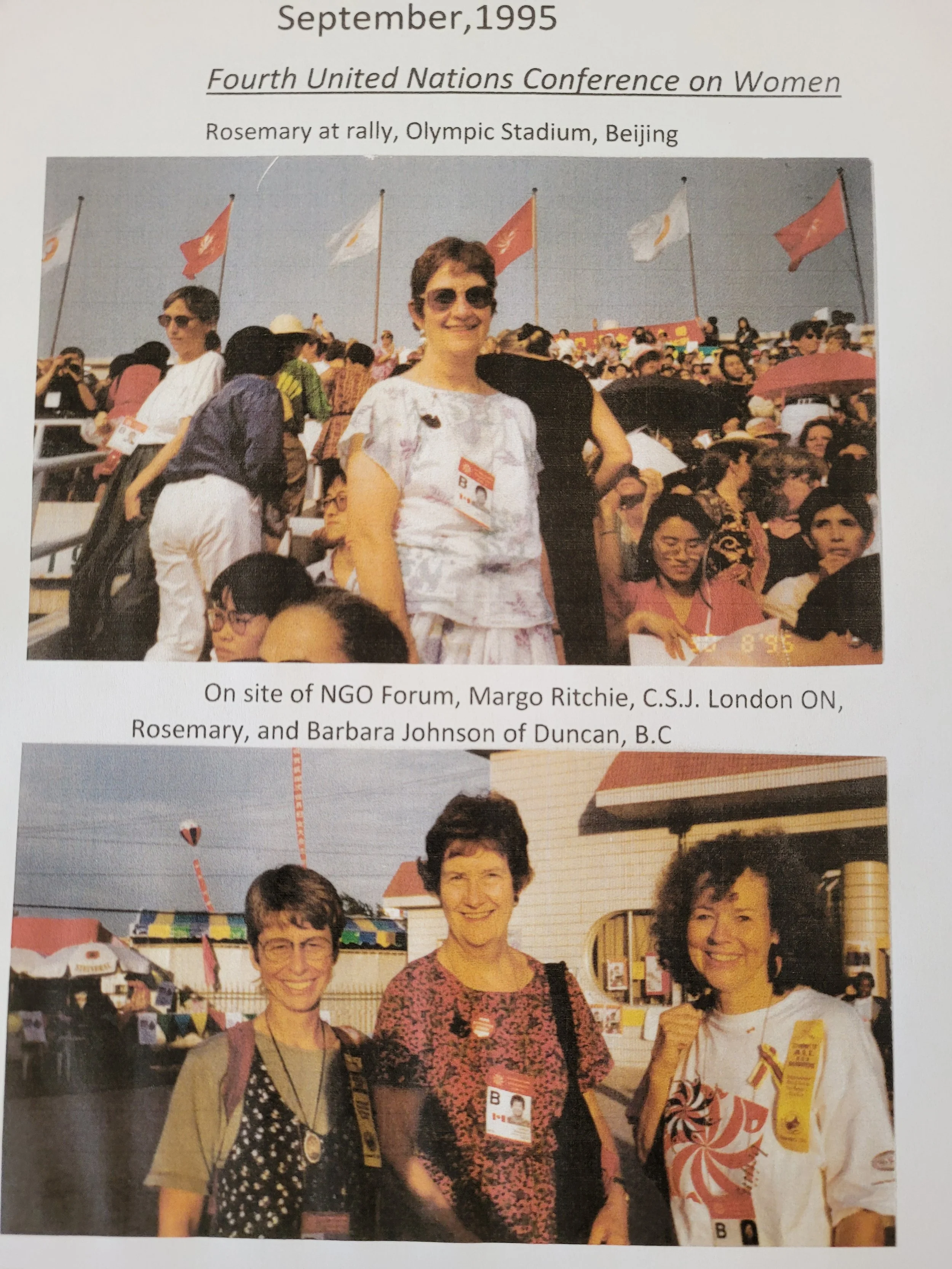
Rosemary with Sister Margo at the Fourth United Nations Conference on Women

How, other than by grace, would I have taken myself off to Montreal at age 20 to a conference of Canadian Catholic students held at the Jesuit Loyola College, and there met the splendid young man who three years later would become my husband, friend and father of our four, and then co- worker with me in the vineyards of education and international development for the next 50 years?

With all that grace poured out on me, I was bound to take up a cause large enough, global enough, to be consuming.

When I looked at the great injustices wracking our world, I came to think that at bottom, was the way female members of humanity were regarded almost universally as inferior to male members.

Sadly, this state of affairs, which justified so many attitudes and practices that were damaging and unhealthy for both and all genders, was tolerated and even encouraged by the world’s religions. ”The roots of women’s oppression are in the religions”, I heard stated at the UN Conference on Women in 1995 in China, by Muslim feminist scholar Riffat Hassan.

Catholic Christianity, the largest of the world’s religions, was blessed with powerful feminist scholars, women such as Elisabeth Schussler Fiorenza, Rosemary Ruether, Sandra Schneiders, Ivonne Gebara, and Elizabeth Johnson, all, to me, doctors of the church. I studied their work, taught it in Jamaica and in various Canadian settings, and each time the shared experience was liberating for me, my students and our faith.

I had not personally been wounded by patriarchy; my father, brothers, spouse and 3 sons were feminists, but in my various parishes over the years, I met suspicion, exclusion, criticism and diminishment.

In the 2000’s, I co-edited an independent Catholic newspaper in Toronto, Catholic New Times and that was liberating. I examined the sexual teachings of the Church and found them dismally wanting, and so joined Catholics for Choice.

I have moved into ecumenical and secular feminist circles too, and into party politics. Change is made by feminists in all these sites.

In 2018, I was honoured to be asked by Prime Minister Trudeau to sit on an 18 member Gender Equality Advisory Council to the G7, which was meeting in Quebec.

Women have been making progress all over the world: In education, health, politics, media, business, leadership, the arts, and every field. I am very proud of Canada. But progress can be temporary, especially in a right-wing surge of populism. Violence against women and girls continues, as does racism and homophobia.

Rosemary Ruether said two crucial things to me. The first was that the transformation to gender equality is a two-hundred-year project, so don’t flag! The second was that the Church is stubbornly patriarchal, so don’t spend more than 15% of your time and energy on it. Guard your psychic and spiritual resources for potentially fruitful work.

I will participate in the Synod with a kind of hopeless hope, but Sr Becquart, Secretary to the Commission hasn’t responded to my hand written letter from November, and she was heard to say that women in the church must form better priests! Not good enough, Sr Nathalie.

Rather, we will announce goodness to the world, and join with others to expand human flourishing. So we reach International Women’s Day, 2022, recommitted and strengthened by feminist theology, (thealogy), liturgy and sisterhood.

I want to make mention of WATER, Women’s Alliance for Theology, Ethics and Ritual led by Mary E Hunt and Diann Neu in Washington. Their free programs have literally carried me through the pandemic.

By Rosemary Ganley,  Feb 2022
Weekly Pause and Ponder

Weekly Pause and Ponder

A sleeping world emerges to new possibilities,

weakening winter’s icy grip, and birdsong and bleating lamb

announce to all the promise that in due season creation bursts into life.

And whilst leaves that fell in winter lie upon the ground,

soon to feed the earth, in nature’s wondrous cycle of death and rebirth,

within the tree is a stirring of new growth.