
Baking tells the Easter Story

Looking for a creative culinary activity that will teach children and others about the true meaning of EASTER?    

THE EMPTY TOMB ROLLS (also known as “Resurrection Rolls”) will not only dazzle and excite little hands but will make a lasting impact, and they taste good, too! The experience of creating these little delectables will more than fulfill your expectations. 

All you will need is:

  • 1 (10 ounce) package jumbo refrigerated crescent rolls 

  • ¼ cup sugar 

  • 1 tablespoon ground cinnamon 

  • 8 large marshmallows 

  • ¼ cup butter (melted) 

INSTRUCTIONS: 

  1. Preheat oven to 375 degrees.  Prepare a jumbo muffin pan with non-stick cooking spray. 

  2. Separate crescent rolls into 8 triangles and set aside.  Combine sugar and cinnamon in a small bowl. 

  3. Dip each marshmallow into butter, then roll in cinnamon sugar and place on a triangle dough.  Pinch dough around marshmallow, sealing all edges. MAKE SURE TO SEAL WELL OR THE MARSHMALLOW WILL ESCAPE. 

  4. Dip tops of dough into the remaining butter and then into the cinnamon-sugar.  Place roll with the sugar side up into the muffin cups. 

  5. Bake at 375 degrees for 13 – 15 minutes.  Eat warm.

  6. Open to reveal the empty tomb!

  7. Read the Easter story from the Bible found in Matthew 27-28, Mark 15-16, Luke 23-24 or in John 19-20. 

If you are not familiar with the Bible the same story is recounted by these four men, Matthew, Mark, Luke or John. The story is virtually the same but is found in these four places in the Bible.  How the rolls represent the Easter Story:

Jesus —marshmallow
After Jesus died on the cross he was wrapped in linen— roll in butter and cinnamon
Jesus put into tomb — crescent roll dough
3rd day Jesus has risen & no longer in tomb — open cooked roll to find NO marshmallow/“empty tomb”

Christ has risen. He has risen indeed!

-Sister Maureen Meloche, CSJ

Palm Sunday: Ancient Prophecy and Personal Remembrance

The Gospel of Matthew is chosen today by the Church to begin the Holy Week events leading to Jesus’ death and resurrection.  I have been reading about the juxtaposition of personal episodes that happened to Jesus as witnessed by the apostles and are rooted in the words of the Old Testament and its prophets concerning the Messiah who would appear.

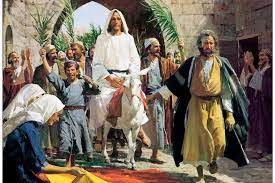
In the Palm Sunday experience, Matthew explains that Jesus, heading to Jerusalem, reached Bethphage and called for a donkey and colt in the village ahead of them. As he rode through the town, the crowds spread palm branches on the road and hailed him “Son of David! Blessed is the one who comes in the name of the Lord!”

After Jesus’ death, the disciples remembered the amazing happening along the route and recalled the ancient Prophet saying, “Tell the daughter of Zion, ‘Look, your king is coming to you, humble, and mounted on a donkey and on a colt, the foal of a donkey.’”

During the reading of Palm Sunday’s Passion narrative, Matthew includes in his Gospel several other incidents that happened the day before Jesus’ crucifixion.  Later recalling them and realizing that these events were rooted in the prophets solidified forever that Jesus was indeed the promised Messiah.

Pointing to his disciples dispersing and hiding in fear after the Last Supper, Jesus spoke of a prophecy matching their behavior: “You will all become deserters because of me this night; for it is written, ‘I will strike the shepherd and the sheep of the flock will be scattered.’ But after I am raised up, I will go ahead of you to Galilee.’” No doubt due to fear, it was some time after the crucifixion that the disciples remembered the prophecy to which Jesus had referred.

After Judas betrayed Jesus with a kiss and thirty pieces of silver, Matthew writes that Judas repented but hanged himself.  After conferring, the chief priests used the money to buy the potter’s field as a place to bury foreigners. Then was fulfilled what had been spoken through the Prophet Jeremiah, “And they took the thirty pieces of silver… and gave them for the potter’s field.”

Gospel writers Mark, Luke and John also quoted Old Testament prophecies to validate that Jesus is indeed the Messiah.  The written word of the Gospel, eyewitness accounts, the prophetic word of the Old Testament prophets and the fulfillment of the prophetic word give authenticity to Jesus as Messiah.

-Sister Jean Moylan, CSJ


Image: Unsplash/Brooke Lark

Fifth Sunday of Lent

Fifth Sunday of Lent

“I am going to open your graves, and bring you up from your graves, O my people; …I will put my Spirit within you, and you shall live…” Ezek. 37: 12,14.

 “If the Spirit of God who raised Jesus from the dead dwells in you, he who raised Christ from the dead will give life to your mortal bodies also through his Spirit that dwells in you.” Romans 8:11

 “I am the Resurrection and the Life.  Whoever believes in me, even though they die, will live, and everyone who lives and believes in me will never die.”  John 11: 25-26

Image: Unsplash

The message for this 5th Sunday of Lent holds up to us two promises: the coming of the indwelling, life-giving Spirit, and the eternal life that Spirit assures.  In the first reading, Ezekiel prophesies both the future gift of the Spirit and the resurrection to come.  Paul speaks to the early Christians living that promise in their now reality and assuring them of the life to come.  Then Jesus, raising his friend Lazarus from the dead, demonstrates the truth of his power over death, and speaks clearly that He is the Resurrection, and that all who live in him, will never die. 

Image: Unsplash/Paul Keiffer

We have heard and read these passages so often that sometimes they don’t really sink in.  Like Martha, we know and believe that we will “rise again at the resurrection on the last day”.  But do we realize that the life we will experience when that day comes is not a new life, to be given to us as a reward for living a good life here.  It is, in truth, the fullness of the very life we are living NOW, the life of the Godhead received at our Baptism.  The miracle is that by God’s free, deliberate, and loving gift, God infused the very life of the Trinity into us when, in the waters of Baptism, we were buried with Christ and rose to be a totally new kind of human.  We are now not just the wonderful stardust of the evolutionary process, but an even more amazing creature: I dare to say, the “God-dust” of a new creation, a human imbued with the very life of the Godhead.  That’s a bigger big bang than the first one! So, all our lives, from our Baptism on, our “graves are being opened” and we are rising from the dead by the power of the Spirit who has been given to us.  However, like Lazarus when he first came out of the tomb, we are alive, and yet we are still “bound” by the limits of our mortality and need to be unbound and “let go” in order to live this new life to the full.  Little by little we need to allow God and life to unbind us, to set us free and thus to reveal the wonder of the new creation that we are.  

Image: Unsplash/Pisit Heng

So, I ask: What is the unbinding that is taking place in my life this lent?  Could it be letting go of resentments?  Changing attitudes of discrimination, judgment, or non-inclusion? Seeking comfort or pleasure a little less avidly? or reaching out to unbind someone else who needs to be set free?  Whatever that unbinding might be, I invite Jesus, to come and awaken me.  Show me where I am asleep, still bound, or not letting go.  Come Jesus, call out to me, as you did to Lazarus, “come out”, so that I may live more fully the Trinitarian life planted in me at my Baptism so long ago.   

-Sister Mary Diesbourg, CSJ