

Theo of Golden, a Great Read

Theo of Golden, by Allen Levi, is an unprepossessing book, and the best book I have read in some time. It leaves you deeply touched, and somehow moved to be a little more like Theo.
Theo is an 86-year-old gentleman, possessed of a certain wealth, well-travelled in the world, who speaks five languages. For some reason known only to himself, on a certain spring day just before Easter, he moves from upscale New York City, where his office is, into the small town of Golden. He is not yet certain how long he will live there. On his first day in the town, he goes into the local coffee shop, and notices on the walls of the shop a large number of hand-sketched portraits of local people, all done in pencil, on white paper. After drinking the excellent coffee, he decides to return later, when the shop is not so busy. On his return he spends a long-time walking around the walls, gazing intently at the beautifully drawn portraits, studying both the artists fine work, and the faces he sees depicted there. There are 94 of these portraits hanging on the walls of this café - art gallery. Speaking with the owner of the café, he learns that the portraits are the work of a local artist, named Asher, whose wife was killed a while back in a car accident, and whose daughter, seriously injured, he cares for. Theo is surprised to learn that although the portraits are of local people, are beautifully done, and are for sale at very reasonable prices, so many have not been purchased. An idea is born.
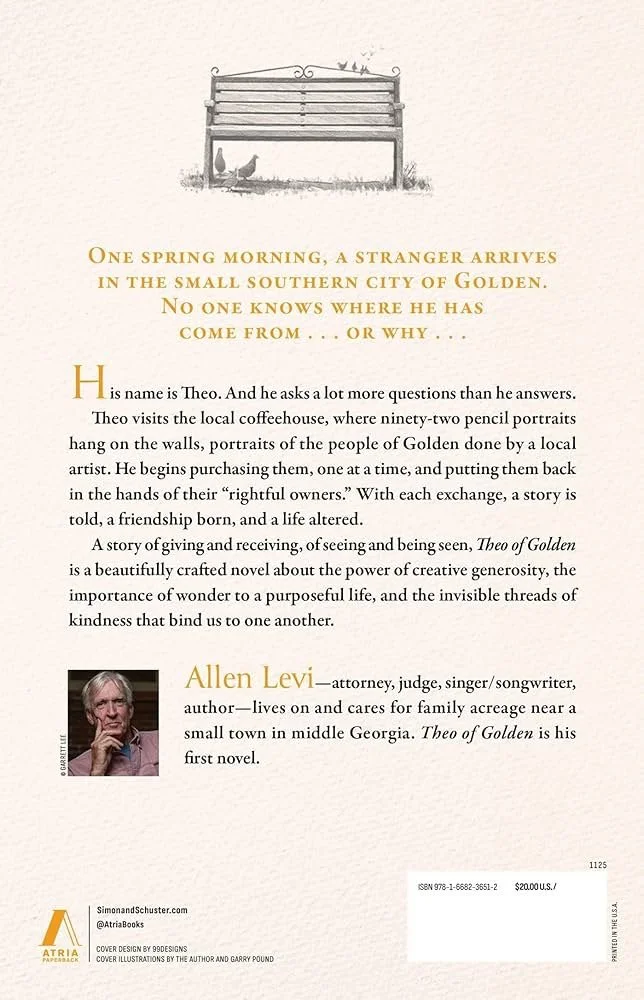
Theo decides to purchase the portraits, one at a time, and to offer each of them as a gift to the person depicted. However, he wants to meet the person involved, and so he hatches a plan. First, he buys the portrait of a young woman with short hair, familiar eyes, and an unsmiling but not unfriendly face, because that one intrigued him most. Then he writes a hand-written letter to this woman, Mrs. Minette Prentiss, whose name is printed on the back of the portrait, introducing himself, and saying that he saw her portrait in the café, and wanted to gift her with it, writing, “after all, it only seems right that the finished work should go to the one who inspired it.” He then says that he will be sitting on a bench beside the fountain in the square nearest to the café, at 7 pm on a given evening, and would be honored if she would meet him there where he could give her the portrait as a free gift. Aware that this would seem an odd request he assures her that he is a harmless old man, a widower, a father and asks nothing of her, except to meet him to receive it. After much deliberation, Minette Prentiss shows up, and is struck by the old man’s warmth, his gentle, almost timid smile, and the impact of his looking intently into her eyes. She feels that he has anticipated this meeting and now takes delight at being in her presence. There follows a beautiful conversation: she opening up her life and her heart to this very kind old man, and he truly listening intently and caringly. After presenting her with the carefully wrapped portrait, Theo tells her what he sees in her face: strength, bravery, kindness, and even some sadness, the good kind. Needless to say, after that meeting, Minette Prentiss goes home feeling a whole new sense of beauty and the goodness that is herself, and happy to have a new friend.
And so it goes, with each of the many portraits Theo purchases over the year that he lives in Golden, gradually meeting many of the local people one by one, looking intently at their portraits, and then at their faces and getting to know each of them, hearing their stories, telling them what goodness he sees in them, and leaving them with a new appreciation of themselves, and a new lease on life.
I won’t tell you the end of the story, as I hope you will read this book. After speaking about it with a friend, she sent me an excerpt from an LCWR booklet that expressed essentially what Theo had done, and how it had transformed the little town of Golden into a whole new kind of community. The excerpt is entitled “Influencing by Listening”, and the writer is Nancy Murphy, DC. of St. Louis Missouri. At the end of her excellent little reflection, Nancy writes,
“I believe we’ve been freed from our past responsibilities to have time to listen—to listen to the voice of God in our sisters and brothers--to help them realize their worth in the eyes of God. Our “influence” is not what we do but how we listen.”
Theo of Golden left me wanting to look more closely at the stories written in the faces of all the people that I interact with, and to listen more intently to their stories.
-Sister Mary Diesbourg, CSJ
Image: freestocks/Unsplash