
Celebrating a Courageous Woman

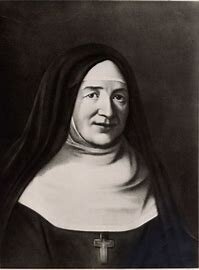
Mother St. John Fontbonne

Mother St. John Fontbonne

As we celebrate the anniversary of the death of Mother St. John Fontbonne on November 22nd may her courage and flexibility inspire us during these trying times.

Covid-19 is certainly not the first set of circumstances to threaten the lives of the Sisters of St. Joseph. We can recall the effects of the French Revolution when our Sisters, and Mother St. John, our Foundress, were imprisoned and facing the possibility of execution on the guillotine when the fall of Robespierre (1794) resulted in the release of the prisoners and the end of the Revolution. Mother St. John left few writings, what has endured are the actions and the traditions she established.

May we embrace the change that these times beckon for the good of all humanity and creation.

“From the first days of her religious life, Mother Saint John had learned to adjust her plans and dreams to respond to the needs that surrounded her. In Salesian terms, she embraced the need to continually adapt herself, ceding her personal desire, and following God’s will as it became manifest through the signs of the times. (page 67)

Instead of conceiving a plan and making it happen, she opened herself so that the plan of God could take flesh and become history - in her and in her neighbour. (page 68)”

-taken from Anything of which Woman is Capable, Volume I, by Mary M. McGlone, CSJ. 2017. Permission granted for reprint.

View the History of Mother St. John Fontbonne: Part I & II:

Enjoy the videos and music you love, upload original content, and share it all with friends, family, and the world on YouTube.


12 Steps to a Compassionate Life - A Book Review

Reviewed by Barbara Stanbridge, IHM, Detroit, MI.

Karen Armstrong, prolific author and religion historian, won a TED grant in 2008 to create a process for reinfusing our global society with compassion. Scholars from six major world religions created a “Charter of Compassion” and have been working ever since with nations and groups to sign on.

12Steps.jpg

In this brief but inspiring book, Armstrong shows how compassion is fundamental to all religious, ethical and spiritual traditions and using the scaffolding of 12 steps, lays out a process for individuals and groups to build their compassion competencies.

Each step is examined and illustrated by way of practices: learning about compassion; looking at our world; compassion for yourself; empathy; mindfulness; action; how little we know; how we should speak to one another; concern for everybody; knowledge; recognition; and love your enemies. This is not another self-help, new age book, but rather a deeply spiritual book for the spiritual seeker with the capacity for reflection. It is in the best tradition of Confucius, Ignatius of Loyola, Teresa of Avila, the Dalai Lama, Etty Hillesum, Dorothy Day, Florence Nightingale and Nelson Mandela.

Perhaps there is nothing more important for us to get a grasp of in these days of polarization than compassion. Karen Armstrong lays out a path.

-Barbara Stanbridge, IHM, Used with kind permission.

Requiescet in Pace

The loss of a loved one is painful and deep. Recently I experienced this, again for the first time, when Ted, Leanne’s husband, phoned.  That he took the time to call me personally, to tell me the circumstances of her passing, was an honour since Leanne comes from a large family which could have taken up all Ted’s time. Leanne and I had a special relationship – I can hear many others who had known Leanne much longer say so did we.  Leanne and I partnered in introducing Christian Meditation into the Hamilton Wentworth Catholic District School Board beginning in 2011.  It was a friendship of like minds and hearts. I used to say to her ‘Leanne, we are tied at the hip’ as we trotted off to school with brown bag lunches and high hope of engaging with the students and teachers. Leanne had just retired after 40 years teaching and was 20 years my junior and she used to say, ‘Sister, you make me feel young’.

For Christians, November is the month dedicated in a special way to remembering our beloved dead.  It is also the month the world honours those who made the ultimate sacrifice for country and freedom.  So I could say that Leanne’s passing was appropriately timed even though she has left a huge crater in the lives and hearts of her family and friends still on this side of the veil. I thought this evening as I prayed my evening prayers (Night Office), now Leanne you know the answer to all those questions we used to ask each other:

what does living your faith look like;

how does prayer work for you;

how do you forgive deeply and authentically unforgivable hurts?

floral image.jpg

Rest in peace my friend

- Sister Ann, csj.

Memories of World War II

war 2.png

Since I was born in 1944, a year before the end of World War II, I experienced little of the effects of those historic six years. My mother gave birth to five babies during that time and my father, who worked the family farm, was considered an essential worker in the war effort and remained home to till the land.  Furthermore, none of my uncles served overseas. 

I knew that most soldiers were young, single, able-bodied, healthy men who were shipped across the ocean to fight in a war about which little was known. To increase my own store of knowledge on life on the home front during the arduous years of 1939-1945, I turned to the recollections of our Sisters living here in London.

I often heard Sr. Mary Eunice speak of the unique time she had dancing with the soldiers preparing to be shipped overseas to fight.  On Fridays at 3:00 pm, a bus arrived at the prominent London Life Insurance building which employed many young women.  A group of them boarded the bus that would take them on a two- hour trip to RCAF Station Trenton (now CFB Trenton) training base, located within the city of Quinten West.  What followed was dinner with the soldiers and evenings of fun, dancing, and socializing with young single men who missed home and the girls they left behind.  This excursion continued for several years with great success.

war3.png

Sister Lucy recalls vividly her mother knitting socks for the soldiers while caring for her eleven children.  Lucy and her classmates at their little Josephsburg country school collected and filled huge onion sacks of milkweed pods for the war effort. The buoyancy of the milkweed floss was used as raw material for life preservers needed for its airmen and sailors.

Ed and Betty Morgan speak about her wedding dress, which was sewn from a German parachute Edwin sent home from Europe during World War II. The dress was incl...

In a similar vein, silk was in short supply during the war years. Therefore, many an innovative bride wore a gown made of silk parachute material (see video, right) that the soldiers brought home from overseas. There were other inconveniences in daily life, including a scarcity of much-needed items. Food rations and tickets for sugar began in January 1942 followed by coffee, tea, and butter by the end of the year.

Sr. Rose’s only recollection of the war was as a 6-year-old riding the train with her mother.  A young soldier gave her a dime.  She was rich!  No doubt, she reminded him of little sisters he had left at home.  Her own eight brothers were too young to sign up for the war.

It takes Remembrance Day to visit dimmed memories of difficult days buried in aging minds.

As I chatted with various Sisters, I could see their eyes grow bright and spirits animated as my questions stoked memories of over 70 years ago.  It takes Remembrance Day to visit dimmed memories of difficult days buried in aging minds. Sr. Joan was full of vivid recollections that came tumbling to the surface as she recalled St. Mary’s Elementary School on the outskirts of Brantford.  It was smack in the middle of a huge army camp - “Army Camp 29”.  She grew up surrounded by young, gun-carrying soldiers marching the two-mile route down the street, past St. Mary’s on Colborne Street, and into the neighbourhood in all kinds of weather.  By age ten, Joan was marching home from school with them: left, right, left, right down the street.  Sometimes, they even let her carry a gun.

Being United States citizens at the time, Sr. Kateri’s brother entered the war in 1942 after Pearl Harbour was bombed on Dec. 1941.  After enlisting, he trained in the signal corps and was sent overseas with SHEAF. Sister remembers her mother’s anxiety, always fearing that the mailman would arrive with dreaded news.  Fortunately, the war ended, and her son arrived home safely in the late fall of 1945. 

Today, in 2020 we mark another November 11th, another Remembrance Day.  The world teeters on the brink of disaster at every turn.  It is time to look back in praise of so many who sacrificed so much to make us free.  Let us pray that somehow peace will prevail in our country and in our fractured world.

-Sister Jean Moylan, csj