

We will soon be celebrating the statutory holiday known as Labour Day which always falls on the first Monday in September. Most of us think of it only as the end of the summer holiday season or the end of the season for wearing white. Google helped me go back to the origins of Labour Day.
In 1869 labourers were required to work 12 hours a day. A movement began in Hamilton, Ontario called the “Nine-Hour Movement,” to advocate for a shorter work week. The request of this union spread to Toronto where the demands for a shorter work week were refused by the owners of printing shops, “most vehemently by George Brown of The Globe.” By 1872 the request had turned into a demand and finally a threat to strike, resulting in a printers strike on March 25.
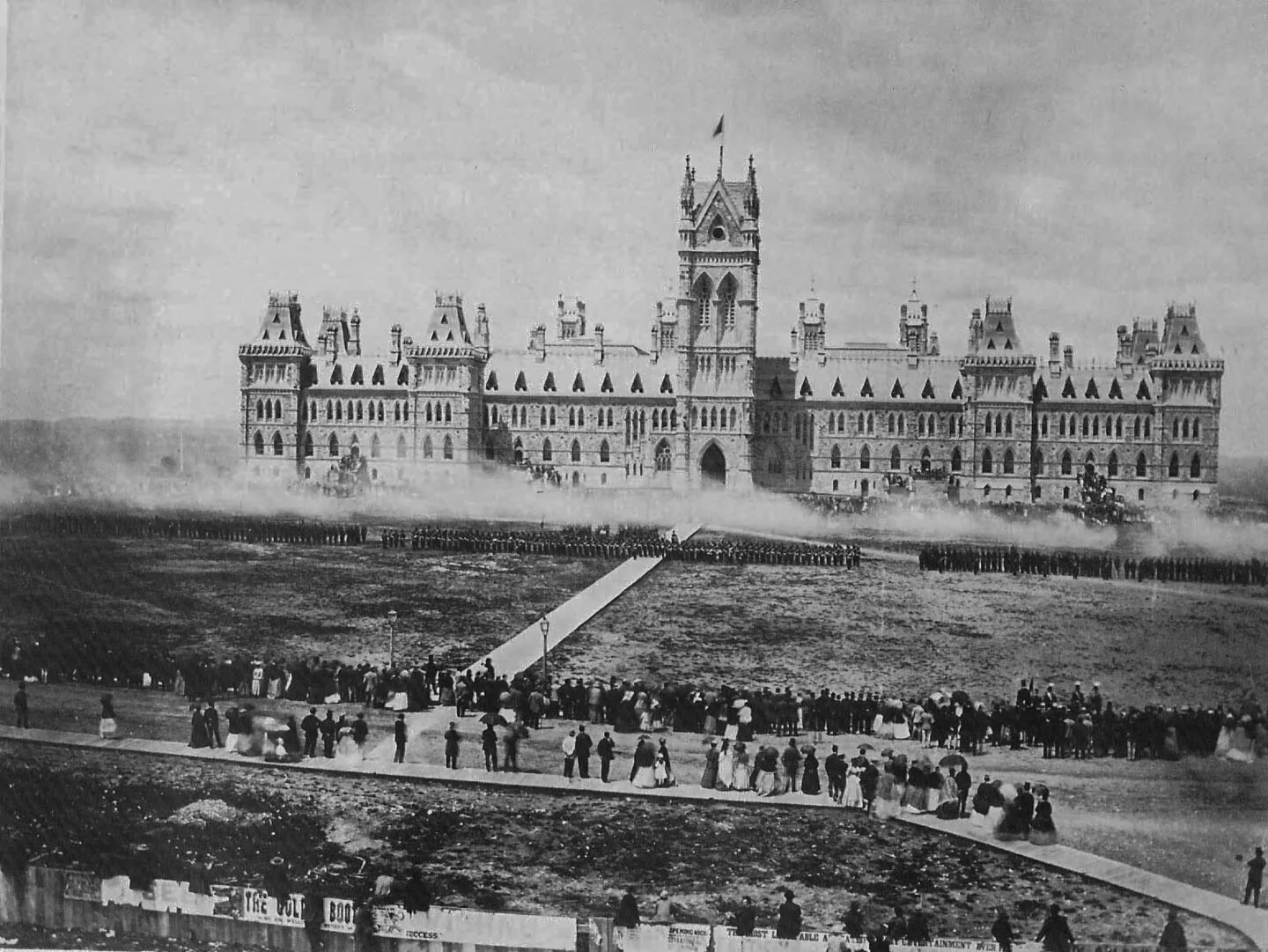
A series of protests, dubbed the Nine Hour Movement, led to the government enacting The Trade Unions Act, which, for the first time, made unions legal in Canada. (Photo: Parliament Hill, Ottawa. Wikimedia Commons/Library and Archives Canada. C-002837.)
To show solidarity with the printers’ strike, 2,000 workers in Toronto paraded through the city led by marching bands. The parade ended at Queen’s Park and had increased to 10,000 sympathizers. George Brown fought back by accusing and successfully jailing members of the strike committee for breaking a Canadian law of 1792-making union activity a criminal offense.
Sir John A. Macdonald embarrassed George Brown by passing the Trade Unions Act on June 14, legalizing and protecting union activity and rescuing the strike committee from prison. Macdonald became a friend of the working class.
The movement spread and so, on September 3, 1894, 3,000 workers met on Market Square in London, Ontario which was acknowledged to be the first nationally recognized Labour Day in Canada. According to Craig Heron and Steve Penfold in their book entitled The Workers’ Festival: A History of Labour Day in Canada,“the first union contingents headed off down the city’s main streets under the blazing noonday sun. Leading the way was a group of seventy-five butchers on horseback, who set the tone of respectable craftsmanship with their crisply white shirts and hats and clean baskets on their arms….”
With this bit of new-found knowledge, I intend to pay more attention to the first Monday of September and pray that workers will find a way to survive the downward trend in the job market. Difficult decisions are being made by business owners; workers are facing the possibility of jobs losses. The experience of COVID was a bit of preparation for what the future holds for workers and now we see Artificial Intelligence making its debut on the horizon. The labour-force survived the Industrial Revolution and I believe the creativity of the human soul will help us evolve our way through the AI revolution.
-Sister Elaine Cole, CSJ

