
Articles

Boundaries and Bridges

Science and religion can be bridged. Michael Dowd, author and evolutionary evangelist interviewed Richard Rohr, a Franciscan who leads the Center for Action and Contemplation in New Mexico. The interview focused on the evolution of the Christian tradition and on science.

Richard Rohr suggested that science can be empirical theology, i.e., things in their bare existence become revelation - that we all share a global heart with care and commitment to a larger global life on which we all depend. Science need not be an enemy. It can teach us not only relative truth, but humility, patience and willingness to live with less certitude in always anticipating further insight and development. The cosmic dance is a global dance not only a sacred dance for my group - we must stop seeing our religion as in competition and instead see ourselves and Christianity as gift.

Richard Rohr goes on to say that our pioneer Jesus crossed boundaries and built bridges. He was inclusive. We “Catholics” in his honour became exclusive. Too long have we been tribal and addicted to group think whereas there is one God for all. Even atheists have a role helping us evolve by rejecting gods that are unbelievable. Richard Rohr’s alternative is to see Jesus, not as exclusive, not as a product, to be reproduced thus setting up boundaries. Instead, he suggested, “be Jesus” and be pioneers who build bridges. Bridges to what?

The sciences are discovering that there are no boundaries because there exists an interconnectedness at levels not available to the naked eye. Yet that is not what most humans at this point in history believe or accept.

Watch The Science of Interconnectedness  


Interconnectedness already exists. We, as humans need to wake up and “realize” it. Moreover, we also need to help one another wake up.  

Do you want to ‘wake up’, to help change our world? 

If so, you are invited to the Symposium “Becoming Agents of Evolutionary Change” July 4-6, 2014. Carter Phipps is the keynote speaker and will be presenting with Sue Wilson, CSJ.  Click HERE for more information.

Stay tuned for Part 2 of this blog.

Mary Vandersteen, csj and Ann Steadman, Associate


The resurrection to which Easter calls us....

The old news about Easter is that it is about resurrection. The new news may be that it is not so much about the resurrection of Jesus as it is about our own. Unfortunately, we so often miss it. Jesus, you see, is already gone from one tomb. The only question now is whether or not we are willing to abandon our own, leave the old trappings behind and live in the light of Jesus, the Christ, whom the religious establishment persecuted and politicians condemned. It is the greatest question of them all in a world that practices religion as an act of private devotion and sees law and government as an arm of God.

The resurrection to which Easter calls us — our own — requires that we prepare to find God where God is by opening ourselves to the world around us with a listening ear. This means that we must be prepared to be surprised by God in strange places, in ways we never thought we’d see and through the words of those we never thought we’d hear.

We must allow others — even those whom we have till now refused to consider — to open our hearts to things we do not want to hear. We must release the voice of God in everyone, everywhere. It means
putting down the social phobias that protect us from one another. It requires that we clean out from
our vocabulary our contempt for “liberals,” our frustration for “radicals” and our disdain for
“conservatives.” It presumes that we will reach out to all others — to the gays and the immigrants and
other races, to the strangers, the prisoners and the poor — in order to divine what visions to see with
them, what cries to cry for them, what stones to move from the front of their graves.

That will, of course, involve listening to women for a change, seeing angels where strangers are,
emptying tombs, contending with Pharisees and walking to Emmaus with strangers crying, “Hosanna” all the way.

Easter is not simply a day of celebration: It is, as well, a day of decision. What is really to be decided is
whether or not we ourselves will rise from the deadening grip of this world’s burnt-out systems to the
light-giving time of God’s coming again, this time in us.

Then the Easter Alleluia is true: God is surely “with us.”


“Ideas in Passing” from Joan Chittister:  Easter 2010

http://www.benetvision.org/Ideas_In_Passing/04_05_10.html


Good Friday’s Reflection

Good Friday invites us to set aside our regular routines to enter a sacred time of quietness and reflection. Today beckons us to delve deeper into the depths of the unfathomable Paschal Mystery, the life, death and resurrection of Jesus. We are invited to see its sacred cycle inherent in the very pattern of our lives within our personal ups and downs. Our prayer seeks to draws us reverently into this mystery. The events of the Passion are an integrated segment of a whole: part of the unfolding mystery of God’s design. Thoughts can easily go awry if we too narrowly try to find the meaning of Jesus’ death apart from his ongoing incarnation and resurrection.

I propose that one might consider the writing style of Matthew, Mark and Luke akin to reporters of the daily news. Whereas, John’s approach more closely resembles the writing style of a documentary writer who wishes to convey to his audience a central message.

Sandra Schneider describes John’s central message in this manner:

“In the fourth gospel, events are not put forth in terms of sacrifice or retribution but in terms of self-gift: God so loved his own in the world that he laid down his life for them. Jesus’ self-gift was an act of friendship: “no longer do I call you servants…you I have called friends.” John’s gospel’s trilogy of –life, light, and love- captures [this] entire dynamic.”

In God’s unfolding design the Word became flesh and lived among us. Jesus graciously took upon himself all that human life entailed. Faithfulness to his mission and message brought him face to face with opposing forces. Opposition strong enough to demand a death sentence with capital punishment meted out in accordance with the methods of the day.   

We should not be too myopic in our view of Jesus’ death on the cross but see it in the context of Jesus’ whole life. Let us rather treasure the image of the crucified Jesus not as one defined moment, but as a sacrament of Jesus’ total life among us, Jesus’ fidelity to his mission without limiting the cost, and our example of a life of total self-gift.

Nancy Wales, CSJ


We Are God`s Tents

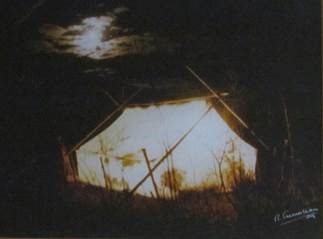
As I sit in my office awaiting a client, my attention is drawn to this picture on the wall before me. It was given to me as part of a >thank you’ gift at the conclusion of a weekend retreat. The givers of this gift will never know the depth of meaning this picture has for me.

It is a powerful reminder of a profound insight I received many years ago when I was studying Scripture. In the Book of Kings we read that AGod pitched God=s tent among us@ (1Kings 8) and as our professor stated, “and never took it up again”. The word used for God in this passage is “Shekina”- a feminine word for God. - the ONE who gives life to and dwells within each one of us. We carry Sacred Presence within us whether we know it or not. But what a gift it is when we are cognizant of this reality as we make our way along life`s path with its various twists and turns.

This Indwelling Presence of the Divine has become the heart and centre of my spiritual life, and the One to whom I turn when my ego suggests less loving reactions to the person(s) or situations before me. Shekina, thank you for your abiding Presence.

Doreen Kraemer CSJ

Connecting the Dots: More Oil Out-Faster Climate Change

From time beyond memory, rivers and streams have created networks across this land. In recent centuries roads and rails have woven new networks crossing over, and sometimes under, these rivers and streams. Today, a whole new network is being created. It is a network of pipelines that will criss-cross nearly every province and territory. Perhaps you have heard of the proposed Northern Gateway Pipeline in British Columbia, the Keystone XL line through Alberta and Saskatchewan extending into to the United States, the risky reversal of Line 9 from Sarnia eastward, or the proposed Energy East Pipeline project. The later will convert Trans -Canada’s 40 year old gas pipeline to an oil pipeline to carry diluted oil to ports in eastern Canada and beyond that to other countries. New pipelines are being considered to travel through parts of the three Prairie Provinces, southern Ontario, Quebec and New Brunswick. This proposed and already- partially- existing network will create a greater threat to our streams, rivers, lakes, underground aquifers, and oceans than anything previously developed.   We need only to connect the dots to see this network. All of the earth community, including humans, are increasingly at risk.

  • We, Sisters of St. Joseph, value the sacredness of creation in all its life-forms.
  • We acknowledge our call to tend to creation with respect, love and honour.
  • We recognize that every form of life offers its own unique gifts and vulnerability.
  • We recognize our responsibility to protect water, land, plant, animal, and human life.

Despite promises of effective new technology for prevention and clean-up of spills or leaks, we believe that increased oil production and transportation threaten to pollute and destroy life.  We call ourselves and others to connect the dots. Doing so will reveal the relationships between this network of pipelines, the consequent increased tar sands/oil sands development, increased global carbon emissions and more rapid and potentially destructive climate change.

We live in a society that values personal material profit and benefits over the common good and over the principles of equality and the sacredness of life. As a society we do not know or acknowledge when enough is enough. Neither do we recognize the reality of limitations to the earth’s physical resources. We accept behaviour that ignores the needs of future generations and dismiss the incredible, irreversible extinction of life currently occurring.

When will we have the wisdom and courage to really connect the dots, to limit our use of oil and oil-based products, to recognize ‘enough’?

Priscilla Solomon CSJ
Federation Ecology Committee