
Guest Bloggers

Archivists Meet at Historic Conference


Archivists and leaders from across the U.S. and Canadian Federations of the Sisters of St. Joseph.

Last month archivists, historians, and leaders convened on the Boston College campus to discuss the major issues surrounding Catholic archives across the world. Meeting from July 11-July 13, the "Envisioning the Future of Catholic Religious Archives" conference gave various groups a chance to exchange ideas and best practices while stressing the importance of preserving the future of Catholic religious.


According to the conference committee, this type of conference is a first of it's kind for Catholic religious archives. The conference included presentations, discussion groups, and break-out sessions that helped tailor the conference to each individual's concerns and interests. Note-takers were present at each session and table during break-out sessions to ensure that unique ideas were recorded. The conference's main goal was to be a "working conference," allowing archivists, historians, and leaders ample opportunity to use their expertise to spark new conversations surrounding a variety of topics.

One of the most important and central questions posed during the conference came from Kathryn Oosterhuis, archivist of the Mercy Heritage Center of the Americas. During her presentation, Oosterhuis posed the question "What do we want our legacy to be?" Continuing, she reminded the audience that archives are a key part of religious communities' enduring legacy.   
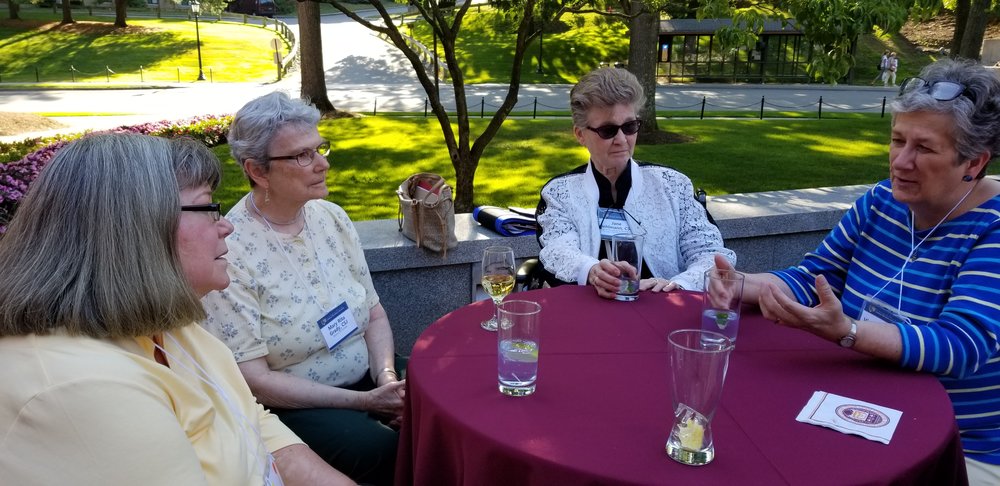
 

Pictured: Mary Kosta (In Canada), Sr. Mary Rita Grady (Boston), Sr. Jane Behlmann (St. Louis- Carondelet), and Virginia Dowd (Brentwood) talk best practices with their archives.

The conference included plenty of input and participation from the Sisters of St. Joseph family from both the U.S. and Canada. Attendees were first greeted by Carol Coburn, Ph.D., the director of the CSJ Center for Heritage, Spirituality, and Service at Avila University. Lisa Gibbon, archivist for the Congregation of St. Joseph, hosted a lightning round about the creation of collaborative and charism-based archives.  Coburn also spoke during the lightning round offering her perspective on the importance of congregational and community histories.


Members of the CSSJ family also in attendance were: Sr. Jane Behlmann, archivist for the St. Louis- Carondelet province; Virginia Dowd, archivist for the Brentwood congregation; Sherry M. Enserro, archivist for the Springfield congregation; Sr. Mary Rita Grady, archivist for the Boston congregation; Sr. Patty Johnson, director of the U.S. Federation of the Sisters of St. Joseph; Mary Kosta, archivist for the Congregation of the Sisters of St. Joseph in Canada; Adonna Thompson, archivist for the Martha Smith, CSJ, Ph.D. Archives and Research Center, which houses the U.S. Federation's archives; Kathleen Washy, archivist for the Baden congregation; and Kristen Whitney Daniels, the assistant director of the U.S. Federation.

In the coming months, the conference hopes to release a "white paper" regarding best practices for Catholic archives. Using the notes from the discussion groups and presentations, conference committee members will utilize the input "to flesh out a national, even global strategy for preserving and providing access to the precious archival heritage of Catholic religious congregations and communities," according to conference staff. The white paper is expected to be available to the public following its release.

[Kristen Whitney Daniels is the assistant executive director of the U.S. Federation of the Sisters of St. Joseph]


Water: source of life, source of empowerment

Sisters of St. Joseph in Canada partner with SOPAR - a Canadian international development organization - to bring upon change.

It’s hard to believe but close to 800 million people on our planet do not have an easy access to drinking water. What does this mean? It means that these people walk long distances every day to fetch water. It might be 1, 3, or 5km. Back and forth. And back again to get some more. The water they collect is often contaminated leading to an array of diseases and health issues. The World Health Organization says that 340 000 children under five die every year from diarrhoeal diseases due to unsafe drinking water, poor sanitation and poor hygiene. Many water sources in the villages where SOPAR works face an extra challenge: they contain quantities of fluoride that surpass acceptable limits. Prolonged consumption of such water is known to cause serious damage to bones, joints and teeth.

Access to water is one of SOPAR's key programs. Our goal is to raise awareness on health and hygiene issues related to water. We help villagers get an easy access to water by building borewells and by installing water purification systems in needy villages.

Laxmi, pictured to the left, is one of the children touched by our Water Program. Laxmi lives in a small village in India’s state of Andhra Pradesh. She is 14 years old. Neighbors say that she is a brilliant and hardworking girl. She loves going to school and dreams of becoming a teacher.

Laxmi is an only child. She helps her mother with all the house choirs. Her biggest task is fetching water. Up until now, she was going to draw water from a well located 2 kilometers from the village. She had to do several trips every day to get enough water for her family’s needs. To arrive in time for school, Laxmi had to get up at 4 o'clock in the morning. Most days the queue at the well was very long and she would arrive 1 or 2 hours late at school.

Up to now, SOPAR has helped more 3 million villagers like Laxmi to get an easy and affordable access to water. But that is not all…

We believe people must participate actively and take ownership in all stages of their development, from needs assessment to finding solutions for their own problems. At SOPAR, it’s more than just building a well… We get villagers to invest time, energy and money in their projects. We support the creation of elected local committees that play a determining role in the projects’ management. And so, our Water Program acts as a catalyst in communities. Mobilized, trained, and proud, villagers are inspired to lead other needed development initiatives in their community. - Janice Aubry, Program Manager


Bishop’s Dinner Acknowledges Sisters’ Sesquicentennial

Last month, on June 13, 2018, in honour of the Sisters of St. Joseph’s 150th anniversary in the Diocese of London, twelve Sisters represented the Congregation as guests of Bishop Ronald Fabbro, host of the 10th annual Bishop’s Dinner for London and surrounding communities.

A crowded London Convention Centre twinkled in candlelight as supporters of the works of the Roman Catholic Diocese of London gathered in a celebration of faith, friendship and charity.  Prior to settling into the festive meal, Bishop Fabbro addressed the participants with thanks and appreciation.  He lauded the Sisters of St. Joseph for their 150 years of service in the diocese and far beyond its confines.  He gave a brief sketch of their beginnings when 6 Sisters arrived by train from Toronto to London on Dec.  11th, 1867.  He outlined the congregation’s rapid growth and variety of ministries and founding of many missions in the diocese and beyond its borders to Edmonton, The NorthWest Territories, etc.  The bishop highlighted the community’s adaptability following Vatican II in the sixties when the needs of people saw the congregation[j1]  move from more traditional works in healthcare and education to many forms of assisting the poor in soup kitchen, work with immigrants, detox centre, social justice initiatives and a myriad of other ministries.  In addition, the sisters answered a call from the bishop, a mission was opened in Peru where the Sisters served for almost 50 years alongside volunteer priests from the Diocese of London. As Bishop Fabbro ended his tribute, the Sisters stood and were acknowledged with grateful applause and standing ovation.

Following dinner, six diocesan priests who chose the name “Vocati” performed light-hearted and beautifully stirring hymns to the delight of the crowd. Our own Sr. Loretta Manzara and Celine Murray provided piano and violin accompaniment respectively.  Many cameras were trained on the performers who on a special June evening made a name for themselves.         - Jean Moylan, csj


 [j1]Ove fo

Café Scientifique, A Free Community Event

"Café Scientifique" are events known for their informal and friendly atmosphere. Café Scientifique aims to demystify scientific research for the general public and empower non-scientists to more comfortably and accurately assess science. (Source: Wikipedia)

 Bedside to Bench:  Health Research with Real-Time Benefits       

On June 25, 2018, Dr. Arlene MacDougall moderated a panel of three researchers from London’s Lawson Health Research Institute (the research institute of London Health Sciences Centre and St. Joseph’s Health Care London) who gave presentations on their work in slowing the decline of neurodegenerative diseases.  The researchers use their experience with patients to shape research activities, and to directly apply what they discover to improve their patients’ lives.  Café Scientifique provided an opportunity for health practitioners and interested community members to learn about new discoveries and question the researchers.  

Dr. Jennie Wells clinical and research work involves Alzheimer’s Disease and Geriatric Rehabilitation. She focuses on the potential for non-drug interventions, such as diet and exercise, to slow down the progression of dementia.  As well, Dr. Wells is the principal site investigator in a study of drugs used to treat dementia, mild cognitive impairment and subjective cognitive impairment. 

Dr. Elizabeth Finger described her work in delineating the cognitive and neural systems that are affected in patients with frontotemporal dementia, related disorders, and the patients’ at-risk family members. She noted that persons who suffer from rheumatoid arthritis have an increased risk of developing Alzheimer’s disease.

Dr. Mandar Jog fascinated the audience with illustrations of patients with Parkinson’s’ Disease walking on a specialized mat.  Telemetric data collected from the mat was turned into walking stick figures that illustrated the patients’ gait, e.g., speed, length, pauses, and varied weight of steps along the length of the mat.  Tremor disorders affect a significant number of people and these also can be analyzed by telemetric monitoring and treated.   Application of this research has led to effective treatments.  For example, injection of botulinum toxins in the brains of patients with Parkinson’s Disease results in improved gait.

I came away from Café Scientifique with useful knowledge:  Twelve minutes of meditation a day reduces inflammation of the brain in persons at risk of neurodegenerative disease.  Tai Chi, which combines elements of resistance training, aerobic exercise, and meditation has a triple beneficial impact. But most of all, I was awed by the quality of research being done in London’s Lawson Health Research Institute and the passionate dedication of researchers who spend far more than forty hours per week exploring ang applying knowledge that benefits humanity.  I hope that our government and individual donors will continue to support the health research taking place in London. - Sister Patricia McKeon

Water as a Human Right: water access is divided both locally and globally

As a Blue Community, the Sisters of St. Joseph are raising their awareness about who has clean water and who does not. Social and political inequities are magnified by water. Even though water is foundational to life, it remains exclusive based on wealth and white privilege. Let’s look at this issue for Canada, the Great Lakes, and globally to understand why this the human right to water matters and how we can collectively ensure that everyone has water for drinking and sanitation.

Canada is blessed with over 20% of the world’s freshwater. Accessible freshwater (not frozen in glaciers) makes up less than 1% of all water on mother earth. Zooming into a map of Canada reveals a vast network of water arteries feeding all life in its path. Canada is also one of the richest countries in the world. Ranked #38 for population (almost 37 million people) we rank #8 for top wealth (with 6.4 trillion in wealth). Yet too many people here go without clean water.


The image left is a crisis map. In Ontario alone, there are 80 First Nations living with a Drinking Water Advisory (DWA). These DWAs are a combination of Boil Water advisories, Do Not Consume advisories, and Do Not Use advisories (read about the differences). Based on Canada’s wealth, it’s hard to believe that some people in Canada can not do what most take for granted – turning on the taps with trust. This is not a recent crisis. Some First Nations have not had access to clean water for decades.

Canada does not have consistent and enforceable drinking water standards. Those not living on a First Nation reserve have Provincial water rules and layers of government infrastructure support. First Nations fall under the jurisdiction of the Ministry of Indian Affairs and Northern Development and this Federal support is chronically neglected. On March 22, 2016 (auspiciously World Water Day) new Prime Minister Justin Trudeau announced $4.6 billion for new infrastructure in Indigenous communities over the next five years. This includes money for water and wastewater systems. This Human Rights Watch article explains the issues and comments more. The Trudeau government has promised to end all DWAs, but the progress has been flat and The Parliamentary Budget Officer has estimated that this spending meets only 70% of the total amount required.

The David Suzuki Foundation and the Council of Canadians put out a report called Glass Half Full to evaluate the Trudeau promise. Not only is this Federal promise far from being on track, there are increased fears of the funding gap being closed by water privatization. One way to monitor the updates is by visiting the Water Today maps. Here is a sample of current DWAs for southern Ontario:


Ecojustice has also researched this human rights crisis and makes the following observation:
Being unable to use the water in your home isn’t simply an inconvenience, it is something that poses a serious threat to one’s health and quality of life. Studies have shown that communities that lack access to safe, clean drinking water face significant health risks, including elevated rates of waterborne illnesses, pneumonia, influenza, whooping cough, and other infections. The long history of the drinking water crisis in Indigenous communities is an egregious injustice, and the fact that it has gone unaddressed for so long is unacceptable.

It serves to perpetuate and contribute to existing disadvantages faced by Indigenous peoples in this country due to the ongoing effects of colonialism and systemic racism.

The Council of Canadians is leading a Water Drop letter-writing campaign. Print off this letter template in the shape of a water drop and tell PM Trudeau to keep his promise. Our Federation’s Congregations also call the Great Lakes watershed home. We live, pray, and serve within lakes Superior, Huron, Erie, and Ontario. But some of our water neighbours in the United States are denied water because of price, pollution, and systemic discrimination.


From 2014 to 2017, over 100,000 homes have been denied water. Daily acts of refreshment, sanitation, and feeding are denied because of unaffordable water bills.

Earlier this year, Detroit's Water and Sewerage Department began turning off water utilities for overdue or delinquent accounts. Since April, the department has cut off the water for nearly 3,000 households per week — meaning roughly 100,000 Motor City residents are without water. Entrenched at the bottom of Detroit's current economic crisis, many of those without water are the city's poorest resident. The city’s shut-off campaign has garnered international press attention, and has been called “an affront to human rights” by representatives of the United Nations. VICE News traveled to Detroit to see first-hand how residents are dealing with the water shut-offs, speak with local government representatives about the issue, and discuss possible resolutions with activist groups. Watch the video here


In Detroit, a Great Lakes city bordering 20% of the earth’s 1% freshwater, hundreds of thousands of people are having their water and rights taken away because the City is drowning in a confluence of municipal, racial, and wealth issues. Once servicing 2 million people, the flight of manufacturing jobs has depopulated the city down to 700,000 people. Not only are these remaining people the ones less willing and able to leave, they now have to pay for that major waterworks system with their minor funds. People have to choose between buying food and buying water.


Combined with systemic racism and water privatization, downtown residents pay some of the highest water utility bills in the USA even though they are some of the poorest people in the country. People are fighting back. Detroit’s People’s Water Board Coalition is just one of many groups coordinating water access, policy change, political accountability, and community action.

Hear more voices affected by these shut-offs. Before the crisis, one woman was paying $60 for three months. Now she needs to pay $100 for one month.
But it’s not just Detroit in crisis. Over 5,000 children in Flint Michigan have been poisoned with lead in their water. This 2011 -- 2017 CNN timeline describes the series of system failures that switched Flint’s drinking water source, ignored public alerts, sacrificed human health, and still demands people to pay for their poisoned water. This on-going struggle for clean water also impacts people’s heath and trust in public institutions -- impacts that will last decades.

This CBC report shows the personal and political affects.

A recent Michigan Civil Rights Commission report concluded that “decisions would have been different had they concerned the state’s wealthier, predominantly white communities.” This same Toronto Star article reported that:

“Flint resident Claire McClinton said she’s grateful for the efforts but finds the report “underwhelming.” She said the emergency manager law needs to be abolished, the Army Corps of Engineers should replace the old pipes, and Medicare needs to be made available to “all impacted residents.”

At a water justice gathering in the Fall of 2017, McClinton said, “In Flint Michigan, you can buy a gallon of lead free gas, or a gallon of lead free paint, but you can’t get a gallon of lead free water from your own tap.
The human right to clean water is also a global issue. In 2010, the United Nations agreed that clean water and sanitation is a human right. The infographic below helps tell the story with 2.6 billion people denied basic sanitation and 884 million people without clean drinking water. 


This Circle of Blue map shows where the human right to water is most critical.

In 2010 the United Nations General Assembly passed a resolution that affirms the human right to clean water and basic sanitation. After originally abstaining from this vote, Canada agreed to this resolution in 2012. According to the Safe Drinking Water Foundation:

The government is obliged to ensure that people can enjoy their basic human rights. There are three levels of obligation. First, the government must respect the right, and not do anything to interfere with the right. In the case of drinking water, this means that the government cannot deny anyone access to safe drinking water.

The second level of the government’s duty is to protect the right, by preventing third party interference. For drinking water, this may involve the establishment of legislation that prohibits manufacturing companies from polluting drinking water.

The third level of obligation is to fulfill the right, when necessary. In the case of drinking water, this may require the government to establish a water treatment plant or construct wells to provide safe drinking water.

What does this issue obligate you to do? How can we amplify this human rights message to a wider audience? - Paul Bain c/o Blue Communities Now