
Guest Bloggers

Thoughts on the Summer Solstice

There’s Fire in the Heart

Passion and Compassion Thrive

An Alive Human

Fire in the Heart haiku - Gurunam Khalsa (2003)

Empty yourself continually in honor of the Incarnate Word who emptied himself with so much love for you (Phil.2:7).
Make your commitment to live in the practice of the most sincere, true and profound humility possible to you. 
— MAXIM 3

Many suns have passed since I was young and filled with unbounded enthusiasm. At that time, gatherings with friends centered around exploring issues like the feminine face of God, women’s spirituality, and our role in the Church. Though engaged in social justice work, the group also created opportunities for personal reflection and even solstice celebrations.  Both summer and winter solstices held different energies. We all did too.

IMAGE: Unsplash/Isi Parente

Burnt into memory is one particular Summer Solstice when members of our group gathered in the large garden of a friend to celebrate this zenith moment of the year around a solstice fire.  Did we know that jumping over the flames was supposed to bring us good luck and rid the soul of evil? That doing it three times would make the ritual even more powerful. And the higher the jump, the better?

As we partook in a potluck dinner together – each dish a reflection of the taste, skill and inventiveness of the individual cook – we reflected on the joy of being one despite a diversity in age, religious background, body type and sexual preference.  We were simply a group of women, gathering to celebrate our value and role in society. With wild abandon, the fire jumping began. Oh, it felt good until one of us twisted her ankle and fell, luckily not burning herself or her clothes but twisting her ankle quite badly. Frenzied fun gave way to anxious concern as we rushed to attend to her needs.
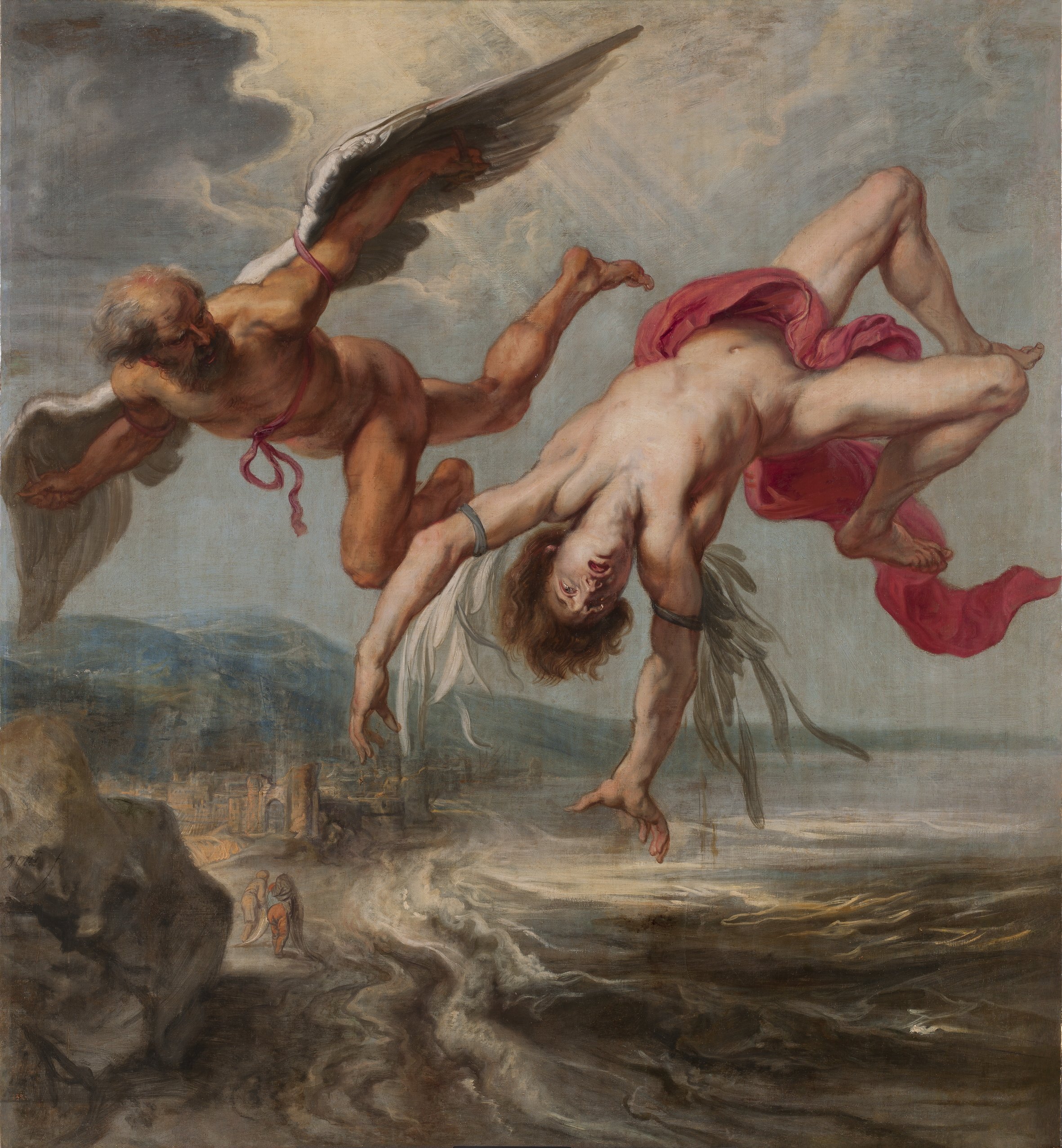
Jacob Peter Gowy's The Flight of Icarus (1635–1637)

Hints of the Icarus myth invade my mind: Icarus, though advised by his father to neither fly too high to the sun nor too close to the seas to escape imprisonment, instead soared high and beyond, so close to the sun that the beeswax holding his wings together melted from the heat. Perhaps it was fear that motivated him or a sense of his own strength and will but regardless, his actions were guided from within and not from a place of trust in his father.

Perhaps there is a bit of Icarus in all of us. A very wise Sister Shirley Tapp, csj once told me that the flute cannot be played unless it is hollow and allows the breath of God to move through it.  Aspiring to fly high like Icarus, fueled by our own will and desires or jumping over the Fire of the Sun/Son can have unfortunate outcomes.  Instead, on Summer Solstice and each day we wait for the Son-rise that warms and ignites the Holy Spark of Love within us. 

- Susan Hendricks, CSJ Associate | Winnipeg, MB


REFERENCES: 1) Fire in the Heart haiku - Gurunam Khalsa (2003). Haiku Heart: Vol. 1.  West Palm Beach: FL: HeartLuck Global Publishing. 2) Maxim 3 as quoted in https://www.sjabr.org/about/congregation-of-st-joseph/maxims.

The Living Water Promised to Me

In her book, Hidden Women of the Gospels, Kathy Coffey points out that of the 1,426 people given names in the Scriptures, 111 of them are female and many have no name. In contrast to say, Andrew, James or John, we meet the Samaritan Woman in this Sunday’s gospel. Can you imagine being referred to as the Toronto Woman or the New York Lady? Surely, Jesus would have called the Samaritan Woman by her name. What might have been her name? So, before you listen to this unnamed Samaritan Woman tell her story, might you give her a name? Your name?

Judith Fritchman; Living Water, The Woman At The Well

The day is so hot and the water-pot so heavy … I come in the hot sun when no one is around because the other women laugh at me, quietly, in whispers. They talk about me and how I live. Don’t they know the pain I have felt over these years? I just want them to look at me and smile, acknowledge my presence. I am treated as an outcast by women of my own nation, my own bloodline.

But here I am alone … Wait, I am not alone … there is a man sitting at the well. Just what I need… Another man to deal with in the hot sun … I just want to get my water-pot filled and leave. ‘Give Me a drink,’ He says to me. Who does he think he is, asking me a woman, a Samaritan woman no less, for a drink?

Yet He looks at me - like no other man has ever looked at me. His eyes pierce me, as if He is looking into my soul, the depths of my being. He sees everything - the sins, the pain, the sorrow, the injustice. Somehow, something within me is changed. He speaks of ‘Living Water’. Is it this Living Water that changes me? I can feel this water cleansing, refreshing me. I am the one now who wants to drink - to drink more of this Living Water, to quench the thirst of my dryness, the dryness of my sin, the dryness of injustice, the dryness of my sorrow. I am not ashamed, as I was with the others, that He knows my life, because He has not judged, has not condemned me.

Now I must go and tell the others, ‘Come and see the man … could He be the Christ?’ They do not need to believe me, but to come and see for themselves.

I have left my water-pot behind! I no longer need it because now I have the Living Water promised to me by the prophet from Galilee.

Does this woman’s story resonate with you? Are you, and I, not often like the Samaritan Woman at the well? She speaks to us in our ‘parched’ times, so with her let us raise our hearts and voices.

Quench our thirst for meekness when we are parched by a need for power.

Quench our thirst for humility when we are parched with pride.

Quench our thirst for compassion when we are parched with disregard.

Quench our thirst for forgiveness of others when we are parched with revenge.

Quench our thirst for joy in You when we are parched with sadness.

Quench our thirst for boldness when we are parched with apathy.

Quench our thirst for salvation when we are parched by our sinfulness.

-Mary Timko, Associate of the Missionary Sisters of the Precious Blood

International Women’s Day

International Women’s Day

Guest Blogger – Maryam Monsef, Peterborough Ontario

Maryam is a former Cabinet Minister in the Liberal Government and held the portfolio of Minister for Women and Gender Equality.  She is currently at Trent University, Peterborough obtaining a Masters Degree in Canadian and Indigenous Studies.

During my time in Government, March 8th was one of the busiest and most enjoyable days of the year.  With so many inspiring events taking place at home, across Canada, and around the world, preparation for the day itself, would fill my cup for months.

I first experienced the magic of International Women’s Day right here in Peterborough in a church space filled with feminists, do-gooders and allies from all walks of life.  I remember the energy in the room, the thoughtful and courageous speakers, the breaking of bread with other human beings and feeling safe in my own skin.  I knew I wanted to be part of this sisterhood, and loved showing up to all future gatherings, as well as the “oh-so-early” International Person’s Breakfasts convened by a long time feminist.

Image: Unsplash/Vonecia Carswell

What do I remember when I close my eyes and think of those early days of discovering what community means?  A feeling of belonging,  and being empowered by the strength of other feminists who have come before me and those around me, hearing inspiring stories of resilience and progress that have paved the way for women like me. 

Happy International Women’s Day!

-Maryam Monsef

TESTING… TRIALS… TRIUMPH.

Lent is early this year, though occasionally, it can even begin as early as February 4th. For many, the month of February is associated with Valentine’s Day and not with Ash Wednesday nor Lent. Last week on Valentine’s Day, roses and chocolates were tokens of love and affection. On that day of love, did you notice a hint of Lent hiding in Valentine’s Day?  Close on the heels of heart day, having crossed the threshold into Lent, we focus on a different kind of love during the next forty days. 

Even a cursory read of the Bible makes one notice the significance of the number 40. The Israelites wandered 40 years in the wilderness before they entered the Promised Land (Deut. 8:2). And Jesus was tested in the desert for 40 days and 40 nights (Mt. 4:2). Likewise, for us, Lent may well be a time of forty days in the desert. Figuratively speaking, these days many parts of our world resemble a wilderness or desert. Even just glancing at the headlines of a newspaper brings home the state of our world. In the Ukraine, Turkey, Syria, and many other places in our world a calm oasis in this ‘desert’ can be hard to find. At times, it can be equally hard to find an oasis in our busy lives. So, I wonder whether, instead of viewing this season of Lent merely as a time of fasting, abstinence, and almsgiving, we could approach it in a different way.  

Yes, there certainly is room for mortification. However, might there also be room to find beauty in our ‘desert’? For Jesus, the time in the desert was filled with testing and trials. So, he prayed, fasted, and triumphed. This may be sheer conjecture but if Jesus did not have an eye for the beauty of nature, including the desert, would he have said: “Consider the lilies of the field, how they grow: they neither toil nor spin, yet I tell you, even Solomon in all his glory was not arrayed like one of these” (Mt. 6:28-29).

The forty days in the desert were a huge challenge for Jesus, as perhaps this Lent will be for us too. Yet, looking with the eyes of the heart, can we not also find and focus on the beauty in our ‘desert’? In her recent blog, How Does Your Best Self Feel?  Sr. Nancy Wales wrote, “Thinking of one’s best self could engender a desire for creating concrete ways needed to experience your YOU - only BETTER!”

Central to Pope Francis’ message for Lent this year, is the Transfiguration. While he invites us to ponder on Jesus being transfigured, might this also be an invitation for us during this Lent to transform our lives, bringing out the beautiful and best in us? There may well be times of testing and trials. However, with the grace of God we can transform the trials and pain into prayer. Perhaps, as Max Lucado suggests,

“Our prayers may be awkward [and] our attempts feeble. But since the power of prayer is in the One who hears it and not in the one who says it, our prayers make a difference.”
— Max Lucado

In his Lenten message, Pope Francis points out that, "We rarely connect Lent and beauty,” but this is what he invites us to do.  During these forty days, let us set aside time to spend in a place of beauty, there to listen to God with the ears of our hearts and be transformed. “Lent is a time of grace to the extent that we listen to him as he speaks to us” writes Pope Francis.  With the grace of God, may we experience our better selves during these Lenten days, and as God’s beloved, joyfully celebrate and welcome the Easter message, “Peace be with you.”        

-Sister Magdalena Vogt, cps      

Shrove Tuesday - Pancake Tuesday

As a child, I was unfamiliar with Pancake/Shrove Tuesday and the traditions surrounding it, but my best friend and her family invited me to their church for supper, where I was able to experience the festivities firsthand. Of course, there were the pancakes but beyond the food, was the sense of community and camaraderie that comes with sharing a meal together.

Events like this can provide us with an opportunity to come together and celebrate our shared values, while also acknowledging the importance of reflection and repentance. And, you experience firsthand a chance to form connections with others in the community. As a child I did not understand the significance of “Pancake Tuesday” only that it was a lot of fun and delicious! Many friends I know still ask - WHAT IS SHROVE TUESDAY?

Shrove Tuesday, also known as Pancake Day, is a significant day in the Christian faith, marking the start of the Lenten season. It is a day of celebration and preparation, where people indulge in rich and indulgent foods before the start of a period of fasting and sacrifice.

The origin of Shrove Tuesday can be traced back to medieval times when people would confess their sins and receive absolution, or "shrive" themselves before the start of Lent. It was a time of preparation for the penitential season, where Christians would make sacrifices, give alms, and focus on their relationship with God.

As the custom of confessing one's sins before Lent waned, the focus shifted to food, and Shrove Tuesday became associated with indulging in rich foods. Pancakes, in particular, became a traditional food as they were a way of using up ingredients like sugar, butter, and eggs that would be forbidden during Lent. Pancakes were also seen as a symbol of unity, as they could be made easily and quickly, bringing people together to celebrate and enjoy each other's company.

From a faith perspective, Shrove Tuesday is an important reminder that we need to take the time to reflect on our relationship with God and prepare ourselves for the Lenten season. It is a time to confess our sins, seek forgiveness, and commit to making positive changes in our lives. The indulgent foods we enjoy on this day should not distract us from this central message; rather, they should serve as a reminder that we need to make sacrifices and give up our worldly desires in order to focus on our spiritual well-being.

Shrove Tuesday is a day of celebration and joy, but it is also a time for reflection and repentance. As we indulge in our pancakes and other treats, let us take the opportunity to reflect on our relationship with God and commit to making positive changes in our lives. Let us remember the true meaning of this day and the importance of preparing ourselves for the Lenten season.

-Connie Rodgers, Guest Blog