
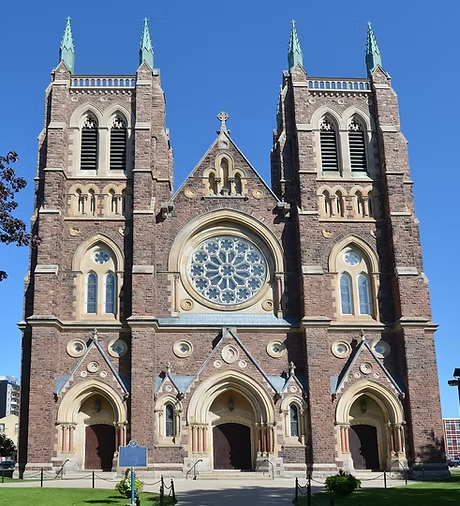
St. Peter’s Cathedral Basilica, London, ON
Crowds don’t usually gather on a Monday at St. Peter’s Cathedral Basilica in London, Ontario, but on June 29th there will be great festivity, and a joyful celebration of the Church as we install Bishop Daniel Miehm as the 11th Bishop of the Diocese of London.
There is an interesting fact about this Feast of the martyrs St. Peter and St. Paul. The Anglican Cathedral – St. Paul’s is located one block from St. Peter’s Cathedral. The two parish communities have a practice of celebrating Evening Prayer together on this feast. So, on June 29th this added nuance of common prayer is expanded with the presence of representatives from the Anglican Diocese of Huron, the United Church of Canada and the Presbyterian Church.
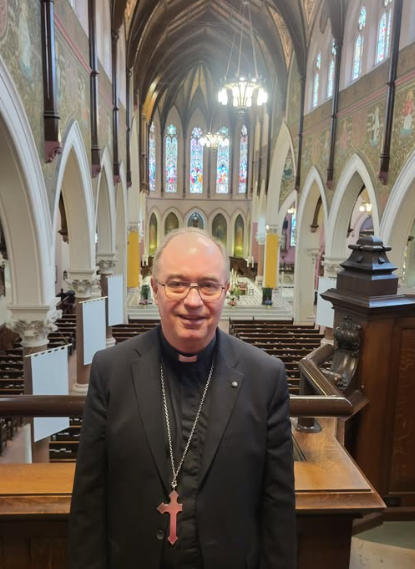
As we consider the Installation Liturgy of Bishop Miehm, there are a number of ritual moments that reveal a more expansive understanding of the universal Church.
Once Bishop Miehm enters the cathedral, he will be presented with a crucifix which he kisses and then he will sprinkle the people around him with holy water. Receiving and kissing the crucifix is a reverent sign of the Bishop’s willingness to accept this particular call, in this particular place and time. The Diocese spans far and wide throughout southwestern Ontario, but the cathedral is positioned in the heart of the city of London, neighbour to the Anglican Cathedral, Metropolitan United Church, and First Baptist Church. Beautiful Victoria Park provides God’s abundant green space adjacent to these churches. In the year 2000, we celebrated a major ecumenical gathering on those grounds resonating with song, faith, and gratitude. The call of this particular place at this time perhaps proposes a synodal approach to ecumenism!
With the sprinkling of holy water, we are reminded that Baptism unites all of us in the one Body of Christ, here represented by the full assembly: laity, bishops, priests, deacons, ecumenical leaders. “There is one body, but it has many parts. But all its many parts make up one body. It is the same with Christ. We were all baptized by one Holy Spirit. And so, we are formed into one body.” (1 Corinthians 12: 12, 13)
When the Apostolic Letter of appointment is read, the assembly acclaims their acceptance and the bishop is ritually seated in the cathedra (chair). Now the fullness of the Body of Christ shines as representatives are presented to the bishop: members of various presbyteral and pastoral organizations, laity of the local church, representatives from the education system and health care institutions, youth and outreach personnel. Later as the bread and wine are processed to the altar, persons suffering poverty are remembered as a donation to alleviate homelessness is presented.
As the liturgy comes to its final note, the church has gathered, praise has been sung to our loving God, the Word has been proclaimed, intercessions have been voiced for the needs of the world, the banquet of Christ’s selfless gift has been shared. Now the gathered community goes forth to serve as Jesus with justice and compassion striving that one day “all may be one”.
-Sister Loretta Manzara, csj

