
My Octopus Teacher

My Octopus Teacher: A Must-See Movie

octopus.png

Did you know 8 October was World Octopus Day?  I would be surprised if you tell me you knew.  I mean, who knew there is such a day?  This week I discovered why we celebrate Octopus Day.  Apparently, octopuses are among “the most distinctive creatures on the planet today [and they are] worthy of appreciation for a number of reasons. First, they are one of the earth’s great survivors. Indeed, despite their relatively short lifespan, octopus fossils date back more than 300 million years, meaning that they pre-date even dinosaurs. They are also highly intelligent, with around 500 million neurons located in their brains and arms, allowing them to bypass their instincts, learn lessons, and solve problems.” (daysoftheyear.com) If that weren’t awesome enough, how about this, octopuses are also visually stunning, come in various colours and shapes – and they are the chameleons of the sea.  Not only can these clever creatures change colour in the blink of an eye, but they can also modify their skin texture to mimic rocks, sand, coral heads, or other landscape elements by altering the papillae on their skin to blend in with their environment.

octopus teacher.jpg

You may wonder how I came to know about World Octopus Day.  Last week a friend in South Africa alerted me to the new Netflix documentary My Octopus Teacher which triggered fond memories I have of a fascinating visit Ripley’s Aquarium in Toronto a couple of years ago.  In that gigantic aquarium I was enveloped by 5.7 million litres of marine and freshwater, seemingly sharing the habitat of some of the most exotic critters from across the world. I remember gawking, in awe and wonder, as I meandered through exhibit after exhibit teeming with innumerable exquisite sea and freshwater jewels. I was particularly intrigued by the octopus, the real life relative of Hank, the octopus, in the movie Finding Dory. I learned that day that these startlingly strange boneless creatures have three hearts and a good mind, making them some of the smartest invertebrates.  Though they have no spine, they are far from spineless.

If you watched the movie Finding Dory you may remember Hank, though not your typical octopus since he only has seven arms. Hank, the shapeshifting, curmudgeonly, camouflaging octopus with his strange antics.  Well, let me tell you something, as much fun as Hank may have been, you haven’t seen anything yet until you see the incredible octopus in My Octopus Teacher.  I know I might be biased about this documentary since it was filmed by the South African diver and filmmaker Craig Foster who lives west of Cape Town, at the most southern tip of Africa, where I lived for many years.  
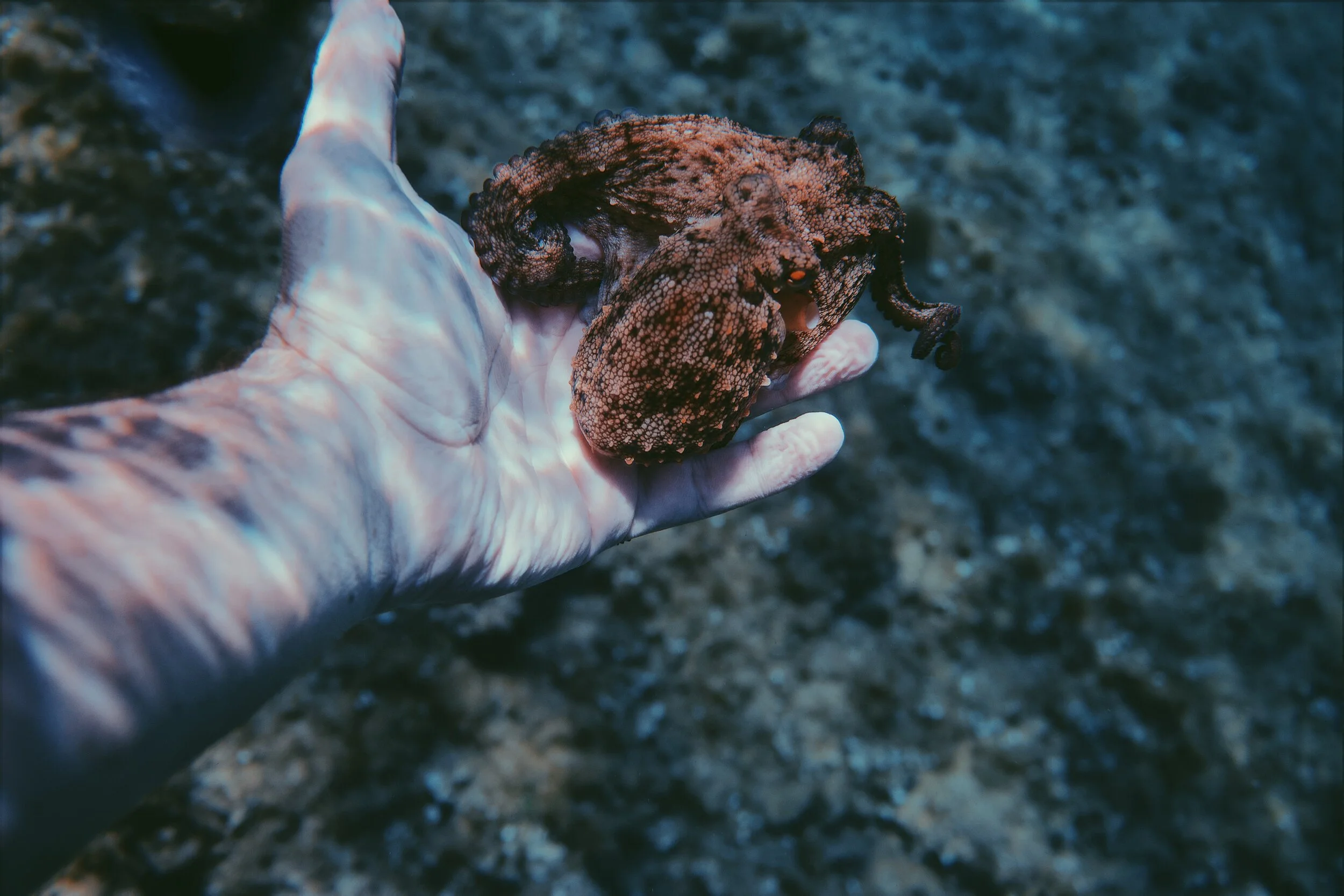
In a nutshell, Wikipedia has this to say about My Octopus Teacher, released last month. “… Foster began in 2010 to free-dive in a cold underwater kelp-forest at the tip of South Africa. He started to film his experiences, and, in time, a curious young octopus captured his attention. By visiting her den and tracking her movements every day for months, he won the animal’s trust. In the film, Foster describes the impact on his life of his relationship with the octopus.” This is the mere bare bone description of this incredibly moving documentary I watched earlier this week.  It has been said, My Octopus Teacher is easily one of the most beautiful films on Netflix right now.” (decider.com) Be that as it may, I found it to be a most beautiful, deeply moving story about the unlikely relationship and bond between a human and a creature from the wild.  One of the comments I came across online says this about Foster’s amazing relationship with the octopus , “No nature documentary you've ever seen will quite prepare you for My Octopus Teacher, a heart-gripping tale of a friendship (one might even call it a romance) between a human and a mollusk.”

“Praise the LORD from the earth,
you great sea creatures and all ocean depths...”
Psalm 148:7

I cannot recommend this documentary highly enough. Watching it will leave a deep impression on your mind and heart, will leave you in awe about the incredible interconnectedness between humans and all creatures. 

-Sister Magdalena Vogt, cps

The Community Hub - Bringing People Together in London, Ontario

Sisters of St. Joseph in Canada &
London Cares Homeless Response Services

The Community Hub

More and more in our local community, we are seeing people struggling with mental health and addictions with nowhere to go and the system in place to support them often feeling intimidatingly difficult to navigate.

Both the Congregation of the Sisters of St. Joseph in Canada (CSJ) and London Cares Homeless Response Services (London Cares) serve these individuals in need in their own ways. The Sisters of St. Joseph operate St. Joseph’s Hospitality Centre – a place individuals can visit to get a hot meal and find fellowship. London Cares is a housing-first organization that prioritizes getting individuals into homes and providing wraparound supports after. While organizations like these have been getting better and better at serving the needs of their clients over the years, the underlying issues have been getting worse.

When I first started, we’d serve maybe 150 individuals a day,” says Bill Payne, Coordinator of the St. Joseph’s Hospitality Centre. Over the last 26 years we’ve seen more and more people come in with increasingly severe substance abuse and mental health issues. We serve about 400 meals a day now.”

Thanks to a Community Vitality Grant, the CSJ and London Cares will collaborate on The Community Hub, a new location that will house many of the support services our most vulnerable citizens need, all under one roof. With additional partners in Regional HIV/AIDS Connection and London InterCommunity Health Centre potentially offering services out of the new location, the Community Hub will make navigating our city’s support systems easier for everyone.

With the COVID-19 pandemic complicating so many lives throughout the city, the need for simplicity has never been more apparent.

While closures and restrictions have certainly impacted service delivery, the sense of closeness and community that accompanied shared spaces like the soup kitchen is an equal loss.

“I think the thing that’s struck me the most is that at the soup kitchen, while it's obvious we do food, it has always been about community, and because of the physical distancing guidelines designed to keep everyone safe, we’ve lost some of that,” says Bill. “Our folks are so resilient and I'm so proud of how they face their situations with a smile, and how they’re able to pass that smile along to me.”

it has always been about community

The Community Hub aims to be a model for the future of service delivery, centered around collaboration between partner agencies to ensure that everyone has the opportunity to seek and receive the help they need to thrive. Taking a trauma-informed approach and providing specialty training to staff will ensure that service comes from a place of compassion and understanding.

Ultimately, the Community Hub is about bringing people together, both agencies and people in need of support, building community, encouraging a greater understanding of the issues our city is facing, and collaborating on solutions to help our most vulnerable populations.

“I don't think we're under any illusion that we're getting rid of poverty or we're going to solve everything,” says Bill. “My hope is that with the Community Hub, we’ll have made a hospitable, welcoming place that makes life just a little easier for our clients.”

There is no doubt there is a crisis in supportive housing, mental health and addiction in our community. At the heart of the collaboration to create a hub with these amazing organizations is community. Community is the most radical idea to create substantial change. We have collaborated for two years from a base of shared values. We will offer services in shared space and hope to create a welcoming environment where people can more easily get the supports they need.
-Sister Margo Ritchie, Congregational Leader for the Sisters of St. Joseph

Neighbours on Downie Street

From my second-floor window – at 7:30 a.m. each day I watch a young mother, a teacher, wheel her 2-year-old twin daughters down the steps and get them settled in their van.  This daily routine also includes her interaction with a middle-aged man from our neighborhood.  His name is Kelly and he is a regular visitor sharing his news early in the morning in a rather loud tone – which could be about his dog or what his plans are for the day.  The mom, while getting her children settled takes time to listen to Kelly and offers encouraging words to him as he retells (a couple of times over) the story about his dog and what his plans are for the day. 

BE KIND.jpg

Kelly approaches the window of the van and offers a wave and blows kisses to the children and then crosses the street and returns to his own home, giving this mother some positive affirmations as she heads to her classroom for another day.

With this pandemic and my own inability to volunteer with the marginalized, I think I have received a gift that is happening right outside my window every morning.  I feel that I am participating in this exchange between these neighbors – as I witness the respect for one another, and kindness being given freely to Kelly – who represents many in our society today who are not treated with respect or dignity.

I am realizing that being present can happen in many different ways…

-Sister Ann MacDonald, csj

Goodbye and Good Riddance!

Canada to ban six single-use plastic items next year.

This month, the federal government announced it would be adding plastics to the Toxic Substance List under the Canadian Environmental Protection Act (CEPA). This is a crucial step towards regulations that would reduce plastic production, use and disposal. It’s about time.

plastic2.jpg

Canada to ban six single-use plastic items

Photo credit: Ruth Hartnup/Flickr Creative Commons

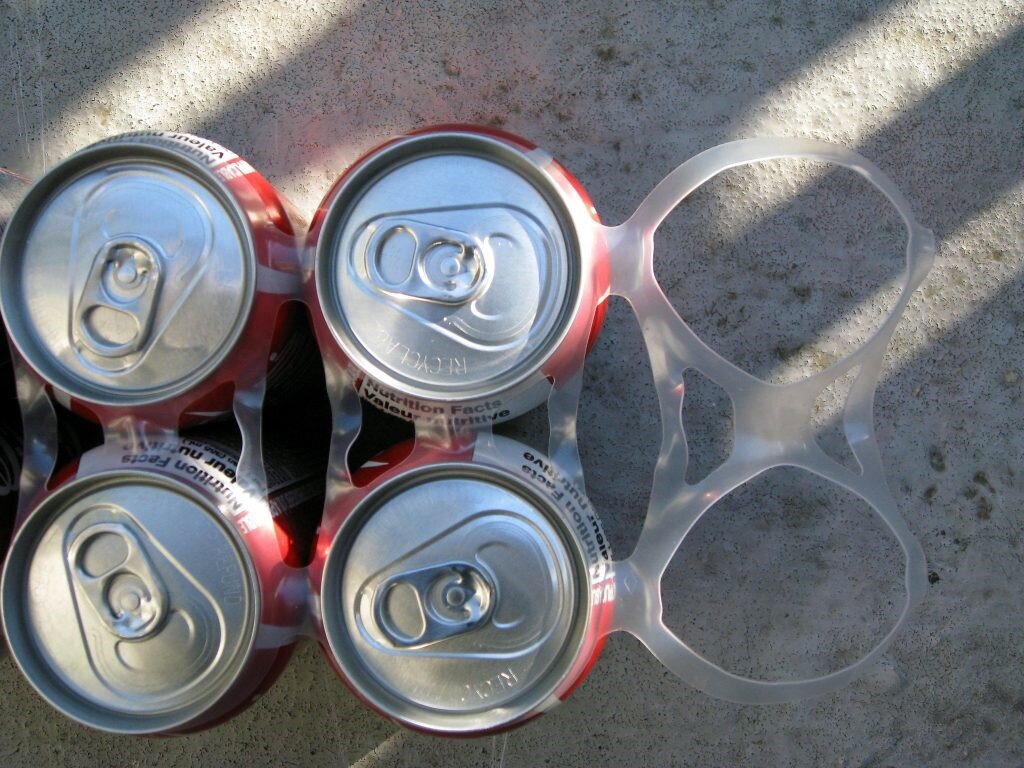
As part of the same announcement, Environment Minister Jonathan Wilkinson released a draft management plan outlining the actions his ministry is considering to eliminate plastic waste. One of those actions is banning some single-use plastic items, specifically: grocery bags, straws, cutlery, six-pack rings, some takeout containers, and stir sticks.

The list itself is a good start. Canada has obviously been taking cues from the European Union (EU), which already moved to ban most of the same items last year. But Canada needs to do much more than ban plastic straws and spoons if it’s serious about a zero plastic waste future.

Much more is needed to tackle the plastic crisis

The truth is that our current, linear economy—where disposable products and packaging are the norm—is unsustainable. Instead, we need to transition to a circular economy, where reduction, reuse, and repair are prioritized and materials stay in the economy and out of landfills, incinerators and the environment.

Unfortunately, notwithstanding the bans, it looks like the government is going all-in on recycling as a silver bullet solution to plastic waste. But the reality is that recycling was a lie sold to us by the same industry committed to filling our cabinets, landfills and oceans with plastic —the petrochemical lobby.

Beyond the fact that many kinds of plastic are impractical or impossible to recycle, there are limits on the number of times plastic can be recycled before the polymers are too degraded and the material needs to be thrown away.

That’s why Canada needs to impose and enforce reduction and reuse targets, in addition to recycling and recycled content targets.

Next steps for Canada to tackle plastic pollution

plastic3.jpg

Between now and December 9, the government is asking Canadians, businesses, and other stakeholders to provide feedback on their proposed management plan. We’ll be at the table, pushing hard for the regulations we need to eliminate plastic waste in Canada, including:

  1. Finalizing the addition of plastics to the Toxic Substance List, under Schedule 1 of the Canadian Environmental Protection Act, 1999 by the end of 2020;

  2. Banning at a minimum the six items proposed in the draft management plan by the end of 2021, and adding additional plastic items to the ban list in future years;

  3. Working with provinces and territories to make the companies that produce plastic products and packaging financially and operationally responsible for plastic waste (Extended Producer Responsibility, EPR), and ensuring harmonization from coast-to-coast-to-coast; and

  4. Establishing and enforcing high reduction, reuse, recycling, and recycled content targets to support Canada’s transition to a circular economy.

The plastic crisis has been growing for decades, and there is no immediate solution. It will take actions from all levels of governments, industry and society to overcome it. But this announcement is a step in the right direction.

- Ashley Wallis, Plastics Program Manager, Environmental Defence