a Cree poem

With so much in our news these days related to Indigenous people, this little Cree poem brings an insightful story to our attention.  The brief, creative style, sites a challenge we all might share. A beautiful poem to share with friends!

- Sister Patricia St. Louis csj

The truth is

I have mud on my hands

from digging roots


The truth is

I brought them to you


It is the truth

I worked to get them

And complained

while digging them up


The truth is

Once I got back here

And saw your face

It didn’t matter,


that work


-          Cree poem.

The Choice - A Book Review

The Choice was acclaimed a Best Seller by the New York Times and came to me highly recommended.  Dr Edith Eger is the 90-year author and an internationally known psychologist.

It begins with her Hungarian Jewish family living in an active neighbourhood and then eventually the rumblings of war, the Nazis, restrictions imposed, and eventually the movement of family and neighbours to Auschwitz in the cattle car of a crowded train.  At arrival into the camp separation of parents and children occurs.  Edith, a teenager excelling in ballet and gymnastics is allowed to remain with her sister while her dear Mom and Dad are separated and faced immediate death.  

Hope is the boldest act of imagination I know
— Edith Eva Eger

Edith and her sister are courageous survivors of horrific trauma. However, throughout their years of concentration, they maintained that hope was essential.  Hope for another day urged them on each day.  “Hope is the boldest act of imagination I know,” Edith writes.  In 1945, the prisoners in the camp are liberated by the American soldiers.  Edith is discovered among the dying prisoners. In her study and work as a psychologist, Edith discovers a valuable way to use her personal traumatic, experiences to assist others: 

“Our painful experiences aren’t a liability, they are a gift.”

 -Sister Mabel St. Louis, csj

“Change is about interrupting the habits and patterns that no longer serve us”

A Canada Day Like None Other

A Canada Day Like None Other; A Liturgy Like None Other

Canada Day, July 1, 2021, was like none other I had experienced. Canada Day, July 1, 2021, I experienced liturgy like none other, but one for which I have dreamed, hoped, and prayed.

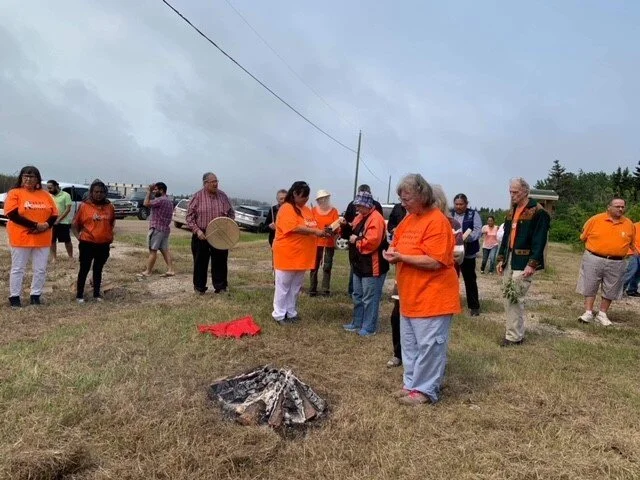
Sister Linda and Sister Diane had come to Hay River from Yellowknife to visit for a few days. On July 1st, Canada Day, we joined the community of Katlodeeche First Nation Reserve to honour and remember the children who did not return home from Residential School. Approximately 220 people, many wearing orange, had gathered for the memorial. Although the last days of June had been extremely hot, mixed with rain and thunderstorms, that morning the weather cleared, the sun came out, (as well as the bugs!).

The memorial was to begin at 13:23 hours, signifying the number of graves (at the point of planning) that had been discovered, 1,323. Those planning to attend were invited to gather at 13:00 hours in order that the memorial could begin on time.

As we arrived, the table had been set - a small fire with a few logs. The drummers were present, warming their drums over the fire, ready to sing a prayer song.

peggycan2.jpg

Chief April Martel welcomed everyone; community members, many people from the town of Hay River including the mayor and counsellors, RCMP, Rangers, men, women and children, Dene, Metis and Inuit, as well as non-indigenous. All had come to stand in solidarity.

Roy Fabian, former chief and elder, began to speak. Roy began explaining the word “Dene”. He explained that it consisted of two words, De and Ne. De means the water, the rivers and Ne of the land, the plants, animals, and people. All is gift from the Creator.

We had gathered on the site of the former residential school. Roy shared with us some history of the residential days and he spoke the truth, in the fact that not all was good.  

A Canada Day like none other ...but one for which I have dreamed, hoped and prayed.

Following Roy’s words, the feeding of the fire began. Roy explained that traditionally the hunter would take the fat/muscle from behind the eye of the animal and offer it in thanksgiving for its life and thanksgiving to the Creator. Today, tobacco is used. Everyone present, who wished, was invited to make an offering.

Taking some tobacco in his hands, Pat Martel, a former chief and elder, began the fire feeding ceremony with a prayer in his Dene language. He then sprinkled the tobacco in the fire. This was followed by Chief April Martel, elder Roy Fabian and the drummers. The drummers then began to sing the prayer song while those present came forward to make their offering.

It was a vey sacred moment. As individuals and families came to the fire, taking some tobacco in their fingers, each one took a few moments to reflect and remember. Among the crowd gathered, there was an atmosphere of profound quietness as we stood in solidarity. The drummers continued to drum and sing throughout the fire-feeding ceremony.

Up to this point, the memorial was in honour of the children who did not come home, within an atmosphere of quietness and grief. And then the mood changed. The drumming took on an air of celebration as everyone joined in a tea dance. Roy explained that the dance was in honour of the children now, in the present.

 As the drummers led the dance with a celebratory drum beat and joyful song, a large circle formed around the monument on the Residential School site as we danced to the beat of the drum.

As Sister Linda had just moved to Yellowknife in September, we ended our day going to Alexandra Falls. As we walked through the trees to get to the lookout, I was aware that we had come full circle from Roy’s words explaining the word Dene.

I was profoundly moved at the memorial for the children who did not come home from Residential School. Being in solidarity, praying, listening, offering, and dancing, experiencing community… I did not receive the Eucharist, the Real Presence, as we believe, however, I was nourished by the real presence of each person. It occurred to me that perhaps this is what Jesus envisioned for “church”. These past few days I feel much like the disciples on the road to Emmaus… “were not our hearts burning…”

Was not my heart deeply moved!

I dream and pray and hope for a new way of “church” everywhere, but especially in the north; one in which spiritualities of many cultures can be woven together in a deep spiritual experience of community.

Sister Maggie Beaudette, CSJ
canada day 2021.png

Weekly Pause and Ponder

Weekly Pause and Ponder

“to be” is “to be with.” Reality is “being with another” in a way open to more union and more being. Since being is existence towards another, being is relational and exists for the sake of giving. I do not exist in order that I may possess; rather I exist in order that I may give of myself for it is in giving that I am myself… Being is first a “we” before it can become an “I.”

- Ilia Delio. The Unbearable Wholeness of Being, p. 45.