
Alleluia! Christ Has Risen!

Christ has risen, Alleluia!  Alleluia!  Alleluia!

After this holy time of preparation during Lent, we burst with the spirit of Easter joy which will carry us forward as we share the truly Good News with a world that is sorely in need of good news.  How will you celebrate this Easter?  A joyful Easter liturgy?  A quiet day with a chocolate bunny?  A gathering with family or friends?  An Easter hike?  Hopefully, there is some way for each of us to experience that sense of Easter joy which is a gift from God.
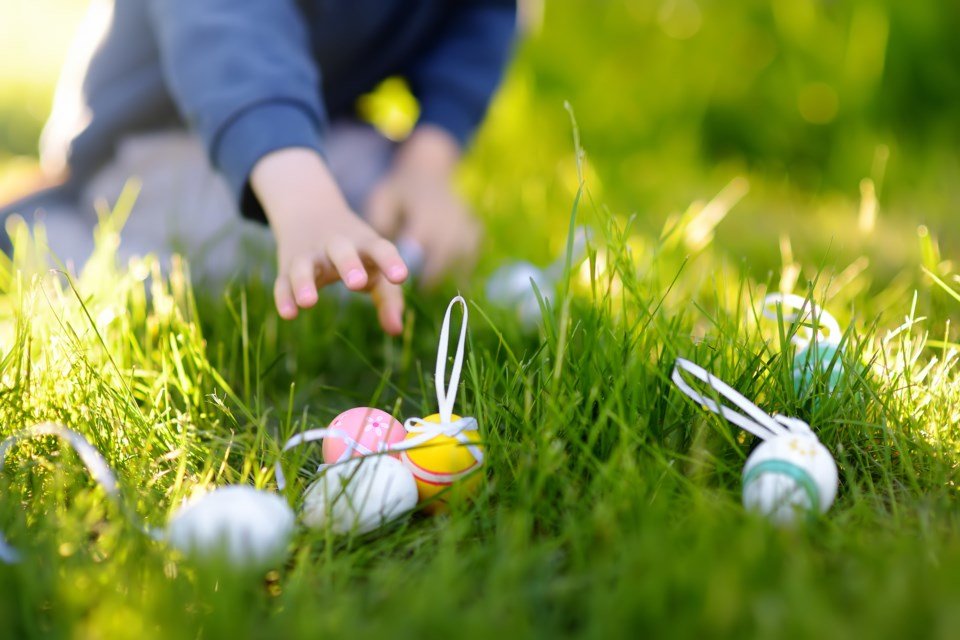
For myself, Easter Sunday will start with mass at the Cathedral in Hamilton, followed by coffee with some of the Sisters.  In the afternoon, I will join my family in a long standing family tradition of an Easter Egg hunt and Easter Quiz at my brother’s house.  Being COVID times, it will be held outside.  [A side note:  As this will be the first time we are gathering in over two years, we will meet the new babies in the family who arrived during the COVID pandemic including one little fellow who arrived at the very start of the pandemic in January 2020 and whose name is Cove.  No, it is not short for Covid.  His father is Irish so he was named after the city of Cobh in Ireland but knowing that most people would not know how to pronounce Cobh, they decided to spell it as it sounds.

This joy we experience as an Easter people who recognize and rejoice in the Resurrection needs to be shared with whoever crosses our path.  How it is shared can be summed up in the words of one of our wise Sisters:

‘The most important thing is loving the person in front of you’.

Amen.  Alleluia!  Alleluia!  Alleluia!

-Sister Nancy Sullivan, csj


Image: Unsplash/Bruno van der Kraan

Holy Saturday - Time “In-Between”

Image: Unsplash/Pisit Heng

The Paschal Mystery we have just celebrated in the Western Christian Churches is written about by theologians as one event beginning with Holy Thursday through to the Easter celebration of Resurrection.  However, this time is filled with so many events that our human experience and understanding requires that we pause from one day to the next to help us more fully enter into the Mystery of the passion, death and resurrection of Jesus Christ.  I like to think of Holy Saturday as “in-between” time.  What does this mean?

This is time to pause to help us enter the mystery of which we are a part.  This time is where we live our lives – between birth and death and rebirth into communion with God.  As we learn from the life of Jesus we are invited into the journey of love.  Any of us who watch the news or read the newspapers know that so much of what we see and read, is the opposite of love.  We see a false sense of power which destroys life and love.

Image: Unsplash/Alicia Quan

This Holy Saturday if each of us paused just long enough to consider how life can teach us to love and not to be lured into a false sense of power.  Jesus before Pontius Pilate remained detached from the power of Pilate.  Jesus understands that he too has power that is of God.  We desire to know this and can only learn its truth if we stop to listen for that longing in our hearts.  Our longing for what is yet to be realized is part of the birth of what is yet to come.   To long for love in our lives and our world is to be part of the creation of love.  To desire wellness for our families and the earth is to stir the energies within us that can be transformed into words and actions of well-being for our world.  This is the holy desire we touch on days like “Holy Saturday”.  In the words of John Philip Newell, “…This is the holy desire we can be part of, to long for oneness even in the most broken and apparently God-forsaken places of our lives and our world.  Desire leads to conception and conception leads to birth.”  This is how we walk this journey of life and love.  Blessing of love for all.

- Sister Joan Atkinson, CSJ

GOOD FRIDAY

Image: Unsplash/Wim van 't Einde

As a child I always wondered what was so “good” about Good Friday given its silent solemnity in Church and at home where I truly had to uncharacteristically “behave”, and because of the sadness of the commemoration itself.

Sometimes, even as adults, we can become stuck in the “gloom” of the day, and it becomes almost impossible to see beyond it. Indeed, this year given the war in Ukraine, violence in so many places locally and globally, the continuing pandemic and its repercussions, the devastating consequences of climate change and its consequences for the poorest of the poor, we may be feeling very stuck, overwhelmed, and frustrated – alone in the darkness! On the other hand, some of us may want to deny “Good Friday” and move directly to the alleluias of Easter morning. Sister Gemma Simmonds says that in this case “we can appear glibly optimistic and superficial in our engagement with the crucifixion of Christ that continues in his desperately suffering people and God’s desecrated creation.”

So, then what is so “good” about Good Friday? Perhaps it is the paradox of light in the darkness, the both/and of cross and resurrection, death and new life echoed in our liturgical celebration of the Easter Triduum and in the natural world with its springtime promise of new shoots emerging from the still cold Earth. Bishop Erik Varden of Trondheim in Norway describes this reality. He writes,

“The path will, in a Christian optic, necessarily go through the cross; but the cross is a passage, the emblem of Christ’s Pasch. It looms large on the horizon but bears the promise of new, endless life and flourishing to be found on the other side.”

Here we find hope in the darkness, promise in the shadows, the very place and condition of our growth and new life. In Christ’s acceptance of his suffering, definitely not chosen but imposed upon him by forces of injustice, we see the goodness of unconditional love. And, as the ancient hymn reminds us, when we “survey the wondrous cross”, we see the One who extravagantly loved to the end and then loves the world into resurrection.

It is precisely this great love that invites and calls us to love radically

image: unsplash/Yannick Pulver

It is precisely this great love that in turn invites and calls us to love radically, to the end, to join our own struggles with the suffering of the world; the suffering world that includes not only we humans but the whole of creation. In Romans 8 we read that creation itself cries out for liberation. God’s salvation embraces all the world’s sufferings, cosmic, social, and personal. This Good Friday, let’s seek the goodness of the day, embrace it, and live it by our presence, image of God’s presence, and then as we intone again the great alleluias of Easter may we receive hope and become God’s people of promise in this struggling world.

-Sister Mary Rowell, CSJ

HOLY THURSDAY

Behold a broken world we pray where want and war increase.

At no other time have the opening lines of this hymn been so profound in meaning. (CBW 538)

I write this blog a few weeks ahead of April 14. I don’t know what the world situation will be on that day, but the particularity of today is concrete: bombings, death, homelessness, displaced children, beauty demolished, apologies being sought. With such a reality how might we approach the church’s liturgy and sing in the Pange Lingua: “Hail the Blood which, shed for sinners, did a broken world restore”, a broken world restore.”

We feast on unleavened bread and wine transformed to be for us total embodiment in Christ. We feast sometimes with wavering hope, wanting oh so much to be confident, that our broken world will be restored in the here and now. In the same liturgy we ritualize the humbling act of foot washing, knowing that we too are called to serve, called to engage in making our broken world whole again. But when O God . . . when? Lament and sorrow are so real. Is not the self-giving of Christ the vessel in which to hold the present moment? The One who is Love itself holding the world in the tragedy of the moment.

The Holy Thursday liturgy is the grounding place to move into the darkness of Good Friday and the silence of Holy Saturday. It invites us to be for others just as Christ: washing feet, sharing the gifts of the earth, seeking a better world where all races, genders, creeds are one. The liturgy teaches us ways of being, that weave the world community together.

It invites us to be for others just as Christ: washing feet, sharing the gifts of the earth, seeking a better world where all races, genders, creeds are one. The liturgy teaches us ways of being, that weave the world community together.

Nations are welcoming, clothing, feeding those fleeing from the violence. Other nations are financing care. In the midst of the tragedy, I heard a Ukrainian woman challenge us not to forget the millions who are fleeing other violent, oppressive regimes. The human heart beats with every breath: love one another.

The hymn I first quoted ends this way:

Bring Lord, your better world to birth, . . . .  Where peace with God, and peace on earth and peace eternal reign.  (Hymn text by Timothy Dudley Smith, Catholic Book of Worship III #538)

At the end of the Holy Thursday liturgy, we pray together in deep silence, so too in this moment . . .

-Sister Loretta Manzara, csj