
Tending Our Irish Roots

Canadians live in a land of immigrants who never forget their homeland. Most Canadians love this great country and have found it to be a peaceful place where they can flourish, enjoy freedom, and educate their children.  However, deep in their hearts, immigrants long to visit their homeland and do so, if possible.  This longing is true in my own family that emigrated from Ireland prior to the Great Irish Famine of 1845-1847. 

My great-grandfather arrived in Canada with his three brothers and two sisters. As a young man, he arrived in Huron County. There, he purchased and cleared land from the Canada Company, married the maiden from across the fields and became part of an Irish settlement that prospered as the generations passed.  

His brothers and sisters settled nearby. Of course, the new settlers missed family and friends in Ireland but visiting their roots was not an option.

Years passed and our grandparents kept the stories of Ireland alive in our minds.  Finally, during the ‘60s, when families had saved sufficient funds, the third generation Irish in my area began to realize their long-held dreams to visit the land of their ancestors. My generation, the fourth, followed suit as we longed to visit our motherland where our ancestors had toiled to make a living under the heavy hand of the British.

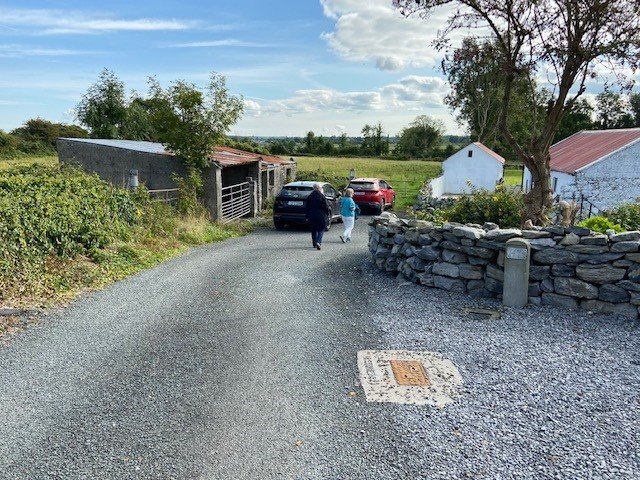
Our Michigan cousin, a history buff, researched all things Irish. He and his family made several trips to the Old Sod and encouraged us to do likewise.  In preparation, we studied his detailed outline of our family in the Galway region.

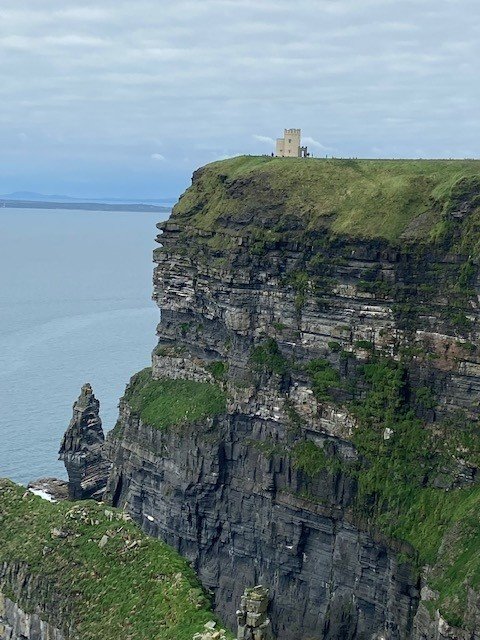
In 2013, I had an opportunity to cross the ocean and bask in the sights and sounds of Ireland. As we landed at Shannon airport, old songs of Ireland once sung around our living room piano, came rushing to my mind.  My heart sang, “Where the River Shannon Flows” as I walked over its famous bridge at twilight.  “Christmas in Killarney” came to mind in that pretty city.  Of course, “Galway Bay” hummed in my heart as I sat on a wooden bench staring into peaceful water surrounded by gentle morning mist.  A few days later, at the end of our bus trip around the famous Ring of Kerry, who appeared coming out of a rest area building but my first cousin Ann and her husband from Windsor.  They too, were exploring Ann’s Irish roots.  We were surprised and delighted!

Now in our sixth generation, my brother and his wife recently took their daughter and son, his wife with baby in utero and their two-year-old daughter to see the beauties of Ireland.  The children are young, but already they have been inducted into tending our Irish roots.

-Sister Jean Moylan, CSJ 🍀


Header Image: Unsplash/Philipp Baumann; All other Images: The Moylan Family.

The Living Water Promised to Me

In her book, Hidden Women of the Gospels, Kathy Coffey points out that of the 1,426 people given names in the Scriptures, 111 of them are female and many have no name. In contrast to say, Andrew, James or John, we meet the Samaritan Woman in this Sunday’s gospel. Can you imagine being referred to as the Toronto Woman or the New York Lady? Surely, Jesus would have called the Samaritan Woman by her name. What might have been her name? So, before you listen to this unnamed Samaritan Woman tell her story, might you give her a name? Your name?

Judith Fritchman; Living Water, The Woman At The Well

The day is so hot and the water-pot so heavy … I come in the hot sun when no one is around because the other women laugh at me, quietly, in whispers. They talk about me and how I live. Don’t they know the pain I have felt over these years? I just want them to look at me and smile, acknowledge my presence. I am treated as an outcast by women of my own nation, my own bloodline.

But here I am alone … Wait, I am not alone … there is a man sitting at the well. Just what I need… Another man to deal with in the hot sun … I just want to get my water-pot filled and leave. ‘Give Me a drink,’ He says to me. Who does he think he is, asking me a woman, a Samaritan woman no less, for a drink?

Yet He looks at me - like no other man has ever looked at me. His eyes pierce me, as if He is looking into my soul, the depths of my being. He sees everything - the sins, the pain, the sorrow, the injustice. Somehow, something within me is changed. He speaks of ‘Living Water’. Is it this Living Water that changes me? I can feel this water cleansing, refreshing me. I am the one now who wants to drink - to drink more of this Living Water, to quench the thirst of my dryness, the dryness of my sin, the dryness of injustice, the dryness of my sorrow. I am not ashamed, as I was with the others, that He knows my life, because He has not judged, has not condemned me.

Now I must go and tell the others, ‘Come and see the man … could He be the Christ?’ They do not need to believe me, but to come and see for themselves.

I have left my water-pot behind! I no longer need it because now I have the Living Water promised to me by the prophet from Galilee.

Does this woman’s story resonate with you? Are you, and I, not often like the Samaritan Woman at the well? She speaks to us in our ‘parched’ times, so with her let us raise our hearts and voices.

Quench our thirst for meekness when we are parched by a need for power.

Quench our thirst for humility when we are parched with pride.

Quench our thirst for compassion when we are parched with disregard.

Quench our thirst for forgiveness of others when we are parched with revenge.

Quench our thirst for joy in You when we are parched with sadness.

Quench our thirst for boldness when we are parched with apathy.

Quench our thirst for salvation when we are parched by our sinfulness.

-Mary Timko, Associate of the Missionary Sisters of the Precious Blood

Lent 3 - Jesus is Thirsty

JESUS IS THIRSTY (John: 4:1-42)

Image: Unsplash/Jimmy Chang

Jesus and his disciples are leaving Judea where Jesus had turned water into wine at the wedding feast in Cana, and where he made a lot of enemies by cleansing the temple of its money-changers, and where John the Baptist had been baptizing with water.  Jesus’ followers were also baptizing with water. 

While these events may not have occurred simultaneously in John’s Gospel, we can be sure that Jesus was tired and thirsty when he and his disciples reached Jacob’s well in the land of Samaria on their way to Galilee.

“Will you give me a drink?” Jesus said to the Samaritan woman.  She obviously had to be asked and did not anticipate that here was a thirsty man waiting for a helping hand to relieve his thirst.  She saw only a Jewish man who would reject, with contempt, a Samaritan woman. 

Surprise!  Jesus uses his thirst to reveal his weakness and invites this woman at the well to thirst for water to drink so that she will never be thirsty again.  As we continue to read Chapter 4 in John’s Gospel we see that many Samaritans in the town believed in Jesus on the strength of the woman’s word of testimony: “He told me everything I ever did.” 

Jesus’ thirst at the well eventually transformed the entire town into “thirsty” believers;  Jesus really is, “the Savior of the world”.

-Sister Elaine Cole, CSJ

Encounters on the Trail

The rewards of walking on London, Ontario’s trails exceed that of mere exercise.   I meet friendly cyclists, walkers, pedestrians, and dogs.  I listen to birds, search for frogs in springtime, and experience the constant changes in the weather and scenery.  Occasionally there is an intriguing encounter. 

Image: Unsplash/Blake Lisk

Today I met a man, whom I will name, Joseph, who was walking up a slope from a tent on the river’s edge. He had descended to the tent to check on the welfare of the occupant because of the very cold temperature.  The tent’s owner was absent, and the walker expressed hope that the tent-dweller was in a safe, warm place.  Joseph spoke about his regular walking tours of London’s trails. He described having urged a tent dweller on another trail to seek temporary shelter; this man had declined the suggestion, stating that several blankets kept him sufficiently warm and that staying in a men’s shelter was too dangerous.  Joseph spoke of another occasion in which he had met a young female tent dweller, convinced her to leave her unsafe location, and assisted her to find refuge from her alcohol-addicted boyfriend. Walking the trails in London to search for people in need is a regular practice of this good Samaritan.  

We conversed together about the difficulties for people who have no homes, the lack of adequate resources, and the failure of past efforts to remedy a grievous problem in our city. We also noted the anonymous donation of twenty-five million dollars for a new effort to overcome homelessness, the willing cooperation of several organizations to remedy an untenable situation, and the skilled leadership from the city that together provide hope that London can, at last, overcome a longstanding calamity. 

Patricia McKeon, CSJ