
Earth Day

Each year on April 22, we observe the birthday of the modern environmental movement, which began in 1970. Earth Day celebrates its 52nd anniversary this year.

“In the decades leading up to the first Earth Day, Americans were consuming vast amounts of leaded gas through massive and inefficient automobiles. Industry belched out smoke and sludge with little fear of the consequences from either the law or bad press. Air pollution was commonly accepted as the smell of prosperity...America remained largely oblivious to environmental concerns and how a polluted environment threatens human health.”

I remember the publication of Rachel Carson’s book, Silent Spring, in 1962, “which raised public awareness and concern for living organisms, the environment and the inextricable links between pollution and public health.”

Senator Gaylord Nelson from Wisconsin had already been concerned about environmental deterioration in the USA, when, in January 1969, a massive oil spill in Santa Barbara, California ravaged the area. Wanting to harness the energy of the student anti-war protests and direct them into consciousness about air and water pollution, the Senator came up with the idea of a teach-in on college campuses. April 22 was chosen as it occurred on a weekday between Spring Break and Final Exams, to maximize the greatest student participation.

Denis Hayes who did the initial organizing realized that all Americans could participate in this movement. As ever more organizations, faith groups and others joined in the various events across the country, the name was changed to Earth Day. National media coverage resulted in “20 million Americans... taking to the streets, parks, and auditoriums to demonstrate against the impacts of 150 years of industrial development which had left a legacy of serious human health impacts... By the end of 1970, the first Earth Day led to the creation of the United States Environmental Protection Agency and the passage of other first of their kind environmental laws... “

In 1990 “Earth Day went global, mobilizing 200 million people in 141 countries...30 years on, Earth Day 2000 sent world leaders a loud and clear message: Citizens around the world wanted quick and decisive action on global warming and clean energy.”

But more challenges faced the environmental community in 2010, as climate change deniers and well-funded oil lobbyists, etc. continued their opposition. But Earth Day continued and EARTHDAY.ORG prevailed, making Earth Day a main proponent for global action for the environment.

Today, as the climate crisis grows and the fight for a clean environment is even more urgent, it is imperative we do our part to work for our planet and its people.

-Sister Patricia Cataldi, CPS/The Missionary Sisters of the Precious Blood

(Adapted from www.earthday.org) 
Finding Sacred Spaces - Earth Day

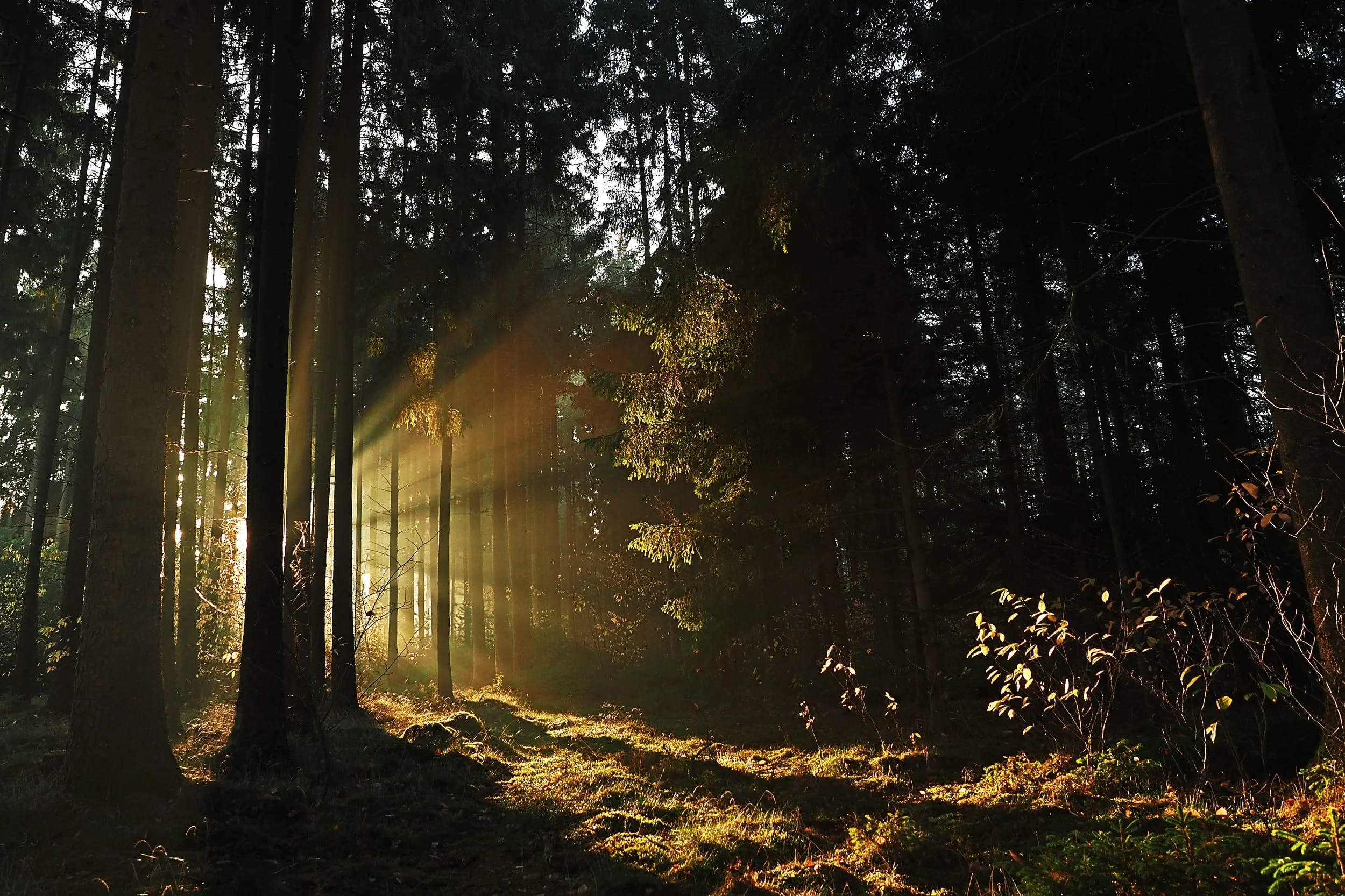
Image: Unsplash/Pascal van de Vendel

When I was about 9 years old, I set out one morning on an adventure along the beach by my home on the West Coast. I loved nature and the outdoors. I walked about a mile or so along the beach, crossed a stream balancing on fallen logs, then clamoured up a large rock outcropping. But the forest at it’s top was beckoning to me. I wandered into its shepherding branches and was soon entranced by the stalwart beauty reaching to clearest skies. It was like I’d walked into a cathedral of wonder. There was a glimmer ahead through the branches and I followed it. Then the woods broke open into a little space where sunlight sparkled upon a grove of purest white little woodland Easter lilies. It was so breathtaking I knelt down to behold it. Joy filled my soul.

Then I thought how I would love to share this beauty and bring some of the Easter lilies home to my mother. So, I gathered a little bunch up and set off home. Down the rock outcropping, along the beach and over the stream and just a little further to home. I was running now because I was so excited.  I burst into the kitchen with my joyful bouquet. But my mother’s reaction wasn’t what I expected. She was very upset with my gift because these Easter lilies were protected by law. And further I was a Junior Naturalist so I should have known better than to pick them. She was right. The Easter lilies I picked wouldn’t bloom for another 7 years. I was deeply saddened.

But I argued, there were so many of them. It wouldn’t matter, but my mother was firm. She would not take the Easter lilies from me. Instead, she ordered me to return them to their woodland home. Plus, she said, I was trespassing. But I didn’t think that counted though because there wasn’t a fence!

So down to the beach along the shore and over the stream I reluctantly trudged. Up the big rock outcropping I clamoured and puffed and then into the woods. As I knelt by the little woodland grove with my wilting Easter lilies, I realized somehow, in my child’s mind, that I had violated their sacred space. I remember crying and saying how sorry I was. The woodland with the sunlit grove was sacred space, a holy moment that I had been gifted with. I felt and knew in my heart the Easter lilies acknowledging my sorrow.

Image: Unsplash/Noah Buscher

There were many other years in the spring when I would return to that woodland grove, for it had become a sacred space for me. And I was gifted then with the realization that we do not need to take and have everything of beauty, peace, and sacredness else we lose it forever. We need to treasure it and protect it. The memory of that sacred space remains forever with me and has guided me.

Where might your sacred space be?

-Sister Linda Gregg, csj

Earth Day 2022

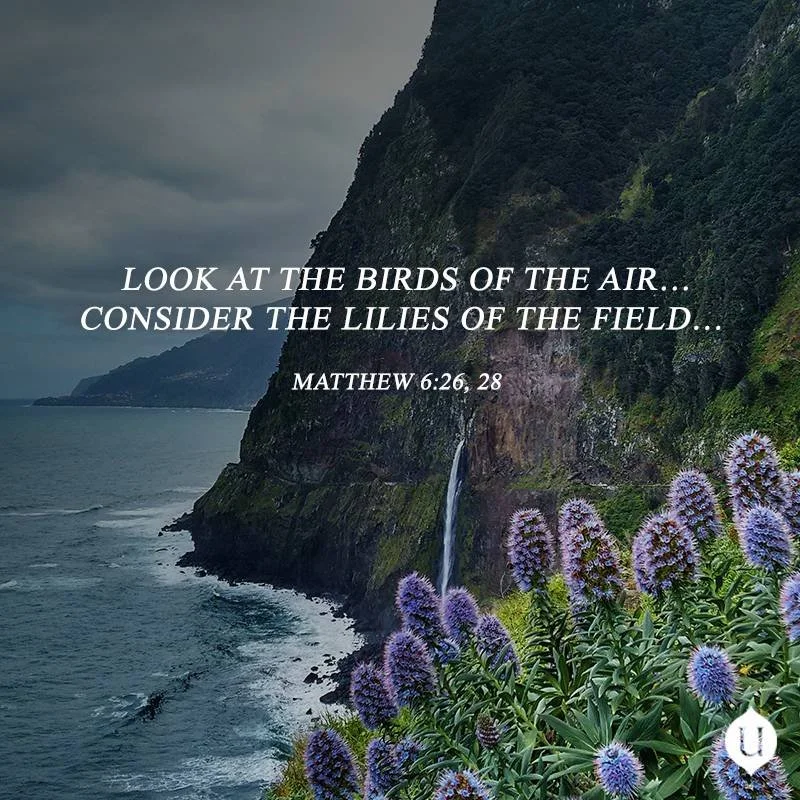
In the scriptures, Jesus reminds us of the care of the Father for each of us, as well as, the birds and the flowers. (Matthew 6:26, Luke 12:27). We, in northern Canada, are so blessed with the beauty of creation.

Earth Day encompasses not only nature, but all aspects of our Mother Earth. Again, as we think and reflect on our life in the North, we are aware of how blessed we are to know and be in relationship with people from many countries of the world. We are indeed, interconnected and interrelated! And in times of hardship, sorrow, and sometimes utter disbelief, we turn, in unity to prayer.

In November 2018, I made a retreat called Boundless Compassion facilitated by Joyce Rupp. The setting was the beautiful Bowen Island, British Columbia. One of the days of the retreat was dedicated to Compassion for Creation. Joyce invited us to go for a walk and have a conversation with something in creation. In this conversation, we were encouraged to listen, more than speak. The following is what a tree stump shared with me.

November 28, 2018 Tree Stump tells me about herself:

This tree stump in my yard is a feeder for birds in winter and a garden in summer. Below, images from my surroundings.

“Well, at one time, I was one of the tall trees on the property. I could see far over the water. My branches would even touch my brothers and sisters. But there came a time that I needed to be cut down…and that is a story for another time. 

Did you know that the beautiful part of our life as trees, is that, although we lose our crowning glory of branches and foliage, we remain connected in and through our root system?

Now my role is quite different. Did you notice the tiny mushrooms growing on my side? I am somewhat of a nurse giving life. And ants come and burrow and carry off sawdust. I think the tinge of green lichen or moss gives a certain decorative beauty. I can still see the water and hear the birds and even now and then a seagull or black bird will rest on me. I am happy in my old age!”

Today I encourage you to have a conversation with Mother Earth. Remember to listen.

Creator of all living beings, we desire the restoration of the health of Mother Earth. As wise stewards of all that you have entrusted to us, we resolve to evaluate our lifestyle and patterns of consumption in order to make necessary changes. Provident God, we are partners with you. By the power of your Spirit, fill us with courage and conviction as we take responsible action to ensure the sustainability of our Earth. We pray in the name of Jesus who shows us the way. Amen.

(Adapted from “An Earth Day Prayer Service”)

Blessings, Sister Maggie Beaudette, CSJ

World Bee Day - May 20th

A few years ago a local organization started a community beekeeping program in Peterborough. I have always found bees fascinating creatures and so I decided to join an enthusiastic bunch of other people. What I learned took me down a path of self-discovery, which was both educational and illuminating. It was nothing like the path the Israelites took out of Egypt (Exodus 3:8) but it was still a turning point for me -- and although beekeeping did not flow with milk there was always lots of honey.

It is estimated that in the world today there are between 20,000 – 30,000 species of bees, with approximately 4,000 species native to North America. Up to 75% of our crops rely on bees and other pollinators like butterflies. At the same time all pollinators are seeing a dramatic drop in their populations due to climate change, use of insecticides, loss of habitat, and other factors. And the main culprit of all this damage is humans.

The star of the bee world is the honeybee. We see it everywhere, from packages of seeds to a Cheerios box. Often overlooked but just as important are solitary native bee species like the Leafcutter, Mason or Sweat Bee. The European honeybee was brought by settler colonialists 400 years ago to Turtle Island (North America), for the sole reason that it produced honey and beeswax. This type of bee is not a native species but is considered by biologists to be an invasive species.

In our human history, honey has been a constant. For example, honey has been found in the pyramids in Egypt. It was coveted for its purity and sometimes became more valuable than gold. It was also used by many cultures through the ages as a medicine, taken internally or used as a salve for burns or other injuries.

In our world now, stories of bees and insects often fill the news; in the past few years we’ve read about killer bees and murder hornets. These are chilling images, but not new ones, as these scary harbingers of fear and death show up elsewhere in the story of the Israelites. (Exodus 23:28 and Deuteronomy 7:20). I would wager that the majority of people would prefer the honeybee over a murder hornet any day. Having worked with honeybees and having had unfortunate run-ins with hornets I would definitely take the former.

We live in a world struggling to come out of a pandemic, seeing the terror of war, facing climate change and addressing so many existential crises coming at us we can easily become overwhelmed and discouraged. The decline of bees and other pollinators has affected the ecological balance of the planet. What can each one of us do to be the change in the world? It starts with educating ourselves (and those around us) and being aware of the world. To look at things with a child’s viewpoint. There is nothing more wonderful then when I work with children at a hive or in the classroom, and when I see the wonder of this blue orb in space (we call Earth) through their eyes.

We – adults and children—can help bees and other pollinators by planting flowers which attract them. We can help bees by buying honey from local beekeepers, not using insecticides, letting dandelions grow in the spring (as they are one of the first sources of nectar) or by learning more about native bee species in our gardens. If we help one species we help all the world. That would be a good lesson for humanity to finally learn. It’s appropriate that the purpose of the UN World Bee Day is “Bee engaged: Build Back Better for Bees”.

By: Tom Childs

Tom is a husband, father and grandfather, was born and raised in Toronto and now lives in Peterborough. He is also an ordained elder and lay missionary in the Presbyterian Church in Canada.